Advanced Organic Chemistry: Infrared spectrum of 1-chloropropane CH3CH2CH2Cl
|
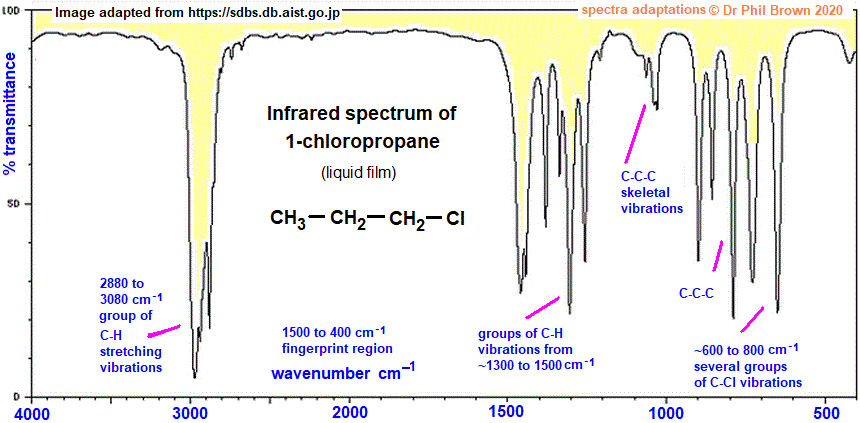
Interpreting the infrared spectrum of 1-chloropropane CH3CH2CH2Cl [Author © Dr Phil Brown GRIC, PhD: Doc Brown's advanced level organic chemistry exam revision notes suitable for students of UK A level chemistry courses & US K12 grade 11, grade 12 and AP honors chemistry courses: Molecular spectroscopy - analysing the infrared spectrum of 1-chloropropane [updated RE-EDIT]* email doc brown * [privacy, cookies & disclaimer policies] * Re-edit infrared spectrum of CH3CH2CH2Cl LINKS associated with 1-chloropropane This is a BIG website, please take time to explore it Infrared spectroscopy - spectra index Isomers of molecular formula C3H7X (where X = F, Cl, Br or I) Introductory note on the infrared spectrum of 1-chloropropane
1-chloropropane C3H7Cl
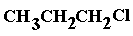
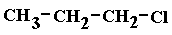
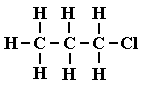
The molecular structure and naming of haloalkanes
Summary of the infrared spectrum of 1-chloropropane and extra comments
Functional Overview the infrared spectrum of 1-chloropropane1-chloropropane is a primary haloalkane, so its IR spectrum lacks strong functional group peaks like C=O or O–H. Instead, it features:
Prominent Wavenumbers Table for the infrared spectrum of 1-chloropropane
Note: The C–Cl stretch is typically weak and may appear broad or low in intensity, often near 600–700 cm⁻¹. Common Misconceptions about the infrared spectrum of 1-chloropropane (see also below)
Exam Tips for questions involving the infrared spectrum of 1-chloropropane (see also above)
Key words & phrases: C3H7Cl CH3CH2CH2Cl image and diagram explaining the infrared spectrum of 1-chloropropane, complete infrared absorption spectrum of 1-chloropropane, comparative spectra of 1-chloropropane, prominent peaks/troughs for identifying functional groups in the infrared spectrum of 1-chloropropane, important wavenumber values in cm-1 for peaks/troughs in the infrared spectrum of 1-chloropropane, revision of infrared spectroscopy of 1-chloropropane, fingerprint region analysis of 1-chloropropane, how to identify 1-chloropropane from its infrared spectrum, identifying organic compounds like 1-chloropropane from their infrared spectrum, how to analyse the absorption bands in the infrared spectrum of 1-chloropropane detection of functional groups in the 1-chloropropane molecule example of the infrared spectrum of a molecule like 1-chloropropane with a functional group interpreting interpretation of the infrared spectrum of 1-chloropropane shows presence of functional group n-propyl chloride How do you interpret the infrared absorption spectrum of 1-chloropropane How to interpret the infrared spectrum of 1-chloropropane Explanatory diagram of the infrared spectrum of the 1-chloropropane molecule in terms of its molecular structure. Listing data of the prominent main wavenumber peaks troughs in the infrared spectrum of 1-chloropropane. How to explain the infrared spectrum of 1-chloropropane. Use of the infrared spectrum of 1-chloropropane, identification of 1-chloropropane from its infrared spectrum - fingerprint wavenumber pattern to identify the 1-chloropropane molecule. The uses of the infrared spectrum of the 1-chloropropane molecule. The distinctive features of the infrared spectrum of the 1-chloropropane molecule explained. explaining the peaks-trough of the transmittance of the infrared spectrum of 1-chloropropane what does the infrared spectrum tell you about the structure and properties of the 1-chloropropane molecule? How is infrared spectrum of 1-chloropropane used to identify 1-chloropropane? Links associated with 1-chloropropane
Index of my advanced
(pre-college/university) organic
chemistry revision notes
The chemistry of
alkanes and the petrochemical
industry
The chemistry of
aldehydes
and ketones The chemistry of organo-nitrogen compounds The chemistry of aromatic compounds Website content © Dr Phil Brown 2000+. All copyrights reserved on revision notes, images, quizzes, worksheets etc. Copying of Doc Brown's pre-university advanced level chemistry website material is NOT permitted. Exam revision summaries & references to science course specifications are unofficial. These organic chemistry revision notes on the spectroscopy of 1-chloropropane - its infrared spectrum, detailed analysis, diagnostic features, data analysed, useful spectra comments are suitable for use of pre-university students studying AQA advanced level chemistry, Edexcel advanced level chemistry, OCR advanced level chemistry, IB advanced level chemistry, WJEC (Eduqas) advanced level chemistry, CIE advanced level chemistry, CCEA advanced level chemistry, US grade 11-12 AP honors chemistry courses and they will also prove useful to 1st year undergraduate students of chemistry. |

 ▲ENTER▲
chemistry words e.g. topic, module, exam board,
formula, compound, reaction, structure, concept, equation, any 'phrase',
homework question! anything of chemical interest, like your latest homework question!
or anything
of scientific interest! This is a very comprehensive Google
generated search of my website.
▲ENTER▲
chemistry words e.g. topic, module, exam board,
formula, compound, reaction, structure, concept, equation, any 'phrase',
homework question! anything of chemical interest, like your latest homework question!
or anything
of scientific interest! This is a very comprehensive Google
generated search of my website. |