|
Doc Brown's
Advanced Chemistry: PART
15.5
Selected uv and visible absorption spectra of copper(II) complex ions -
transition metal absorption spectroscopy of copper compounds
[Author
©
Dr
Phil Brown GRIC, PhD: Doc
Brown's advanced level inorganic chemistry exam revision notes suitable
for students of UK A level chemistry courses & US K12 grade 11, grade 12
& AP honors chemistry courses: visible absorption spectra
of selected complex ions of copper(II)
[uv-visible
spectra page updated
RE-EDIT]
The chemistry of copper
Other
Associated links
*
[WEBSITE SEARCH
BOX]
email doc
brown: query, comment?
*
[privacy policy, cookies
and disclaimer]
The uv
and copper(II) complex ions absorption spectrum of copper complex
ions and compounds
(a)
Octahedral complexes with water and ammonia ligands
If you add conc. ammonia to pale blue copper(II)
sulfate solution, you get a stepwise ligand exchange reaction to
give a whole series of copper(II) ion ammine complexes as each
water molecule is replaced by an ammonia molecules.
This is
accomplished by gradually adding excess ammonia solution after
the initial hydrated copper(II) hydroxide complex
precipitate dissolves (see
The chemistry of copper
for more details and equations)
[Cu(H2O)6]2+(aq)
+ 4NH3(aq) ==>
[Cu(NH3)4(H2O)2]2+(aq)
+ 4H2O(l)
[Cu(NH3)4(H2O)2]2+(aq)
+ 2NH3(aq)
==>
[Cu(NH3)6]2+(aq)
+ 2H2O(l)
The complexes
can be octahedral or tetrahedral/square planar.
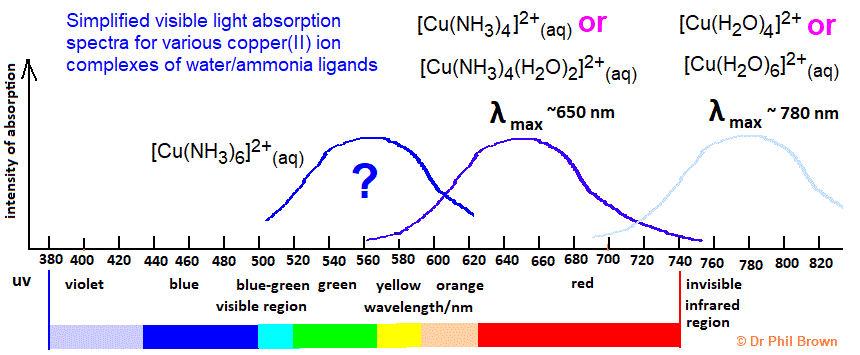
Below are the very simplified
'idealised' diagrams of the spectra of three copper(II) ion
complexes, so the
λmax values are very approximate, but the trend is
correct i.e. from a very pale blue to a much deeper intense
violet-blue.
![[Cu(H2O)6]2+(aq) structure of hexaaquacopper(II) complex ion pale blue-cyan colour absorption spectra](../../page07/SSquestions/0complexCuH2O6.gif) The original [Cu(H2O)6]2+(aq)
hexaaquacopper(II) ion, octahedral, gives a pale blue-cyan
aqueous solution, that absorbs strongly in the red with a
λmax of
780
nm The original [Cu(H2O)6]2+(aq)
hexaaquacopper(II) ion, octahedral, gives a pale blue-cyan
aqueous solution, that absorbs strongly in the red with a
λmax of
780
nm
The
[Cu(NH3)4(H2O)2]2+(aq)
diaquatetraamminecopper(II) ion, is octahedral, and dark blue, absorbing
in
yellow-orange-red region, with a
λmax of
600-650 nm (recently found internet quote).
Structure shown on the right.
![[Cu(NH3)4(H2O)2]2+(aq) structure of diaquatetraamminecopper(II) complex ion dark blue colour absorption spectra](../../page07/SSquestions/0complexCuNH34H2O2.gif) This
ion exhibits E/Z isomerism (cis/trans geometrical isomerism),
in this case, the more stable isomer is the E isomer (trans)
shown. This
ion exhibits E/Z isomerism (cis/trans geometrical isomerism),
in this case, the more stable isomer is the E isomer (trans)
shown.
It worth noting (for 'concept' reasons), that in
E/Z isomers of transition metal complex ions, the central metal
ion experiences a slightly different ligand field effect, hence
a slightly different colour is observed.
There will be
differences in the absorption spectra of E/Z isomers of
complexions.
For more on these complexes see
The chemistry of copper
![[Cu(NH3)6]2+(aq) structure of hexaamminecopper(II) complex ion dark indigo-violet colour absorption spectra](../../page07/SSquestions/0complexCuNH36.gif) The final substitution product is [Cu(NH3)6]2+(aq),
the
hexaamminecopper(II) ion, octahedral, an even deeper violet-indigo-blue.
Unfortunately I could find a
λmax for this ion? I've since found a quote of
λmax of
~610 nm for this complex ion. The final substitution product is [Cu(NH3)6]2+(aq),
the
hexaamminecopper(II) ion, octahedral, an even deeper violet-indigo-blue.
Unfortunately I could find a
λmax for this ion? I've since found a quote of
λmax of
~610 nm for this complex ion.
However, seems obvious, from colour observations, the greater the amount of NH3
replacing the H2O ligand, the deeper the blue colour of the resulting copper(II)
complex ion, so I would expect the
λmax to be less than 650 nm?, with the violet and deep
blue light is transmitted and less of the yellow-orange transmitted?.
The ammonia causes a large splitting of the 3d
orbitals than the water ligand, increasing the energies of
absorptions at shorter wavelengths, giving a more violet-blue
colour.
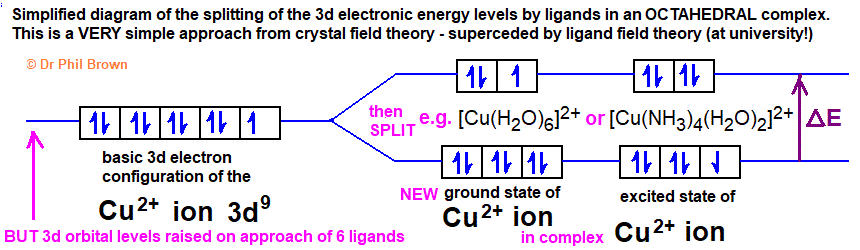
The above electronic energy diagram shows the octahedral field splitting
effect of the 6 water/ammonia ligands on the 3d orbitals of the central
copper ion (Cu2+) which has a 3d9 configuration -
meaning there is partially filled 3d orbital in the complex ion (compare
this with the 3d10 configuration of a Cu+ ion).
The
∆Eelec excitation
energy, promoting an electron from a lower 3d orbital to a higher 3d
orbital is within the copper(II) complex ions light photon range, so the ion is
coloured.
At this pre-university level, the
diagram applies to the square planar complexes of Cu2+ with H2O
or NH3 i.e. for a 4 ligand square complexes like [Cu(NH3)4]2+
or [Cu(H2O)4]2+,
the electronic diagram is the same for an octahedral
complex described above.
(b) A tetrahedral/square planar copper(II) ion complex with a chloride ion ligand
In the presence of excess chloride ions, the octahedral
hexaaquacopper(II) ion forms the tetrahedral (or square planar?) ion,
which theoretically is colourless, but isn't in reality!
[Cu(H2O)6]2+(aq) + 4Cl–(aq)
 [CuCl4]2–(aq) + 6H2O(l)

The above electronic energy diagram shows the tetrahedral field splitting
effect of the 4 chloride ion ligands on the 3d orbitals of the central
copper ion (Cu2+).
In salts, depending on the size of the
cation, you observe an orange colour for the distorted
tetrahedral [CuCl4]2- ion or pale
yellow for the same ion in a square planar configuration.
This shows a change in crystal structure
for the same ion can cause a difference in the
∆Eelec excitation energy, hence a change in
colour of the copper(II) complex ion.
For a 4 ligand square complexes like [Cu(NH3)4]2+
or [Cu(H2O)4]2+,
the electronic diagram is the same for an octahedral
complex described above, noting the 'middle' of an
octahedral complex is square planar.
For more on these complexes see
The chemistry of copper
(c) Complexes of the copper(I) ion
Not all, but many of copper(I) complex ions
are colourless - you get colour with copper(I) charge
transfer complexes.
The reason why you can get a colourless
copper(I) complex ions/compounds is explained in the diagrams below.
So, I'm presenting the 'electronic' argument
as to why you might expect copper(I) compounds to be
colourless e.g. CuCl, copper(I) chloride solid is white, but
readily oxidises in air or water to give a cyan colour of a
copper(II) compound.
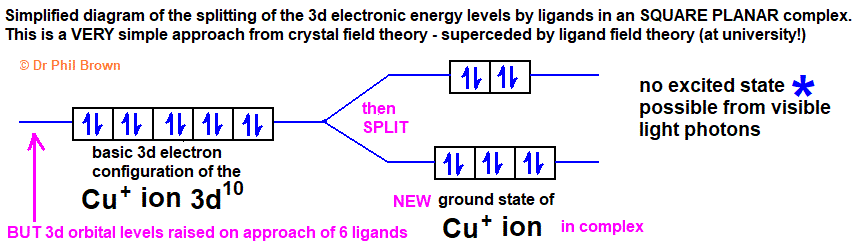
At pre-university level, it is the same electronic diagram for an
octahedral or square planar
complex of the copper(I) ion and note that the 'middle' section
of an octahedral complex is a
square planar arrangement of ligands.
Above and below are the field splitting diagrams for a
square planar or tetrahedral complex
ion based on the copper(I) ion, Cu+.
The Cu+ ion does not normally form an octahedral
complex, usually tetrahedral in shape with a coordination number
of 4 ligands.

The above electronic energy diagrams show the field splitting
effect of the 4 or 6 ligands on the 3d orbitals of the central
copper ion (Cu+) which has a 3d10 configuration
(not the difference from the 3d9 configuration for a Cu2+ ion).
This means there is NO partially filled 3d orbital in
the complex ion.
Therefore, there is no partially filled 3d orbital to
which an electron can be excited by a copper(II) complex ions light photon.
For more on copper(I) chemistry see
The chemistry of copper
Key words & phrases: interpreting the uv-copper(II) complex ions absorption spectra of
copper complexes ions compounds,
identifying the maximum absorption peaks in the uv-copper(II) complex ions absorption spectra of
copper complexes ions compounds, explaining the uv-copper(II) complex ions absorption spectra of
copper complexes ions compounds, how to use the copper(II) complex ions
absorption spectra of copper complexes ions compounds to explain the different colours of
copper complexes ions compounds, applications of the uv-copper(II) complex ions
absorption spectra of copper complexes ions compounds absorption spectrum of
hexaaquacopper(II) ion, identifying the maximum absorption peaks in the
uv-copper(II) complex ions absorption spectrum of hexaaquacopper(II) ion, explaining the uv-copper(II)
complex ions absorption
spectrum of hexaaquacopper(II) ion, how to use the copper(II) complex ions absorption spectra of
hexaaquacopper(II) ion to explain the
colour of hexaaquacopper(II) ion, applications of the uv-copper(II) complex ions
absorption spectrum of hexaaquacopper(II) ion absorption spectrum of
diaquatetraamminecopper(II) complex ion, identifying the maximum absorption peaks in the
uv-copper(II) complex ions absorption spectrum of diaquatetraamminecopper(II)
complex ion, explaining the uv-copper(II) complex ions absorption
spectrum of diaquatetraamminecopper(II) complex ion, how to use the copper(II)
complex ions absorption spectra of diaquatetraamminecopper(II) complex ion to explain the
colour of diaquatetraamminecopper(II) complex ion, applications of the
uv-copper(II) complex ions absorption spectrum of diaquatetraamminecopper(II)
complex ion electronic diagrams to explain the 3d ligand field splitting effects
of ligands to explain the colours of xyz complex ions excitation of 3d orbital
electrons to produce colour in xyz complex ions explaining why copper(I)
compounds and complex ions are colourless and copper(II) compounds and complex
ions are coloured
Associated links
UV and visible spectroscopy index
General introduction to electron configuration
of transition metal ions and colour theory
The chemistry of copper
Index of Advanced A level
Notes on the 3d block and Transition Metals
SPECTROSCOPY
INDEXES
All Advanced Inorganic
Chemistry Notes
Use My Google search site box
email doc
brown: query, comment?
15.5.1
The origin of colour, the wavelengths of
visible light, our perception!
15.5.2
uv-visible spectroscopy
theory, spectrometer, examples of absorption & reflectance spectra
explained
15.5.3
uv-visible absorption
spectra - index of examples: uses, applications, more on the
chemistry of colour
|
Website content © Dr
Phil Brown 2000+. All copyrights reserved on revision notes, images,
quizzes, worksheets etc. Copying of Doc Brown's pre-university/college
advanced level inorganic chemistry website material is NOT
permitted. Exam revision summaries & references to science course specifications
are unofficial. These chemistry revision notes on
spectroscopy on the uv and visible light absorption spectra of selected
copper(II) complex ions are
suitable for use of pre-university students studying AQA advanced level
chemistry, Edexcel advanced level chemistry, OCR advanced level
chemistry, IB advanced level chemistry, WJEC (Eduqas) advanced level
chemistry, CIE advanced level chemistry, US grade 11-12 AP honors
chemistry courses and they will also prove useful to
1st year undergraduate students of chemistry. Examples of uv and visible light absorption
spectra described and explained at Doc Brown's Chemistry |
|
