|
Doc Brown's
Advanced Chemistry: Part 14.7
Isomers of a given molecular formula
Selected aromatic structural
isomers of molecular formula C8H8O2
(those with a benzene ring)
[Author
©
Dr
Phil Brown PhD:
Doc Brown's advanced level organic chemistry exam revision notes
suitable for students of UK advanced level chemistry courses, IB advanced
chemistry & US K12 grades
11-12 and AP honors chemistry courses: Molecular
spectroscopy and analysing the isomers of C8H8O2
[page updated Mar
1st
2026 *]
email doc
brown - comments - query?
*
[privacy policy, cookies
and disclaimer]
Associated organic chemistry page links
Index of sets of isomers for a given
molecular formula
This is a big chemistry website, please allow time
to explore it
Introduction
to isomerism for aromatic compounds of molecular formula
C8H8O2
(see also summary
diagram)
Percent composition of
C8H8O2 based on atomic masses
C= 12.01 H =
1.01 O = 16.00 and Mr(C8H8O2) =
136.16
Element composition of
C8H8O2
aromatic molecules:
carbon = 70.57%
hydrogen = 5.93% oxygen = 23.50%
Empirical formula
C4H4O for molecular formula
C8H8O2
aromatic
molecules
I'm only considering a few selected examples of isomers with
a benzene ring.
Structural isomerism
includes (a) carbon chain variation (usually need a minimum of 4 C atoms),
(b) change in position of a substituent or functional group and
(c) functional group
isomerism where the atoms have a different configuration, usually with
significant differences in chemical and physical properties.
(a) There is variation of the substituent carbon chain
e.g. C-C6H4-C or C6H5-C-C
(b) Lots of positional isomers e.g. the 3 variations in
the methyl benzoic acids, methoxy benzaldehydes or hydroxy
acetophenones.
i.e.
1,2 and 1,3 and 1,4 substituent possibilities.
(c) There is a wealth of functional group isomers:
aromatic carboxylic acids, aromatic aldehydes, ketones, esters, alkene-diols
Stereoisomerism is
where molecules have the same basic constitutional structural formula, but
isomers differ in the 2D/3D arrangement of the atoms. Both applicable
here.
E/Z
stereoisomerism was called 'geometrical isomerism' e.g. cis
and trans isomers of alkenes or disubstituted cyclic alkanes
where there are 3D spatial variations that are not mirror images and not
super imposable.
e.g. (15) C6H5C(OH)=CHOH,
1-phenylethene-1,2-diol has an alkene functional group
R/S
stereoisomerism was called 'optical isomerism', the pairs of
isomers are called enantiomers which are 3D non-superimposable
mirror image forms of the molecule. The molecule must have a chiral centre
(a stereocentre), that is an asymmetric carbon atom with four
different atoms/groups attached to it.
e.g. (14) C6H5 CH(OH)CHO,
2-hydroxy-2-phenylethanal has an asymmetric (chiral) carbon atom.
Selected aromatic structural isomers of molecular formula
C8H8O2
(Mr = 136)
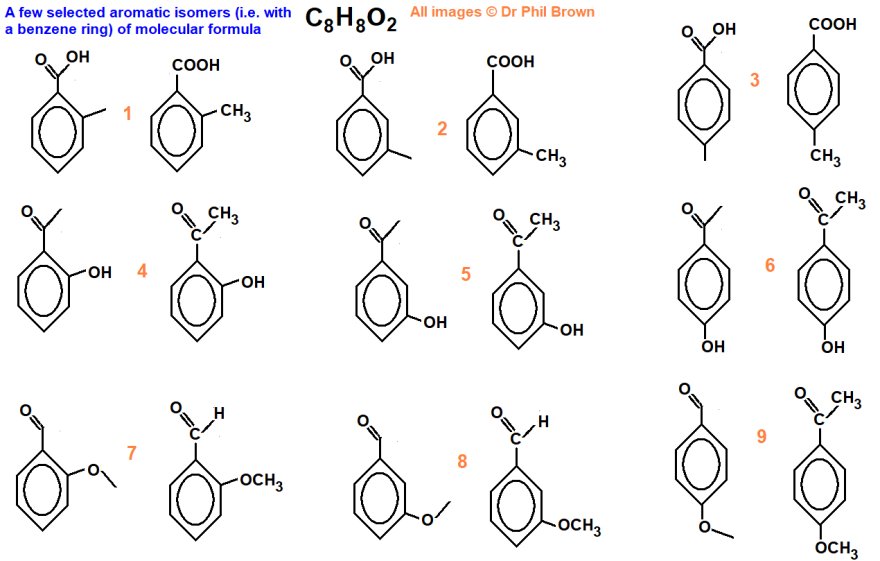
There are many aromatic benzene ring molecules with the molecular formula C8H8O2
I've only selected a few molecules with functional groups
that an advanced pre-university chemistry student should recognise.
(1) to (3) are aromatic carboxylic acids, where
the carboxylic acid functional group is directly attached to the benzene ring
and a 2nd substituent of an alkyl methyl group i.e. methylbenzoic acids.
(1)
2-methylbenzoic acid
 an aromatic carboxylic acid
(2) 3-methylbenzoic acid
 an aromatic carboxylic acid
(3)
4-methybenzoic acid
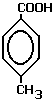 an aromatic carboxylic acid
(4) to (6) Three isomeric bifunctional aromatic
molecules with ketone and phenol functional groups
The very abbreviated structural formula
for them is: HOC6H4COCH3
(4) e.g.
 2-hydroxyacetophenone,
1-(2-hydroxyphenyl)-ethanone 2-hydroxyacetophenone,
1-(2-hydroxyphenyl)-ethanone
(5) 3-hydroxyacetophenone,
1-(3-hydroxyphenyl)-ethanone
(6)
4-hydroxyacetophenone,
1-(4-hydroxyphenyl)-ethanone
(7) to (9) Three isomeric bifunctional aromatic
molecules with an aromatic aldehyde and an ether functional groups.
The very abbreviated structural formula
for them is:
CH3OC6H4CHO
(7)
2-methoxybenzaldehyde,
o‑anisaldehyde
(8)
3-methoxybenzaldehyde,
m‑anisaldehyde
(9) 4-methoxybenzaldehyde,
p‑anisaldehyde
(10) to (11) are esters
(10)
 , ,
 , ,
 , ,
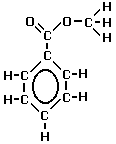 ,
methyl benzoate, ,
methyl benzoate,
The only ester of benzoic acid
possible for
C8H8O2
(11)
the ester phenyl ethanoate , CH3COOC6H5
, 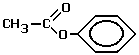
A
2nd ester possible for C8H8O2
but this time an ester of ethanoic acid.
(12)
to (15) are various bifunctional group mono-substituted aromatic benzene compounds
(12) C6H5-CO-CH2OH,
has a ketone and an aliphatic primary alcohol functional groups.
(13) C6H5-CH2-COOH,
phenylethanoic acid, has an aliphatic carboxylic acids
functional group.
(14) C6H5CH(OH)CHO,
2-hydroxy-2-phenylethanal,
a bifunctional aromatic molecule
with an aliphatic aldehyde and aliphatic secondary alcohol
functional groups.
This has a chiral (asymmetric) carbon atom and
will exhibit R/S stereoisomerism - R/S optical isomers
(enantiomers)
(15) C6H5C(OH)=CHOH,
1-phenylethene-1,2-diol
a bifunctional aromatic molecule
with an aliphatic alkene and alcohol
functional groups.
This has a C=C double bond attached to four
different groups and will exhibit E/Z stereoisomerism - a pair
E/Z isomers (cis/trans in old notation).
(16)
to (20) The 'three' refers to the 3 substitution positions i.e. 1,2
and 1,3 and 1,4 possibilities.
(16) Three of
HOC6H4CH=CHOH, these have three functional groups,
phenol, alkene-alcohol ('enol')
and each
will have E/Z geometrical isomers
via the restricted rotation of the C=C bond.
(17)
Three of
HOC6H4C(OH)=CH 2,
these have three functional groups, phenol, alkene-alcohol ('enol')
(18)
Three of
HOC6H4CH2CHO,
a phenol and aliphatic aldehyde functional groups.
(19) Three
methanoate (formate) esters,
HCOOC6H4CH3, just
the ester functional group.
(20) Three of
HOCH2C6H4CHO,
a primary alcohol and aromatic aldehyde functional groups
(hydroxymethyl)benzaldehydes
AND lots and lots of
more isomers.
Links to lots other C8H8O2
isomers, but most are university level molecules
https://www.molport.com/shop/molecular-formula/C8H8O2?pageindex=2
EXTRA NOTES on selected isomers of
C8H8O2
Prominent diagnostic wavenumbers of the infrared spectra of
selected aromatic isomers of C8H8O2
Quick
comparison table of most relevant IR attributes
|
Isomer class |
Diagnostic C=O / C–O / O–H / C–H features (cm⁻¹) |
Aromatic ring
indicators |
|
Aromatic ester
(e.g., methyl benzoate type) |
C=O
strong ~1735–1715; C–O (ester) strong 1250–1050; no
broad OH |
Aromatic C–H
stretch ~3030;
ring overtones 2000–1660; out‑of‑plane C–H bends
diagnostic of substitution pattern (740–810, 690–710, 880–760 ranges) |
|
Aromatic aldehyde
(e.g., methoxybenzaldehyde type) |
C=O
(aldehyde) strong
~1740–1690 (conjugation shifts to lower end ~1690–1705);
aldehyde C–H weak but diagnostic at ~2720 and 2820 (often weak) |
same aromatic bands as
left, plus weak overtones; substitution pattern seen in 900–700 region |
|
Aromatic
carboxylic acid (less common for C8H8O2 but possible in isomer set) |
C=O
(acid) strong ~1710–1680;
broad O–H 2500–3300 (very broad, often overlaps C–H) |
same aromatic bands |
|
Aromatic ether
(Ar–O–R) or methoxy substituted benzene |
C–O
(aryl ether) medium
1275–1020; no C=O; no broad OH; strong aromatic
signatures |
aromatic substitution
patterns as above |
How to
use these bands to tell isomers apart
-
Presence versus absence of C=O: a strong
band near 1700–1740 cm⁻¹ immediately separates carbonyl‑containing isomers
(esters, aldehydes, acids) from ethers and simple substituted benzenes.
-
Different carbonyl types give different C=O
positions: esters usually absorb at slightly higher wavenumbers
(~1735–1715) than conjugated aldehydes/ketones (~1710–1690) and acids
(~1710–1680) because conjugation and H‑bonding lower the frequency.
-
Aldehyde C–H stretches (~2720, 2820 cm⁻¹)
are weak but diagnostic for aldehydes and can confirm an aromatic aldehyde
when the carbonyl position is ambiguous.
-
C–O versus C=O: if you see a strong
carbonyl plus strong C–O bands in the 1250–1050 region, that points to an
ester rather than a ketone or acid.
-
Aromatic substitution pattern: use the
out‑of‑plane C–H bending region (~900–650 cm⁻¹) to assign
mono/ortho/meta/para relationships: typical marker positions differ for
ortho, meta and para patterns and help distinguish positional isomers on the
ring.
-
Aromatic C–H stretches just above 3000 cm⁻¹
confirm the presence of the ring; aliphatic C–H stretches (2850–2960 cm⁻¹)
show alkyl substituents on the ring.
Typical peak ranges
-
Aromatic C–H stretch: ~3030 cm⁻¹.
-
Aliphatic C–H stretches: 2850–2960 cm⁻¹.
-
Aldehyde C–H (weak): 2720 and 2820 cm⁻¹.
-
C=O (ester): ~1735–1715 cm⁻¹.
-
C=O (conjugated aldehyde/ketone):
~1710–1690 cm⁻¹.
-
C=O (carboxylic acid): ~1710–1680 cm⁻¹ plus
broad O–H 2500–3300 cm⁻¹.
-
Aromatic C–C stretches / overtones:
1600–1500 cm⁻¹ and overtones 2000–1660 cm⁻¹.
-
Aromatic out‑of‑plane C–H bends (useful for
substitution pattern): ~900–650 cm⁻¹ with characteristic bands near
~750–810, ~690–710, ~880–760 depending on ortho/meta/para patterns.
Common
student misconceptions
-
“Any C=O band is the same.” Incorrect;
students must consider exact wavenumber shifts from conjugation and
H‑bonding and check for supporting bands (aldehyde C–H, ester C–O).
-
“A broad band around 3000 cm⁻¹ always means OH.”
Not always; aromatic C–H and overlapping aliphatic C–H can appear near 3000
cm⁻¹; true carboxylic O–H is very broad down to ~2500 cm⁻¹.
-
“If the C–O stretch is absent, it is not an ester.”
Small or shifted C–O bands can be weak; always examine 1250–1050 cm⁻¹
carefully and correlate with C=O position.
-
“Substitution pattern can’t be read from IR.”
Incorrect; the out‑of‑plane C–H bending region is a powerful diagnostic for
ortho/meta/para substitution on benzene rings.
Practical exam tips (A‑level, IB, AP)
-
First scan 4000–1500 cm⁻¹ for O–H, aldehyde
C–H (2720–2820), and C=O; these give fast class identification.
-
Then check 1500–600 cm⁻¹ (the fingerprint
region) for aromatic overtones and the out‑of‑plane C–H bends to assign
substitution pattern.
-
When C=O position is borderline, look for:
aldehyde C–H (2720/2820), strong ester C–O at 1250–1050, or a very broad
acid O–H to confirm identity.
-
Practice by comparing spectra of methyl
benzoate, 4‑methoxybenzaldehyde, and simple methoxybenzene to learn the
relative band intensities and confirm how conjugation shifts the C=O band.
-
Use a checklist in exam answers: state the
key peaks, assign functional groups, then use ring‑bend bands to specify
substitution pattern; write the final structural assignment with reasoning
(peak → group → confirmation band).
One‑line practical memory aids
-
C=O + 1250–1050 strong → ester.
-
C=O + weak bands at 2720/2820 → aldehyde.
-
Very broad 2500–3300 + C=O → carboxylic acid.
-
Look at 900–650 cm⁻¹ to tell ortho/meta/para.
A comparison of
the uses and applications of selected isomers of
C8H8O2
Focus more on key classes like esters (methyl benzoate),
aldehydes (anisaldehyde), carboxylic acids (methylbenzoic acids), and
phenols/ethers.
Examples, such as methyl benzoate in perfumes and solvents,
anisaldehyde for flavouring, and toluic acids as intermediates.
Also, a few comments on physical properties, reactivity, and
potential exam tips. That way, I can keep the response concise yet
informative!
Overview of common benzene‑containing isomer types (C8H8O2)
-
Aromatic esters (example: methyl
benzoate) — benzene ring bearing a benzoate ester group; fragrant,
relatively low polarity.
-
Aromatic aldehydes (example:
p‑anisaldehyde, benzaldehyde derivatives) — benzene ring with
an aldehyde substituent; aromatic odorants and synthetic intermediates.
-
Aromatic carboxylic acids (example:
o/m/p‑methylbenzoic acid, “toluic acids”) — ring with a CO2H group;
more polar, crystalline solids used as intermediates.
Benzene derivatives appear across fragrances, flavorings,
solvents and chemical synthesis because the aromatic ring provides stability
and predictable reactivity in electrophilic aromatic substitution and
derivatisation reactions.
Uses
and applications — direct comparison
Aromatic esters (methyl benzoate and analogues)
-
Primary uses: fragrance and flavour
ingredients, solvents, and attractants in pheromone/insect‑trap
formulations.
-
Why used: esters are often volatile and
pleasant smelling; methyl benzoate is a common perfumery material and is
used in small‑scale organic synthesis as an ester representative.
-
Properties relevant to application:
relatively low polarity and moderate volatility make them suitable for
perfumes and solvent roles.
-
Industrial role: starting materials for
transesterification or hydrolysis to give acids/alcohols in synthesis.
Practical note: esters are generally less polar than acids
and thus more soluble in organic solvents and more volatile — important for
fragrance performance.
Aromatic aldehydes (benzaldehyde derivatives such as p‑anisaldehyde)
-
Primary uses: flavourings, fragrances,
aroma chemicals, and synthetic building blocks for dyes, pharmaceuticals and
fine chemicals.
-
Why used: characteristic aromatic and
almond‑like or sweet floral odours; reactive carbonyl carbon makes them
versatile intermediates (condensations, reduction to alcohols, oxidation to
acids).
-
Properties relevant to application:
moderate polarity, reactive C=O functional group; stability depends on
substitution pattern (electron‑donating methoxy groups increase stability
for some derivatives).
Practical note: aldehydes are reactive electrophiles used to
make more complex molecules in perfumery and fine chemical synthesis.
Aromatic carboxylic acids (methylbenzoic acids)
-
Primary uses: synthetic intermediates in
the preparation of esters, amides, anhydrides, and as building blocks in
pharmaceutical and agrochemical synthesis.
-
Why used: the COOH group is a versatile
functional handle for coupling and derivatisation; acids often act as
precursors to polymer monomers or fine chemicals.
-
Properties relevant to application: higher
polarity, often crystalline solids with higher melting points and lower
volatility than esters/aldehydes; amenable to salt formation (useful for
isolation and processing).
Practical note: acids are usually manipulated through
activation (acid chlorides, coupling agents) in synthetic sequences, and
their reduced volatility and higher melting points suit storage and handling
in industry.
How
functional group determines end‑use (summary)
-
Volatility / aromatic performance
(fragrance/flavour): esters and some aldehydes > acids.
-
Synthetic versatility: acids and aldehydes
> esters (acid derivatives enable many coupling reactions; aldehydes are key
electrophiles).
-
Industrial handling / formulation: acids
(solid, less volatile) are easier to store; esters (liquid, volatile) are
preferred for sensory applications.
These patterns follow general organic functional‑group
behaviour for benzene derivatives.
Reactivity differences that underpin applications
-
Aldehydes: nucleophilic additions,
oxidations to acids, reductions to alcohols — used to make fragrances, fine
chemicals and intermediates.
-
Esters: hydrolysis/transesterification (to
give acids or alcohols), reduction (to alcohols), and participation in
fragrance volatility; used where controlled release/volatility is needed.
-
Carboxylic acids: activation (formation of
acid chlorides, esters, amides) for coupling reactions in pharmaceuticals
and materials chemistry.
Aromatic substitution pattern and ring substituents modulate
reactivity (electron‑donating groups speed electrophilic substitution;
electron‑withdrawing groups slow it) which guides their synthetic roles.
Safety, regulatory and formulation considerations
-
Toxicity and exposure: benzene derivatives
vary widely; many aromatic aldehydes and esters are safe at low levels as
fragrances but require handling precautions at scale.
-
Regulation: fragrance and flavour
ingredients are regulated (usage limits, purity specifications); industrial
intermediates require appropriate safety data sheets and containment.
-
Formulation: volatility, solubility and
door threshold determine choice for perfumes, foods or technical solvents.
Understanding physical properties (boiling point,
volatility, polarity) is essential when selecting an isomer for a given
product or process.
Common
student misconceptions about uses and how to avoid them
-
Misconception: “All isomers with the same
formula have the same uses.” — Correct by explaining functional‑group
chemistry: small changes (COOH versus CHO versus COOCH3)
dramatically change volatility, polarity and reactivity, driving different
applications.
-
Misconception: “If two isomers smell
similar they’re interchangeable.” — Explain that stability, regulatory
status and reactivity differ; one isomer may oxidise or polymerise in
formulations while another remains stable.
-
Misconception: “Aromatic means toxic or
unusable.” — Explain that many safe, widely used flavour and fragrance
molecules are aromatic; hazard depends on molecular structure and dose, not
the presence of an aromatic ring alone.
Exam
revision tips (A‑level, IB, AP)
-
Memorise representative structures (methyl benzoate,
p‑anisaldehyde, methylbenzoic acids) and link each to one clear industrial
use (fragrance, flavour/intermediate, synthetic precursor).
-
Practice short argumented answers: state the functional
group, two physical properties that follow from it (volatility, solubility),
and one industrial application with a one‑line justification.
-
Use functional‑group reactivity as justification: show why
an aldehyde is a good intermediate (reactive C=O) or why an ester is chosen
for perfume (volatility and scent profile).
-
When asked to compare isomers, structure your answer:
identity → physical property differences → reactivity differences → specific
uses → safety/handling note.
Quick reference
on selected uses
-
Methyl benzoate (ester): perfume/fragrance, solvent,
insect attractant.
-
Aromatic aldehydes (e.g., p‑anisaldehyde):
flavour/fragrance, fine‑chemical intermediates.
-
Methylbenzoic acids: synthetic intermediates for
esters/amides, pharmaceutical/agrochemical building blocks.
Learning objectives - questions to be answered?
How many aromatic benzene ring isomers are there for
C8H8O2?
How do draw the aromatic benzene ring isomers of
C8H8O2?
How do you name the aromatic benzene ring isomers of
C8H8O2?
Know how to draw diagrams of the skeletal formula of
aromatic benzene ring isomers of C8H8O2
This page will answer
these questions
for molecular formulae
C8H8O2
Associated organic chemistry links
Advanced Level pre-university
organic chemistry notes
IR, mass and H-1 & C-13 NMR
spectra of organic compounds
See also
Examples of the effects of isomerism on the similarity or difference
in the physical and chemical properties of structural isomers
Index of sets of isomers for a given
molecular formula
The
molecular structure
& Naming of AROMATIC Compounds,
including isomers
INDEX of ALL revision notes on the
chemistry of AROMATIC COMPOUNDS
Isomerism: introduction, structural isomerism - chain,
positional, functional group, tautomerism
Stereoisomerism:
introduction, definition,
priority rules, E/Z isomerism (cis/trans isomerism)
Stereoisomerism - R/S isomerism (optical
isomerism) -
definition - examples explained
This is a big chemistry website, please allow time
to explore it
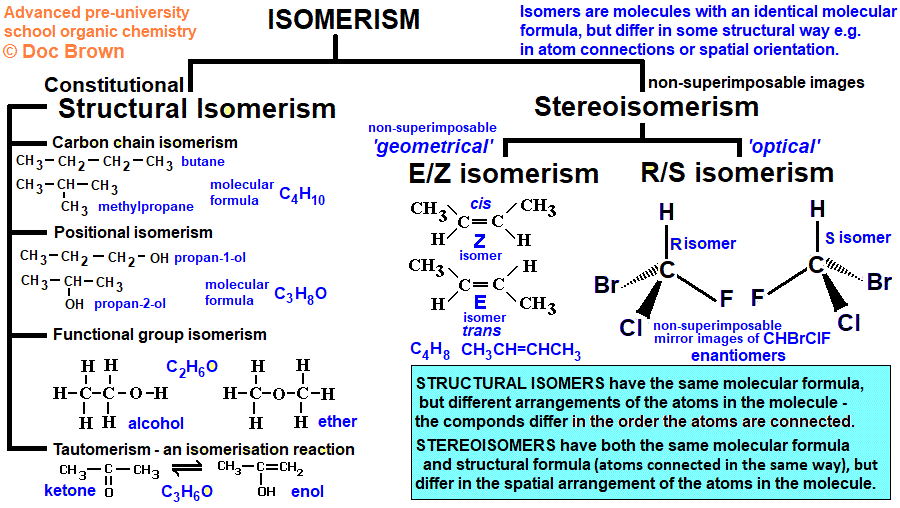
Summary diagram of isomerism which
links to details of the types of isomerism
|
Website content © Dr
Phil Brown 2000+. All copyrights reserved on revision notes, images,
quizzes, worksheets etc. Copying of Doc Brown's pre-university
advanced level chemistry website material is NOT
permitted. Exam revision summaries & references to science course specifications
are unofficial. These organic chemistry revision notes on
isomerism are
suitable for use of pre-university students studying AQA advanced level
chemistry, Edexcel advanced level chemistry, OCR advanced level
chemistry, IB advanced level chemistry, WJEC (Eduqas) advanced level
chemistry, CIE advanced level chemistry, US grade 11-12 AP honors
chemistry courses and they will also prove useful to
1st year undergraduate students of chemistry. |
Keywords or phrases: how many isomers are
there of molecular formula C8H8O2? how do you name the isomers of
molecular formula C8H8O2? what is the molecular structure of the
isomers of C8H8O2, what type of isomerism is exhibited by molecules
of formula C8H8O2, how do you work out the isomers of molecular
formula C8H8O2, what are the structural isomers of C8H8O2, the carbon chain
isomers of C8H8O2 in the homologous series of alkanes, comparing
the spectra of isomers of molecular formula C8H8O2 how many structural isomers of
C8H8O2 can you draw? how many structural isomers does C8H8O2 have?
what are the possible isomers of C8H8O2? revision notes on
isomerism of C8H8O2 molecules, isomerism in
aliphatic carboxylic acids, isomerism in aliphatic esters,
carboxylic acid
isomers of C8H8O2, ester isomers of C8H8O2, the molecular structure of
the isomers of C8H8O2 how to draw the
structural formula of isomers of C8H8O2, how to draw the displayed
formula of isomers of C8H8O2, how to draw the skeletal formula of
isomers of C8H8O2, how to name the isomers of molecular formula C8H8O2
isomerism in C8H8O2 aromatic ester carboxylic acid primary
alcohol aldehyde ketone ether compounds C8H8O2 isomers of
molecular mass 136
The structural-constitutional isomers of
C8H8O2, aromatic isomers have the formula C8H8O2,
benzene ring isomers
with the formula C8H8O2, the names of the aromatic isomers of formula
C8H8O2? how many
possible isomers of C8H8O2 are aromatic molecules, the structure
of the isomers of molecular formula C8H8O2 aromatic molecules,
drawings diagrams of the structural
formula and skeletal formula of the isomers of molecular formula
C8H8O2 aromatic molecules, What types of structural
isomers are there of molecular formula C8H8O2 aromatic molecules,
describe the functional group aromatic isomers with a molecular
formula C8H8O2 with a benzene ring, do C8H8O2 aromatic molecules have any stereoisomers?
are there any E/Z (geometrical)
aromatic isomers with a molecular formula C8H8O2? Are there any R/S (optical)
aromatic isomers
(enantiomers) with a benzene ring formula C8H8O2?
|
