|
Doc Brown's
Advanced Chemistry: Part 14.7
57+
examples of the constitutional structural isomers of molecular formula C5H7F,
C5H7Cl, C5H7Br
and
C5H7I
[Author
©
Dr WP Brown PhD:
Doc Brown's advanced level organic chemistry exam revision notes
suitable for students of UK advanced level chemistry courses, IB advanced
chemistry & US K12 grades
11-12 and AP honors chemistry courses: Molecular
spectroscopy and analysing the isomers of C5H7X
[updated
Feb 23rd 2026 *]
email doc
brown - comments - query?
*
[privacy policy, cookies
and disclaimer]
Index of sets of isomers for a given
molecular formula
Associated organic chemistry page links
This is a big chemistry website, please allow time
to explore
Introduction to the selected
constitutional-structural isomers and stereoisomers of molecular formula
C5H7X
(X = halogen)
Relative molecular mass and
percent composition of
C5H7X
(X = halogen)
based on atomic masses:
C 12.01,
H 1.01, F 19.00, Cl 35.45,
Br 79.90, I 126.90
|
Formula of compound |
Relative molecular
mass |
%
carbon |
%
hydrogen |
%
halogen |
|
C5H7F |
86.13 |
69.73 |
8.21 |
22.06 |
|
C5H7Cl |
102.58 |
58.55 |
6.89 |
34.56 |
|
C5H7Br |
147.03 |
40.85 |
4.81 |
54.34 |
|
C5H7I |
194.03 |
30.96 |
3.64 |
65.40 |
Empirical formula = molecular formula =
C5H7X
(where X = a single halogen atom)

Apologies for the order of text and images, isomers 28 to 57 were an after thought,
but some quite
interesting theoretical structures, some of which actually exist!
If applicable
(see isomerism
summary at the end of the page)
Structural isomerism
- isomers based on different connectivity's of the constituent atoms, so cannot
be spatially identical (but can be defined as having the same shape).
This includes (a)
carbon chain variation (usually need a minimum of 4 atoms),
(b) change in position of a substituent or functional group and
(c) functional group
isomerism where the atoms have a different connectivity configuration, usually with
significant differences in chemical and physical properties e.g.
In terms of isomers of
C5H7X
there are
(a) chain variations based on the open chain
aliphatic linear and branched and also a huge variety of alicyclic structures,
(b) positional isomers e.g. the -X halogen groups
in all of the molecules,
(c) most are all functional group isomers of each
other
e.g. unsaturated open chain alkenes and alkynes versus cyclic
alkenes and saturated bicyclic molecules.
Stereoisomerism - isomers
based on the same connectivity of the atoms (same constitutional formula), but
in some way, they are 2D or 3D spatially different non-superimposable images (e.g. E/Z
'geometrical' isomers or mirror image R/S 'optical' isomers)
This is
where molecules have the same basic constitutional structural formula, but
isomers differ in the 2D/3D arrangement of the atoms.
For stereoisomers, the (CIP) abbreviation means the
IUPAC Cahn-Ingold-Prelog priority
order rule for assigning E/Z (geometrical) and R/S (optical) stereoisomers.
E/Z
stereoisomerism was called 'geometrical isomerism' e.g. cis
and trans isomers of alkenes or disubstituted cyclic alkanes
where there are 2D/3D spatial variations that are not mirror images and not
super imposable.
Many examples in both the open chain aliphatic
and alicyclic compounds sometimes overlapping with R/S optical
isomers for the same molecule!
R/S
stereoisomerism was called 'optical isomerism', the pairs of
isomers are called enantiomers which are 3D non-superimposable
mirror image forms of the molecule (enantiomers). The molecule must have a chiral centre
(a stereocentre), that is an asymmetric carbon atom with four
different atoms/groups attached to it.
Again many examples in both the open chain
aliphatic and alicyclic compounds and again sometimes
overlapping with E/Z geometrical isomers for the same molecule!
NOTE
Some of the
C5H7X
(X = halogen) isomers described may be highly reactive
and very thermodynamically unstable e.g. due to weak highly
strained bonds in cyclic compounds or bulky groups like iodine atoms (which also
the weakest of the C-halogen bonds) and some may not even exist at all (except
theoretically of course!).
I've identified at least 57+ constitutional isomers and at
least 33+ pairs of E/Z geometrical or R/S optical isomers for the molecular
formulae
C5H7F,
C5H7Cl, C5H7Br or
C5H7I
So, theoretically there are at least 90+ distinct isomers of
C5H7F, C5H7Cl, C5H7Br
or C5H7I.
I'm not expert enough to name all these isomers, though made
some attempts, but, since I'm a pre-university chemistry website, I'm not to
fussed about the names, because of these 'types' of isomers would only
D etails of
the selected constitutional isomers and stereoisomers of molecules with formulae
C5H7F,
C5H7Cl, C5H7Br
and
C5H7I
Some of the
C5H7X
(X = halogen) isomers described may be highly reactive and very
thermodynamically unstable e.g. due to weak highly strained bonds and some may
not even exist at all (except theoretically of course!).
(1)
 a substituted cycloalkene (halogenated cyclopentene),
1-fluorocyclopentene, 1-chlorocyclopentene,
1-bromocyclopentene, 1-iodocyclopentene
1-fluorocyclopent-1-ene, 1-chlorocyclopent-1-ene,
1-bromocyclopent-1-ene, 1-iodocyclopent-1-ene
(2)
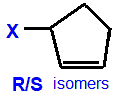 a substituted cycloalkene (cyclopentene), a secondary
haloalkane
a substituted cycloalkene (cyclopentene), a secondary
haloalkane
3-fluorocyclopentene, 3-chlorocyclopentene,
3-bromocyclopentene, 3-iodocyclopentene
3-fluorocyclopent-1-ene, 3-chlorocyclopent-1-ene,
3-bromocyclopent-1-ene, 3-iodocyclopent-1-ene
Exhibits R/S optical isomerism, the ring C3 of the C-X bond
is asymmetric (chiral)
(3)
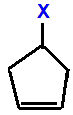 a substituted cycloalkene (cyclopentene), a secondary
haloalkane
a substituted cycloalkene (cyclopentene), a secondary
haloalkane
4-fluorocyclopentene, 4-chlorocyclopentene,
4-bromocyclopentene, 4-iodocyclopentene
4-fluorocyclopent-1-ene, 4-chlorocyclopent-1-ene,
4-bromocyclopent-1-ene, 4-iodocyclopent-1-ene
(4)
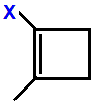 a substituted cycloalkene (cyclobutene) and haloalkene
1-fluoro-2-methylcyclobutene,
1-chloro-2-methylcyclobutene,
1-bromo-2-methylcyclobutene,
1-iodo-2-methylcyclobutene
(5)
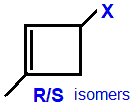 a substituted cycloalkene (cyclobutene) and secondary
haloalkane.
a substituted cycloalkene (cyclobutene) and secondary
haloalkane.
3-fluoro-1-methylcyclobutene,
3-chloro-1-methylcyclobutene,
3-bromo-1-methylcyclobutene,
3-iodo-1-methylcyclobutene
3-fluoro-1-methylcyclobut-1-ene,
3-chloro-1-methylcyclobut-1-ene,
3-bromo-1-methylcyclobut-1-ene,
3-iodo-1-methylcyclobut-1-ene
Exhibits R/S optical isomerism, the C3 of the
C-X bond is asymmetric (chiral)
(6)
 a substituted cycloalkene (cyclobutene) and secondary
haloalkane.
a substituted cycloalkene (cyclobutene) and secondary
haloalkane.
4-fluoro-1-methylcyclobutene,
4-chloro-1-methylcyclobutene,
4-bromo-1-methylcyclobutene,
4-iodo-1-methylcyclobutene
4-fluoro-1-methylcyclobut-1-ene,
4-chloro-1-methylcyclobut-1-ene,
4-bromo-1-methylcyclobut-1-ene,
4-iodo-1-methylcyclobut-1-ene
Exhibits R/S optical isomerism, the C4 of the
C-X bond is asymmetric (chiral)
(7)
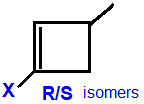 a substituted cycloalkene (cyclobutene) and secondary
haloalkane.
a substituted cycloalkene (cyclobutene) and secondary
haloalkane.
1-fluoro-3-methylcyclobutene,
1-chloro-3-methylcyclobutene,
1-bromo-3-methylcyclobutene,
1-iodo-3-methylcyclobutene
1-fluoro-3-methylcyclobut-1-ene,
1-chloro-3-methylcyclobut-1-ene,
1-bromo-3-methylcyclobut-1-ene,
1-iodo-3-methylcyclobut-1-ene
Exhibits R/S optical isomerism, the C3 of the
C-CH3 bond is asymmetric (chiral)
(8)
 a substituted cycloalkene (cyclobutene) and secondary
haloalkane.
a substituted cycloalkene (cyclobutene) and secondary
haloalkane.
3-fluoro-4-methylcyclobutene,
3-chloro-4-methylcyclobutene,
3-bromo-4-methylcyclobutene,
3-iodo-4-methylcyclobutene
3-fluoro-4-methylcyclobut-1-ene,
3-chloro-4-methylcyclobut-1-ene,
3-bromo-4-methylcyclobut-1-ene,
3-iodo-4-methylcyclobut-1-ene
Exhibits R/S optical isomerism, the two
right carbon atoms of the ring are asymmetric (C3 and C4 are chiral) and
this overlaps with E/Z geometrical isomerism - complicated,
university level analysis.
CIP assignment priority rule for stereoisomers:
ZX >
6C6C > 6C1H
> 1H (X = halogen, Z = 9, 17, 35 or 53)
(9)
 a substituted cycloalkene (cyclobutene) and haloalkene.
2-fluoro-3-methylcyclobutene,
2-chloro-3-methylcyclobutene,
2-bromo-3-methylcyclobutene,
2-iodo-3-methylcyclobutene
2-fluoro-3-methylcyclobut-1-ene,
2-chloro-3-methylcyclobut-1-ene,
2-bromo-3-methylcyclobut-1-ene,
2-iodo-3-methylcyclobut-1-ene
Exhibits R/S optical isomerism, the C3 of the
C-CH3 bond is asymmetric (chiral)
CIP assignment priority rule for E/Z or R/S isomers:6CZX
> 6C6C > 6C1H
> 1H (X = halogen, Z = 9, 17, 35 or 53)
(10)
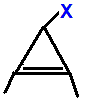 a trisubstituted cycloalkene (cyclopropene) and secondary
haloalkane
a trisubstituted cycloalkene (cyclopropene) and secondary
haloalkane
3-fluoro-1,2-dimethylcyclopropene,
3-chloro-1,2-dimethylcyclopropene,
3-bromo-1,2-dimethylcyclopropene,
3-iodo-1,2-dimethylcyclopropene
(11)
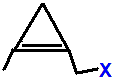 a disubstituted cycloalkene (cyclopropene) and primary
haloalkane
a disubstituted cycloalkene (cyclopropene) and primary
haloalkane
1-(fluoromethyl)-2-methylcyclopropene,
1-(chloromethyl)-2-methylcyclopropene,
1-(bromomethyl)-2-methylcyclopropene,
1-(iodomethyl)-2-methylcyclopropene
(12)
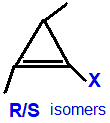 a trisubstituted cycloalkene (cyclopropene) and haloalkene
1-fluoro-2,3-dimethylcyclopropene,
1-chloro-2,3-dimethylcyclopropene,
1-bromo-2,3-dimethylcyclopropene,
1-iodo-2,3-dimethylcyclopropene
Exhibits R/S optical isomerism, the top
carbon atom C3 of the ring is asymmetric (chiral).
(13)
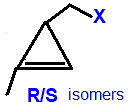 a disubstituted cycloalkene (cyclopropene) and primary
haloalkane
a disubstituted cycloalkene (cyclopropene) and primary
haloalkane
3-(fluoromethyl)-1-methylcyclopropene,
1-(chloromethyl)-2-methylcyclopropene,
1-(bromomethyl)-2-methylcyclopropene,
1-(iodomethyl)-2-methylcyclopropene
Exhibits R/S optical isomerism, the top ring C3 of the
C-CH2X bond is asymmetric (chiral)
(14)
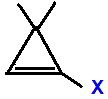 a trisubstituted cycloalkene (cyclopropene) and haloalkene.
1-fluoro-3,3-dimethylcyclopropene,
1-chloro-3,3-dimethylcyclopropene,
1-bromo-3,3-dimethylcyclopropene,
1-iodo-3,3-dimethylcyclopropene
(15)
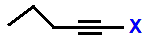 a substituted linear alkyne and haloalkyne
1-fluoropent-1-yne,
1-chloro-pent-1-yne, 1-bromopent-1-yne,
1-iodo-pent-1-yne
(16)
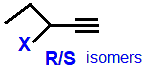 a substituted linear alkyne and secondary haloalkane group.
3-fluoropent-1-yne,
3-chloro-pent-1-yne, 3-bromopent-1-yne,
3-iodo-pent-1-yne
Exhibits R/S optical isomerism, carbon atom
C3 is asymmetric (chiral)
(17)
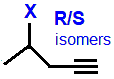 a substituted linear alkyne
and secondary haloalkane group.
a substituted linear alkyne
and secondary haloalkane group.
4-fluoropent-1-yne,
4-chloro-pent-1-yne, 4-bromopent-1-yne,
4-iodo-pent-1-yne
Exhibits R/S optical isomerism, carbon atom
C4 is asymmetric (chiral)
CIP assignment priority rule for R/S isomers:
ZX >
6C6C > 6C1H
> 1H (X = halogen, Z = 9, 17, 35 or 53)
(18)
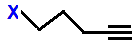 a substituted linear alkyne
and primary haloalkane group.
a substituted linear alkyne
and primary haloalkane group.
5-fluoropent-1-yne,
5-chloropent-1-yne, 5-bromopent-1-yne,
5-iodopent-1-yne
(19)
 a substituted linear alkyne
and primary haloalkane group.
a substituted linear alkyne
and primary haloalkane group.
1-fluoropent-2-yne,
1-chloro-pent-2-yne, 1-bromopent-2-yne,
1-iodo-pent-2-yne
(20)
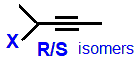 a substituted linear alkyne
and secondary haloalkane group.
a substituted linear alkyne
and secondary haloalkane group.
4-fluoropent-2-yne,
4-chloro-pent-2-yne, 4-bromopent-2-yne,
4-iodo-pent-2-yne
Exhibits R/S optical isomerism, carbon atom
C4 is asymmetric (chiral)
CIP assignment priority rule for R/S isomers:
ZX >
6C6C > 6C1H
> 1H (X = halogen, Z = 9, 17, 35 or 53)
(21)
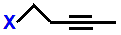 a substituted linear alkyne
and primary haloalkane group.
a substituted linear alkyne
and primary haloalkane group.
5-fluoropent-2-yne,
5-chloropent-2-yne, 5-bromopent-2-yne,
5-iodo-pent-2-yne
(22)
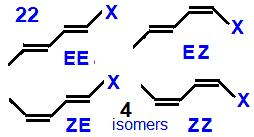 a substituted linear diene, haloalkene
1-fluoropenta-1,3-diene,
1-chloropenta-1,3-diene, 1-bromopenta-1,3-diene,
1-iodoropenta-1,3-diene
This exhibits E/Z geometrical isomerism, the
diagram shows the isomers based on 1-ene group, but the
3-ene alkene group is also a cause of E/Z isomers. Therefore
we have two E/Z geometrical stereocentres in the same
molecule, which gives
four possibilities of E/Z stereoisomers i.e. EE', EZ', E'Z
and ZZ'.
CIP assignment priority rule for E/Z isomers:
ZX >
6C6C > 6C1H
> 1H
CIP rule about the >C=C< double bonds, (X = halogen, Z = 9, 17, 35 or 53)
You can also have, but not shown:
2-fluoropenta-1,3-diene, 2-chloropenta-1,3-diene, 2-bromopenta-1,3-diene, 2-iodopenta-1,3-diene
but these will only give one pair of E/Z
geometrical isomers.
(23)
 a halogen substituted linear diene
3-fluoropenta-1,3-diene,
3-chloropenta-1,3-diene, 3-bromopenta-1,3-diene,
3-iodoropenta-1,3-diene
This exhibits E/Z geometrical isomerism
based on the 3-ene alkene group.
CIP assignment priority rule for E/Z isomers:
ZX >
6C6C > 6C1H
> 1H
CIP rule about the >C=C< double bond, (X = halogen, Z = 9, 17, 35 or 53)
You can also have, but not shown:
2-fluoropenta-1,3-diene,
2-chloropenta-1,3-diene, 2-bromopenta-1,3-diene,
2-iodoropenta-1,3-dienen
4-fluoropenta-1,3-diene,
4-chloropenta-1,3-diene, 4-bromopenta-1,3-diene,
4-iodoropenta-1,3-dienen
5-fluoropenta-1,3-diene, 5-chloropenta-1,3-diene,
5-bromopenta-1,3-diene, 5-iodoropenta-1,3-dienen
(24)
 a halogen substituted linear diene
1-fluoropenta-1,2-diene,
1-chloropenta-1,2-diene, 1-bromopenta-1,2-diene,
1-iodopenta-1,2-diene
This exhibits an 'unusual' R/S (optical) stereoisomerism and has
non-superimposable mirror image forms because the orbitals
of the alkene pi bonds are at 90o to each other.
You can also have, but not shown:
3-fluoropenta-1,2-diene,
3-chloropenta-1,2-diene, 3-bromopenta-1,2-diene,
3-iodopenta-1,2-diene
(25)
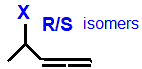 a halogen substituted linear diene
4-fluoropenta-1,2-diene,
4-chloropenta-1,2-diene, 4-bromopenta-1,2-diene,
4-iodopenta-1,2-diene
These molecules exhibit R/S optical
isomerism because carbon atom 4 is asymmetric (chiral).
You can also have, but not shown:
5-fluoropenta-1,2-diene,
5-chloropenta-1,2-diene, 5-bromopenta-1,2-diene,
5-iodopenta-1,2-diene
1-fluoropenta-2,3-diene,
1-chloropenta-2,3-diene, 1-bromopenta-2,3-diene,
1-iodopenta-2,3-diene
2-fluoropenta-2,3-diene,
2-chloropenta-2,3-diene, 2-bromopenta-2,3-diene,
2-iodopenta-2,3-diene
(26)
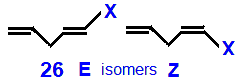 a halogen substituted linear diene
1-fluoropenta-1,4-diene,
1-chloropenta-1,4-diene, 1-bromopenta-1,4-diene,
1-iodoropenta-1,4-diene
This exhibits E/Z geometrical isomerism
based on the 1-ene alkene group.
CIP assignment priority rule for E/Z isomers:
ZX >
6C6C > 6C1H
> 1H
CIP rule about the >C=C< double bond, (X = halogen, Z = 9, 17, 35 or 53)
You can also have, but not shown:
2-fluoropenta-1,4-diene,
2-chloropenta-1,4-diene, 2-bromopenta-1,4-diene,
2-iodoropenta-1,4-diene
(27)
 a halogen substituted linear diene
3-fluoropenta-1,4-diene,
3-chloropenta-1,4-diene, 3-bromopenta-1,4-diene,
3-iodoropenta-1,4-diene
(28)
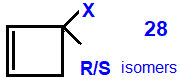 ,
cycloalkene and tertiary haloalkane ,
cycloalkene and tertiary haloalkane
3-fluoro-3-methylcyclbut-1-ene,
3-chloro-3-methylcyclobut-1-ene, 3-bromo-3-methylcyclobut-1-ene,
3-iodo-3-methylcyclobut-1-ene.
R/S optical isomers because the ring C3 of C-X bond is
chiral.
(29-33)

(29) 3-fluoro-1,3-dimethylcyclopropene,
3-chloro-1,3-dimethylcyclopropene, 3-bromo-1,3-dimethylcyclopropene,
3-iodo-1,3-dimethylcyclopropene.
R/S optical isomers due to top C3 of the
Δ being chiral (asymmetric C atom).
(30) 1-(fluoromethyl)-3-methylcyclopropene,
1-(chloromethyl)-3-methylcyclopropene,
1-(bromomethyl)-3-methylcyclopropene, 1-(iodomethyl)-3-methylcyclopropene
R/S optical isomers due to top C3 of the
Δ being chiral (asymmetric C atom).
(31) 3-(fluoromethyl)-3-methylcyclopropene,
3-(chloromethyl)-3-methylcyclopropene,
3-(bromomethyl)-3-methylcyclopropene, 3-(iodomethyl)-3-methylcyclopropene
(32) names?: 1-(2-fluoroethyl)cyclopropene,
1-(2-chloroethyl)cyclopropene, 1-(2-bromoethyl)cyclopropene,
1-(2-iodoethyl)cyclopropene
(33)names?: 3-(2-fluoroethyl)cyclopropene,
3-(2-chloroethyl)cyclopropene, 3-(2-bromoethyl)cyclopropene,
3-(2-iodoethyl)cyclopropene
You can also have theoretically, but not shown:
1-(1-haloethyl)cyclopropenes and
3-(1-haloethyl)cyclopropenes, again names?
(34-36)
 X = F, Cl, Br, I
These halogenated propynes have two functional groups: halide
(C-X) and alkyne (C≡C)
(34) (CH3)2CHC≡CX,
1-fluoro-3-methylbut-1-yne,
1-chloro-3-methylbut-1-yne, 1-bromo-3-methylbut-1-yne,
1-iodo-3-methylbut-1-yne
(35) (CH3)2CClC≡CH,
3-fluoro-3-methylbut-1-yne,
3-chloro-3-methylbut-1-yne, 3-bromo-3-methylbut-1-yne,
3-iodo-3-methylbut-1-yne
(36) XCH2CH(CH3)C≡CH,
4-fluoro-3-methylbut-1-yne,
4-chloro-3-methylbut-1-yne, 4-bromo-3-methylbut-1-yne,
4-iodo-3-methylbut-1-yne
(37-40)

(37) 1-halo-2-methylcyclopropylethene, these exhibit E/Z
geometrical isomerism
e.g. [(1E or 1Z)-2-chloroethenyl]cyclopropane,
1-chloro-2-cyclopropylethene
CIP assignment priority rule for E/Z or R/S isomers:
ZX >
6C > 1H (X = halogen, Z = 9, 17, 35 or 53)
(38) names?: 1-fluoro-1-cyclopropylethene, 1-chloro-1-cyclopropylethene, 1-bromo-1-cyclopropylethene, 1-iodo-1-cyclopropylethene,
(39) names?: 1-fluoro-1-ethenylcyclopropane, 1-chloro-1-ethenylcyclopropane,
1-bromo-1-ethenylcyclopropane, 1-iodo-1-ethenylcyclopropane
(40) names?: 2-fluoro-1-ethenylcyclopropane, 2-chloro-1-ethenylcyclopropane,
2-bromo-1-ethenylcyclopropane, 2-iodo-1-ethenylcyclopropane
(41-46) These have part of an alkene group (methylene) which is
also part of the cyclopropane ring and all have the haloalkane group in various
positions i.e. in a side chain of the ring, directly attached to the ring or
attached to the alkene group.

Examples (41)-(46) would only be encountered at university
level.
(41) names?: e.g. 1-(chloromethyl)-2-methylidenecyclopropane,
1-(chloromethyl)-2-methylenecyclopropane
These exhibit R/S optical isomerism because to the top C of
the
Δ
is chiral.
(42) names?: e.g. 1-chloro-2-methyl-3-methylenecyclopropane
These exhibit R/S optical isomerism because to the top and
bottom carbons of the
Δ
are chiral.
This is very complex stereoisomerism because there are two R/S
chiral centres AND E/Z geometrical isomerism because the -CH3 and
-X can be at different positions above and below the ring.
(43) names?: e.g. 1-chloro-2-ethylidenecyclopropane
These exhibit R/S optical isomerism because to the top and
bottom carbons of the
Δ
are chiral.
Not sure on E/Z geometrical isomerism?
(44) names?: e.g.
These exhibit R/S optical isomerism because to the top and
bottom carbons of the
Δ
are chiral.
Not sure on E/Z geometrical isomerism?
(45) names?: e.g. 1-chloro-1-methyl-2-methylenecyclopropane
These exhibit R/S optical isomerism because to the top and
bottom carbons of the
Δ
are chiral.
(46) names?:
(47-52) These are halogen substituted saturated 'bicyclo'
alkanes

(47) names?: e.g. 1-chlorospiro[2.2]pentane, secondary
haloalkanes, R/S optical isomers
(48) names ?, secondary haloalkanes
(49) names?: e.g. 1-chlorobicyclo[2.1.0]pentane, tertiary
haloalkanes, R/S optical isomers
(50) names ?, secondary haloalkanes, R/S optical isomers
(51) names?: e.g. 1-chlorobicyclo[1.1.1]pentane, a tertiary
haloalkane
(52) names ?, secondary haloalkanes
(53-57) based on methylbuta-1,2-diene or methylbuta-1,3-diene

(53) 1-chloro-3-methylbuta-1,2-diene
(54) 4-chloro-3-methylbuta-1,2-diene
(55) 1-chloro-2-methylbuta-1,3-diene, E/Z geometrical isomers
CIP assignment priority rule for E/Z isomers:
ZX > 6C6C
> 6C1H
> 1H
CIP rule about the >C=C< double bond, (X = halogen, Z = 9, 17, 35 or 53)
(56) 2-chloro-3-methylbuta-1,3-diene
(57) 1-chloro-3-methylbuta-1,3-diene, E/Z geometrical isomers
CIP assignment priority rule for E/Z isomers:
ZX > 6C1H
> 1H
CIP rule about the >C=C< double bond, (X = halogen, Z = 9, 17, 35 or 53)
Extra
information on some of the uses and applications of these isomers
(just out of curiosity!)
Isomers of C5H7X
(where X = F, Cl, Br, I) are typically halogenated cyclopentenes or pentynes,
and their uses span synthetic intermediates, pharmaceuticals, agrochemicals,
and materials science.
Their reactivity and
applications depend on both the halogen and the position of their
substitution.
General Applications of C5H7X Isomers
-
Pharmaceutical intermediates: Fluorinated
alkenes are used to modify bioactivity and metabolic stability.
-
Polymer precursors: Fluorocyclopentenes are
used in specialty polymers with enhanced thermal or chemical resistance.
-
Radiolabeling: Fluorine-18 analogs are used
in PET imaging. | | Chlorine (C5H7Cl)
| Chlorocyclopentene, 1-chloropentene |
-
Agrochemical synthesis: Chlorinated alkenes
serve as precursors to herbicides and fungicides.
-
Cross-coupling reactions: Used in Suzuki
and Heck reactions for building complex molecules.
-
Solvent modifiers: Some isomers are used to
tailor solvent polarity in industrial processes. | | Bromine (C5H7Br)
| Bromocyclopentene, 1-bromopentene |
-
Grignard reagent precursors: Useful in
organometallic synthesis.
-
Pharmaceutical building blocks: Brominated
alkenes are used to introduce reactive handles for further derivatization.
-
Flame retardants: Some brominated compounds
are used in polymer additives. | | Iodine (C5H7I)
| Iodocyclopentene, 1-iodopentene |
-
Radioiodination: Iodine-125 and Iodine-131
analogs are used in radiopharmaceuticals.
-
Cross-coupling chemistry: Excellent leaving
group in palladium-catalyzed reactions.
-
Synthetic intermediates: Used to introduce
iodine into complex organic frameworks. |
Structural Diversity and Reactivity
-
Aliphatic versus cyclic: Isomers may be
straight-chain (e.g. 1-halopentene) or cyclic (e.g. halocyclopentene),
affecting their reactivity and physical properties.
-
Position of halogen: Primary, secondary, or
allylic halides differ in nucleophilicity and stability.
-
Stereoisomers: Cis/trans isomers of
cyclopentenes influence biological activity and synthetic utility.
Research and Niche Uses
-
Medicinal chemistry: Halogenated alkenes
are explored for antiviral, anticancer, and anti-inflammatory properties.
-
Material science: Fluorinated and
brominated isomers are used in liquid crystals and specialty coatings.
-
Environmental chemistry: Some isomers are
studied for degradation pathways and atmospheric reactivity.
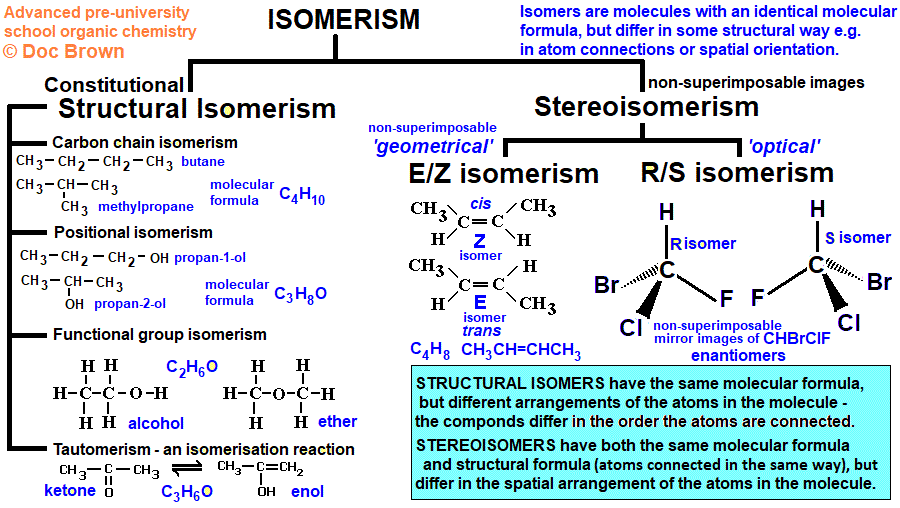
A summary chart of isomerism
Associated organic chemistry links
Index of sets of isomers for a given
molecular formula
Isomerism: introduction, structural isomerism - chain,
positional, functional group, tautomerism
Stereoisomerism:
introduction, definition,
priority rules, E/Z isomerism (cis/trans isomerism)
Stereoisomerism - R/S isomerism (optical
isomerism) -
definition - examples explained
Index of all IR, mass, 1H NMR
and 13C NMR spectroscopy
pages
This is a big chemistry website, please allow time
to explore
Index of advanced
(pre-university) organic
chemistry revision notes
The chemistry of
alkanes and the petrochemical
industry
The
chemistry of alkenes
The
chemistry of organic halogen compounds
The
chemistry of
alcohols
The chemistry of aldehydes
and ketones
The
chemistry of carboxylic acids and derivatives
The chemistry of organo-nitrogen compounds
The chemistry of
aromatic compounds
Keywords or phrases: how many
isomers are there of molecular formula C5H7Cl C5H7Br C5H7I C5H7F? how to draw the
skeletal formula of C5H7Cl C5H7Br C5H7I C5H7F isomers, how do you name the isomers of
molecular formula C5H7Cl C5H7Br C5H7I C5H7F? what is the molecular structure of the
isomers of C5H7Cl C5H7Br C5H7I C5H7F, what type of isomerism is exhibited by molecules
of formula C5H7Cl C5H7Br C5H7I C5H7F, how do you work out the isomers of molecular
formula C5H7Cl C5H7Br C5H7I C5H7F, what are the structural isomers of C5H7Cl C5H7Br C5H7I C5H7F, the carbon
chain isomers of C5H7Cl C5H7Br C5H7I C5H7F in the homologous series how many structural isomers of
C5H7Cl C5H7Br C5H7I C5H7F can you draw? how many structural isomers does C5H7Cl C5H7Br C5H7I C5H7F have?
what are the possible isomers of C5H7Cl C5H7Br C5H7I C5H7F? revision notes on
isomerism of C5H7Cl C5H7Br C5H7I C5H7F molecules, isomerism in
compounds of C5H7Cl C5H7Br C5H7I C5H7F how to draw the
structural formula of isomers of C5H7Cl C5H7Br C5H7I C5H7F, how to draw the skeletal formula of
isomers of C5H7Cl C5H7Br C5H7I C5H7F, how to name the isomers of molecular formula C5H7Cl C5H7Br C5H7I C5H7F,
are there any R/S optical isomers
enantiomers of C5H7Cl C5H7Br C5H7I C5H7F are there any E/Z isomers
cis trans stereoisomers of C5H7Cl C5H7Br C5H7I C5H7F
How do you work out the structure
of the isomers of molecular formula C5H7Cl C5H7Br C5H7I C5H7F? How do you draw the
structural formula and skeletal formula of the isomers of
molecular formula C5H7Cl C5H7Br C5H7I C5H7F? How do you name the isomers of molecular
formula C5H7Cl C5H7Br C5H7I C5H7F? How many positional isomers are there of molecular
formula C5H7Cl C5H7Br C5H7I C5H7F? Are there any functional group isomers with a
molecular formula C5H7Cl C5H7Br C5H7I C5H7F?
Does C5H7Cl C5H7Br C5H7I C5H7F have any stereoisomers? Be able
to deduce the isomers of organic halogen molecules with the
formula C5H7Cl C5H7Br C5H7I C5H7F. Be able to draw and name the
substituted halogen compounds isomers of molecular formula
C5H7Cl C5H7Br C5H7I C5H7F. Be able to deduce if the isomers of
C5H7Cl C5H7Br C5H7I C5H7F organic halogen compounds can exhibit
R/S optical isomerism. Be able to deduce if the isomers of
C5H7Cl C5H7Br C5H7I C5H7F can exhibit E/Z geometrical isomerism
(do C5H7Cl C5H7Br C5H7I C5H7F have cis/trans geometric isomers).
How do you draw the structural formula and skeletal formula of
the isomers of molecular formula C5H7Cl C5H7Br C5H7I C5H7F? How
many aliphatic structural isomers are there of halogen compounds
with molecular formula C5H7Cl C5H7Br C5H7I C5H7F? How many
aliphatic carbon chain isomers are there of halogen compounds
with molecular formula C5H7Cl C5H7Br C5H7I C5H7F? How many
positional isomers are there of organic halogen molecules with
molecular formula C5H7Cl C5H7Br C5H7I C5H7F? How many E/Z
(geometrical) isomers are there of molecular formula C5H7Cl
C5H7Br C5H7I C5H7F? How many R/S (optical) isomers (enantiomers)
of molecular formula C5H7Cl C5H7Br C5H7I C5H7F? Are there any
cyclic haloalkene isomers of formula C5H7Cl C5H7Br C5H7I C5H7F?
Are there any cyclo haloalkane isomers of formula C5H7Cl C5H7Br
C5H7I C5H7F? Are there any halodiene isomers of molecular
formula C5H7Cl C5H7Br C5H7I C5H7F? Are there any haloalkyne
isomers of molecular formula C5H7Cl C5H7Br C5H7I C5H7F? Are
there any functional group isomers with a molecular formula
C5H7Cl C5H7Br C5H7I C5H7F? Do C5H7Cl C5H7Br C5H7I C5H7F organic
halogen molecules have any stereoisomers? Are there any E/Z
(geometrical) isomers with a molecular formula C5H7Cl C5H7Br
C5H7I C5H7F? Are there any R/S (optical) isomers (enantiomers)
with a molecular formula C5H7Cl C5H7Br C5H7I C5H7F? Be able to
deduce the isomers of organic halogen molecules with the formula
C5H7Cl C5H7Br C5H7I C5H7F. Be able to draw and name the
substituted halogen compounds isomers of molecular formula
C5H7Cl C5H7Br C5H7I C5H7F. Be able to deduce if the isomers of
C5H7Cl C5H7Br C5H7I C5H7F organic halogen compounds can exhibit
R/S optical isomerism. Be able to deduce if the isomers of
C5H7Cl C5H7Br C5H7I C5H7F can exhibit E/Z geometrical isomerism
(do C5H7Cl C5H7Br C5H7I C5H7F have cis/trans geometric isomers).
Website content © Dr
Phil Brown 2000+. All copyrights reserved on revision notes, images,
quizzes, worksheets etc. Copying of Doc Brown's pre-university
advanced level chemistry website material is NOT
permitted. Exam revision summaries & references to science course specifications
are unofficial. These organic chemistry revision notes on
isomerism are
suitable for use of pre-university students studying AQA advanced level
chemistry, Edexcel advanced level chemistry, OCR advanced level
chemistry, IB advanced level chemistry, WJEC (Eduqas) advanced level
chemistry, CIE advanced level chemistry, US grade 11-12 AP honors
chemistry courses and they will also prove useful to
1st year undergraduate students of chemistry.
|
