|
Doc Brown's
Advanced Chemistry: Part 14.7
Selected structural
constitutional isomers of molecular formula
C5H6
[Author
©
Dr WP Brown PhD:
Doc Brown's advanced level organic chemistry exam revision notes
suitable for students of UK advanced level chemistry courses, IB advanced
chemistry & US K12 grades
11-12 and AP honors chemistry courses: Molecular
spectroscopy and analysing the isomers of C5H6
[updated
Feb 23rd 2026 *]
Index of sets of isomers for a given
molecular formula
email doc
brown - comments - query?
*
[privacy policy, cookies
and disclaimer]
Associated organic chemistry page links
This is a big chemistry website, please allow time
to explore it
19 selected examples of the constitutional-structural isomers
and stereoisomers of molecular formula
C5H6
Introduction to the isomers of molecular formula C5H6
There is a large number of isomers of C5H6
including a range of highly unsaturated open chain aliphatic
hydrocarbon compounds and unsaturated cyclic compounds -
unsaturated alicyclic compounds.
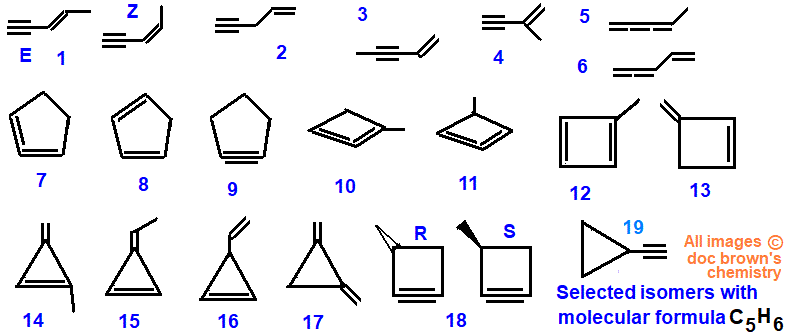 details below
Composition
Percent composition of
C5H 6 based on atomic masses C= 12.01 H =
1.01 and Mr(C5H6) = 66.11
Element composition (to two dp): carbon =
90.83%
hydrogen = 9.17%
Empirical formula C5H6
=
molecular formula C5H6
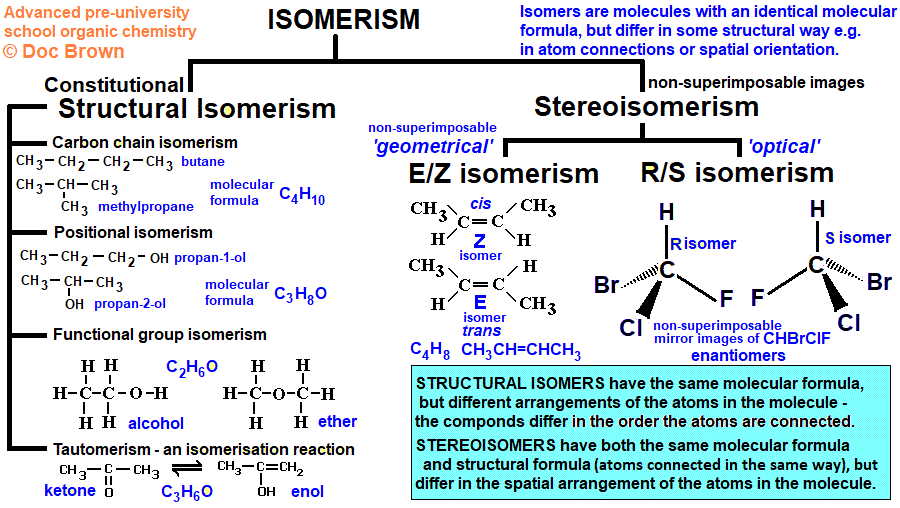
Structural isomerism
- isomers based on different connectivity's of the constituent atoms, so cannot
be spatially identical (but can be defined as having the same shape).
This includes (a)
carbon chain variation (usually need a minimum of 4 atoms),
(b) change in position of a substituent or functional group and
(c) functional group
isomerism where the atoms have a different connectivity configuration, usually with
significant differences in chemical and physical properties e.g.
In terms of isomers of
C5H6
there are
(a) chain variations based on the C atoms,
both open chain and cyclic structures,
(b) positional isomers e.g. the position of
the >C=C< and -C≡C-
groups in open chain compounds.
(c) most are all functional group isomers of each
other
e.g. open chain alkene-alkynes versus cyclic alkenes or alkynes
Stereoisomerism - isomers
based on the same connectivity of the atoms (same constitutional formula), but
in some way, they are 2D or 3D spatially different non-superimposable images (e.g. E/Z
'geometrical' isomers or mirror image R/S 'optical' isomers)
This is
where molecules have the same basic constitutional structural formula, but
isomers differ in the 2D/3D arrangement of the atoms.
For stereoisomers, the (CIP) abbreviation means the
IUPAC Cahn-Ingold-Prelog priority
order rule for assigning E/Z (geometrical) and R/S (optical) stereoisomers.
E/Z
stereoisomerism was called 'geometrical isomerism' e.g. cis
and trans isomers of alkenes or disubstituted cyclic alkanes
where there are 2D/3D spatial variations that are not mirror images and not
super imposable.
One selected isomer exhibits E/Z geometrical isomerism No.
(1)
R/S
stereoisomerism was called 'optical isomerism', the pairs of
isomers are called enantiomers which are 3D non-superimposable
mirror image forms of the molecule (enantiomers). The molecule must have a chiral centre
(a stereocentre), that is an asymmetric carbon atom with four
different atoms/groups attached to it.
One isomer exhibits R/S optical isomerism No.
(18)
NOTE
In total there are at least 41 isomers (from the internet), so I've
selected 19 constitutional-structural isomers for a more detailed description, just to show the
variety of isomeric possibilities, some of which are highly
unstable and very reactive due to extremely strained bonds in
ring systems! Some might not exist?
Examples constitutional structural isomers of molecular
formula
C5H6 isomerism e.g. alkenes
(cyclodienes, open chain trienes), alkene-alkynes - 'enynes', cycloalkenes, cycloalkynes
i.e. a variety of open chain and aliphatic and cyclic alicyclic hydrocarbons, some of which
exhibit stereoisomerism.
Not sure on some of the naming of these compounds - any advice
or correction is most welcome.
For these
19 and lots of other C5H6 isomer structures see
https://zh.wikipedia.org/wiki/File:C5H6isomer.gif
https://www.molport.com/shop/molecular-formula/C5H6
Details of 19 selected isomer
of C5H6
(1) pent-3-en-1-yne,
HC≡C-CH=CH-CH3,
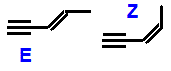 ,
abbreviated structural
formula, skeletal formula of this 'enyne', with two unsaturated
functional groups, an alkene ('ene') and alkyne ('yne') ,
abbreviated structural
formula, skeletal formula of this 'enyne', with two unsaturated
functional groups, an alkene ('ene') and alkyne ('yne')
Also
called 3-penten-1-yne, two E/Z stereoisomers (cis and
trans),
(E)-pent-3-en-1-yne,
(Z)-pent-3-en-1-yne,
(3Z)-pent-3-en-1-yne
or (E)-3-penten-1-yne,
(Z)-3-penten-1-yne
CIP assignment priority rule for E/Z isomers:
6C
> 1H
CIP rule about the >C=C< double bond
Number of low resolution
NMR
chemical shift
δ
signal peaks: 4
1H and
5 13C
(email
if disagree?)
1H NMR ratio of peaks: 1 : 1 : 1
: 3
(for equivalent protons)
(2)
pent-1-en-4-yne,
HC≡C-CH2-CH=CH2,
 ,
abbreviated structural
formula, skeletal formula
,
abbreviated structural
formula, skeletal formula
Also
called pent-4-en-1-yne, 4-penten-1-yne, another bifunctional
group molecule - alkene and alkyne.
Number of low resolution
NMR
chemical shift
δ
signal peaks: 4
1H and
5 13C
(email
if disagree?)
1H NMR ratio of peaks: 1 : 2 : 1
: 2
(for equivalent protons)
BUT, for the 'end' =CH2 alkene protons,
you can get two chemical shifts close together, if there are two
different groups attached to the other carbon of the C=C bond i.e.
R"R'C=CH2 where R" and R' are different. This causes the
two =CH2 protons to experience slightly different fields.
(3)
pent-1-en-3-yne,
H3C-C≡C-CH=CH2
,
 ,
abbreviated structural
formula, skeletal formula
,
abbreviated structural
formula, skeletal formula
Also
called 1-penten-3-yne, another bifunctional group molecule -
alkene and alkyne.
Number of low resolution
NMR
chemical shift
δ
signal peaks: 3
1H and
5 13C
(email
if disagree?)
1H NMR ratio of peaks: 3 : 1 : 2
(for equivalent protons)
BUT, for the 'end' =CH2 alkene protons,
you can get two chemical shifts close together, if there are two
different groups attached to the other carbon of the C=C bond i.e.
R"R'C=CH2 where R" and R' are different. This causes the
two =CH2 protons to experience slightly different fields.
(4) 2-methylbut-1-en-3-yne,
HC≡C-C(CH3)=CH2,
 , abbreviated
structural formula, skeletal formula
, abbreviated
structural formula, skeletal formula
Also
called 2-methyl-1-buten-3-yne, another bifunctional group
molecule - alkene and alkyne.
Number of low resolution
NMR
chemical shift
δ
signal peaks: 3
1H and
5 13C
(email
if disagree?)
1H NMR ratio of peaks: 1 : 3 : 2
(for equivalent protons)
BUT, for the 'end' =CH2 alkene protons,
you can get two chemical shifts close together, if there are two
different groups attached to the other carbon of the C=C bond i.e.
R"R'C=CH2 where R" and R' are different. This causes the
two =CH2 protons to experience slightly different fields.
(5)
penta-1,2,3-triene,
H2C=C=C=CH-CH3,
 , abbreviated structural formula, skeletal formula
Also
called 1,2,3-pentatriene, with three continuously linked
alkene groups.
Number of low resolution
NMR
chemical shift
δ
signal peaks: 3
1H and
5 13C
(email
if disagree?)
1H NMR ratio of peaks: 2 : 1 : 3
(for equivalent protons)
(6)
penta-1,2,4-triene,
H2C=C=CH-CH=CH2,
 , abbreviated structural formula, skeletal formula
Also
called 1,2,4-pentatriene, with three alkene groups, an
alkene and a diene formation.
Number of low resolution
NMR
chemical shift
δ
signal peaks: 4
1H and
5 13C
(email
if disagree?)
1H NMR ratio of peaks: 2 : 1 : 1
: 2
(for equivalent protons)
BUT, for the 'end' =CH2 alkene protons,
you can get two chemical shifts close together, if there are two
different groups attached to the other carbon of the C=C bond i.e.
R"R'C=CH2 where R" and R' are different. This causes the
two =CH2 protons to experience slightly different fields.
(7)
cyclopenta-1,2-diene,
 , skeletal formula
Also
called 1,2-cyclopentadiene, an unsaturated cyclic
hydrocarbon, a cycloalkene, cyclodiene.
Number of low resolution
NMR
chemical shift
δ
signal peaks: 2
1H and
3 13C
(email
if disagree?)
1H NMR ratio of peaks: 2
(1+1) : 4 (2+2) = 1 : 2
(for equivalent protons)
(8)
cyclopenta-1,3-diene,
 , skeletal formula
Also
called 1,3-cyclopentadiene, an unsaturated cyclic
hydrocarbon, a cycloalkene, cyclodiene.
Number of low resolution
NMR
chemical shift
δ
signal peaks: 3
1H and
3 13C
(email
if disagree?)
1H NMR ratio of peaks: 2
(1+1) : 2 (1+1) : 2 = 1
: 1 : 1
(for equivalent protons)
(9)
cyclopentyne,
 , skeletal formula, a cyclic alkyne.
Does it exist? the
normally linear -C≡C-C
of 180o must be terribly strained and the molecule must be highly
unstable and reactive?
Number of low resolution
NMR
chemical shift
δ
signal peaks: 2
1H and
3 13C
(email
if disagree?)
1H NMR ratio of peaks: 4
(2+2) : 2 = 2 : 1
(for equivalent protons)
(10)
1-methylcyclobuta-1,2-diene,
 , skeletal formula
Also
called 1-methyl-1,2-cyclobutadiene, a cyclodiene
hydrocarbon molecule.
Number of low resolution
NMR
chemical shift
δ
signal peaks: 4
1H and
5 13C
(email
if disagree?)
1H NMR ratio of peaks: 1 : 2 : 3
(for equivalent protons)
(11)
4-methylcyclobuta-1,2-diene,
 , skeletal formula
Also
called 4-methyl-1,2-cyclobutadiene, a cyclodiene
hydrocarbon molecule.
Note
the number 4 is a consequence of the 1 and 2 positions of
the C=C bonds.
Number of low resolution
NMR
chemical shift
δ
signal peaks: 3
1H and
4 13C
(email
if disagree?)
1H NMR ratio of peaks: 2
(1+1) : 1 : 3
(for equivalent protons)
(12)
1-methylcyclobuta-1,3-diene,
 , skeletal formula
Also
just called methylcyclobuta-1,3-diene, since only one
position possible for the methyl group, also called
1-methylcyclobutadiene, a cyclodiene hydrocarbon
molecule.
Number of low resolution
NMR
chemical shift
δ
signal peaks: 4
1H and
5 13C
(email
if disagree?)
1H NMR ratio of peaks: 1 : 1 : 1
: 3
(for equivalent protons)
(13)
3-methylenecyclobutene,
 , skeletal formula, a cyclodiene hydrocarbon molecule.
Can
be just called methylenecyclobutene, since only one position
possible.
Number of low resolution
NMR
chemical shift
δ
signal peaks: 4
1H and
5 13C
(email
if disagree?)
1H NMR ratio of peaks: 2 : 2 : 1
: 1
(for equivalent protons)
BUT, for the 'end' =CH2 alkene protons,
you can get two chemical shifts close together, if there are two
different groups attached to the other carbon of the C=C bond i.e.
R"R'C=CH2 where R" and R' are different. This causes the
two =CH2 protons to experience slightly different fields.
(14)
1-methyl-3-methylenecyclopropene,
 , skeletal formula
It is an unsaturated cycloalkene molecule,
but also has an alkene group (methylene), part of which is
part of the ring.
Number of low resolution
NMR
chemical shift
δ
signal peaks: 3
1H and
5 13C
(email
if disagree?)
1H NMR ratio of peaks: 1 : 2 : 3
(for equivalent protons)
BUT, for the 'end' =CH2 alkene protons,
you can get two chemical shifts close together, if there are two
different groups attached to the other carbon of the C=C bond i.e.
R"R'C=CH2 where R" and R' are different. This causes the
two =CH2 protons to experience slightly different fields.
(15)
3-ethylidenecyclopropene,  , skeletal formula
It is an unsaturated cycloalkene molecule,
but also has an alkene group (methylene), part of which is
part of the ring.
Number of low resolution
NMR
chemical shift
δ
signal peaks: 3
1H and
4 13C
(email
if disagree?)
1H NMR ratio of peaks: 2
(1+1) : 1 : 3
(for equivalent protons)
(16)
3-ethenylcyclopropene,
 , skeletal formula
It is an unsaturated cycloalkene molecule,
but also has an alkene group (methylene), part of which is
part of the ring.
Number of low resolution
NMR
chemical shift
δ
signal peaks: 4
1H and
4 13C
(email
if disagree?)
1H NMR ratio of peaks: 2
(1+1, split?) : 1 : 1 : 2
(for equivalent protons)
BUT, for the 'end' =CH2 alkene protons,
you can get two chemical shifts close together, if there are two
different groups attached to the other carbon of the C=C bond i.e.
R"R'C=CH2 where R" and R' are different. This causes the
two =CH2 protons to experience slightly different fields.
(17)
1,2-dimethylenecyclopropane,
 , skeletal formula
The two alkene groups contribute two of the
carbon atoms of the cyclopropane ring.
It is a sort of diene.
Number of low resolution
NMR
chemical shift
δ
signal peaks: 2
1H and
3 13C
(email
if disagree?)
1H NMR ratio of peaks: 2 : 4
(2+2) = 1 : 2
(for equivalent protons)
BUT, for the 'end' =CH2 alkene protons,
you can get two chemical shifts close together, if there are two
different groups attached to the other carbon of the C=C bond i.e.
R"R'C=CH2 where R" and R' are different. This causes the
two =CH2 protons to experience slightly different fields.
(18)
3-methylcyclobutyne,
 ,
,
The skeletal formula of
the two R/S ('optical') stereoisomers (enantiomers), a cycloalkyne
- a triple bond alkyne group in a ring.
R/S isomers, take
either one and flip it over keeping the alkyne group at the bottom of the
'square' and you find they are not super-imposable images!
Do they exist? the
normally linear -C≡C-C
of 180o must be terribly strained and the molecule highly
unstable and reactive?
Number of low resolution
NMR
chemical shift
δ
signal peaks: 3
1H and
5 13C
(email
if disagree?)
1H NMR ratio of peaks: 3 : 1 : 2
(for equivalent protons)
(19)
cyclopropylethyne,
 ,
skeletal formula ,
skeletal formula
Other names:
cyclopropylacetylene, but IUPAC preferred name is ethanylcyclopropane
This is both a
saturated cycloalkane and an open chain alkyne.
Number of low resolution
NMR
chemical shift
δ
signal peaks: 3
1H and
4 13C
(email
if disagree?)
1H NMR ratio of peaks: 4
(2+2) : 1 : 1
(for equivalent protons)
Extra notes on
groups of plausible isomers of C5H6
(from an AI advanced search)
To keep things clear, I’ll list 10 plausible constitutional
isomers of C5H6.
These will be organised into categories: cyclic dienes,
cyclic alkynes, acyclic enyne and cumulenes, and methylcyclobutadienes.
This should provide a good overview without getting too
complicated.
I won’t need to cite sources as it’s more about presenting
the isomers in a structured, easy-to-understand format.
The focus here is on making it straightforward for the user.
Overview of structural types of isomers of C5H6
C5H6 has three degrees of
unsaturation.
That can be arranged as: one ring + two π bonds
(cyclopentadienes and substituted cyclobutadienes), one ring + one triple
bond (cycloalkynes), or an acyclic combination of π and triple bonds
(conjugated/cumulated trienes, enynes).
Below are the common constitutional isomers grouped by those
types.
Cyclic dienes and related ring system isomers of C5H6
-
1,3-Cyclopentadiene
-
1,2-Cyclopentadiene (less common tautomeric
/ positional isomerization relative to 1,3)
-
Methylcyclobuta-1,2-diene (two
constitutional positions: 1-methyl- and 2-methyl-cyclobutadiene)
Cycloalkynes and ring + triple-bond isomers of C5H6
-
Cyclopentyne (ring containing one C≡C
triple bond; highly strained/unstable but a valid constitutional isomer)
-
Methyl-substituted cyclobutene with extra
unsaturation (formal isomers that can be viewed as a 4‑membered
ring plus exocyclic unsaturation; listed here as ring-with-additional-π
isomers)
Acyclic enynes, cumulene and triene isomers of C5H6
-
4-Penten-1-yne (CH2=CH–CH2–C≡CH;
an enyne)
-
1-Penten-3-yne (CH3–CH=CH–C≡CH;
positional enyne isomer)
-
1,2,4-Pentatriene (an isomer with cumulated
double bonds; allenic character)
-
1,2,3-Pentatriene (another cumulated-triene
arrangement)
Notes on count, stability and nomenclature of
isomers of C5H6
-
Many of these isomers are highly strained or transient
(cyclopentyne, cyclobutadiene derivatives, some cumulenes) and may be
difficult or impossible to isolate under normal conditions.
-
Some names above represent families of positional isomers
(for example, methylcyclobutadiene has distinct constitutional isomers
depending on methyl position).
Learning objectives - questions to be answered?
How do you work out the structure
of the isomers of molecular formula C5H6?
How do you draw the structural
formula and skeletal formula of the isomers of molecular formula
C5H6?
How do you name the isomers of molecular formula
C5H6?
How many aliphatic structural
isomers are there of molecular formula C5H6?
How many aliphatic carbon chain
isomers are there of molecular formula C5H6?
How many positional isomers are
there of molecular formula C5H6?
Are there any aliphatic open chain
alkene isomers of molecular formula C5H6?
Are there any carboxylic acid isomers of
molecular formula C5H6?
Are there any alkene isomers of molecular formula C5H6?
Are there any alcohol isomers of molecular formula C5H6?
Are there any functional group
isomers with a molecular formula C5H6?
Does C5H6 have any stereoisomers?
Are there any E/Z (geometrical)
isomers with a molecular formula C5H6?
Are there any R/S (optical) isomers
(enantiomers) with a molecular formula C5H6?
How many E/Z (geometrical) isomers
are there of molecular formula C5H6?
How many R/S (optical) isomers
(enantiomers) of molecular formula C5H6?
This
page will answer these questions for molecular formula C5H6
Associated organic chemistry links
Index of sets of isomers for a given
molecular formula
All my advanced Level pre-university
organic chemistry notes
IR, mass and H-1 and C-13 NMR
spectra of organic compounds
The molecular structure and
naming of ALKANES (how
to name and draw alkane structures)
The molecular structure and naming
of ALKENES
(how to name and draw alkene structures)
Index of revision notes
on the chemistry of ALKANES and the petrochemical
industry
INDEX of
ALL revision notes on the chemistry ALKENES
including reactions and polymers
Isomerism: introduction, structural isomerism - chain,
positional, functional group, tautomerism
Stereoisomerism:
introduction, definition,
priority rules, E/Z isomerism (cis/trans isomerism)
Stereoisomerism - R/S isomerism (optical
isomerism) -
definition - examples explained
This is a big chemistry website, please allow time
to explore it
|
Website content © Dr
Phil Brown 2000+. All copyrights reserved on revision notes, images,
quizzes, worksheets etc. Copying of Doc Brown's pre-university
advanced level chemistry website material is NOT
permitted. Exam revision summaries & references to science course specifications
are unofficial. These organic chemistry revision notes on
isomerism are
suitable for use of pre-university students studying AQA advanced level
chemistry, Edexcel advanced level chemistry, OCR advanced level
chemistry, IB advanced level chemistry, WJEC (Eduqas) advanced level
chemistry, CIE advanced level chemistry, US grade 11-12 AP honors
chemistry courses and they will also prove useful to
1st year undergraduate students of chemistry. |
Keywords or phrases: how many isomers are
there of molecular formula C5H6? how do you name the isomers of
molecular formula C5H6? what is the molecular structure of the
isomers of C5H6, what type of isomerism is exhibited by molecules
of formula C5H6, how do you work out the isomers of cycloalkenes
and alkynes of molecular
formula C5H6, what are the structural isomers of C5H6, the carbon chain
isomers of C5H6 in the homologous series of alkanes, comparing
the spectra of isomers of molecular formula C5H6 how many structural isomers of
C5H6 can you draw? how many structural isomers does C5H6 have?
what are the possible isomers of C5H6? revision notes on
isomerism of C5H6 molecules, isomerism in
alkane, alkene and alkyne
isomers of C5H6, alkyne isomers of C5H6, the molecular structure of
the isomers of C5H6 how to draw the
structural formula of isomers of C5H6, how to draw the displayed
formula of isomers of C5H6, how to draw the skeletal formula of
isomers of C5H6 cycloalkenes and alkynes, how to name the isomers of molecular formula C5H6,
isomers of C5H6 of molecular mass ? R/S optical isomers
enantiomers of C5H6 cycloalkenes and alkynes E/Z isomers
cis trans stereoisomers of C5H6
E/Z isomers of molecular formula C5H6 (geometric cis/trans
isomers) alkene molecules isomeric of molecular formula C5H6,
molecules isomeric with molecular formula C5H6, structural isomers of molecular
formula C5H6, optical isomers R/S enantiomers isomeric with molecular
formula C5H6, positional isomers isomeric with cycloalkenes and
alkynes of molecular formula C5H6,
which types of isomerism are exhibited by molecules isomeric with
molecular formula C5H6 alkyl positional isomers of C5H6 branched
carbon chain alkene isomers of C5H6 cycloalkanes of molecular formula
C5H6 which are isomeric with alkenes of molecular formula C5H6
stereoisomers of molecular formula C5H6
cycloalkene molecules isomeric of molecular formula C5H6,
cycloalkenes and alkynes molecules isomeric with molecular formula C5H6, structural isomers of molecular
formula C5H6, optical isomers R/S enantiomers isomeric with molecular
formula C5H6, positional isomers isomeric with molecular formula C5H6,
which types of isomerism are exhibited by molecules isomeric with
molecular formula C5H6 alkyl positional isomers of C5H6 cycloalkenes
and alkynes branched
carbon chain cycloalkene isomers of molecular formula C5H6 mass 66
cyclic alkanes of formula C5H6 E/Z isomers of molecular formula
C5H6 (geometric cis/trans
isomers) alkene molecules isomeric of molecular formula C5H6,
molecules isomeric with molecular formula C5H6, structural isomers of molecular
formula C5H6, optical isomers R/S enantiomers isomeric with molecular
formula C5H6, positional isomers isomeric with molecular formula
C5H6,
alicyclic alkanes of formula C5H6 which types of isomerism are exhibited by molecules isomeric with
molecular formula C5H6 alkyl positional isomers of C5H6 branched
carbon chain alkene isomers of C5H6 cycloalkanes of molecular formula
C5H6 which are isomeric with alkenes of molecular formula C5H6
stereoisomers of molecular formula C5H6 cycloalkane functional group
isomers of C5H6 are there alkyne isomers of C5H6? are there
cycloalkanes of formula C5H6? are there cycloalkenes of formula
C5H6 chain isomers of C5H6 functional group isomers of C5H6
substituent and functional group positional isomers of C5H6
|

