|
Doc Brown's
Advanced Chemistry: Part 14.7
Isomers and extra notes on their properties and uses
Selected
constitutional structural isomers
and
stereoisomers of molecular formula C3H5FO2
,
C3H5ClO2 , C3H5BrO2
and
C3H5IO2
[Author
©
Dr WP Brown PhD:
Doc Brown's advanced level organic chemistry exam revision notes
suitable for students of UK A level chemistry courses, IB advanced chemistry & US K12 grade
11, grade 12 and AP honors chemistry courses: Molecular
spectroscopy and analysing the isomers of C3H5XO2
[isomerism page updated Feb 11th 2026 *]
Index of sets of isomers for a given
molecular formula
email doc
brown - comments - query?
* [privacy policy
and disclaimer]
Associated organic chemistry page links
This is a big chemistry website, please allow time
to explore
Selected
constitutional structural isomers
and
stereoisomers of molecular formula C3H5FO2
,
C3H5ClO2 , C3H5BrO2
and
C3H5IO2
Relative molecular mass and
percent composition by mass based on atomic masses:
C 12.01,
H 1.01, O = 16.00, F 19.00, Cl 35.45,
Br 79.90, I 126.90
| Molecular formula |
Mr (C3H5XO2) |
% carbon |
% hydrogen |
% halogen |
% oxygen |
|
C3H5FO2 |
92.08 |
39.13 |
5.49 |
20.63 |
34.75 |
|
C3H5ClO2 |
108.53 |
33.20 |
4.65 |
32.66 |
29.48 |
|
C3H5BrO2 |
152.98 |
23.55 |
3.30 |
52.23 |
20.92 |
|
C3H5IO2 |
199.98 |
18.02 |
2.52 |
63.46 |
16.00 |
Empirical formula = molecular formula = C3H5XO2
(where X = F, Cl, Br or I)
Introduction to selected isomers of molecular formula
C3H5FO2 , C3H5ClO2
,
C3H5BrO2
and
C3H5IO2
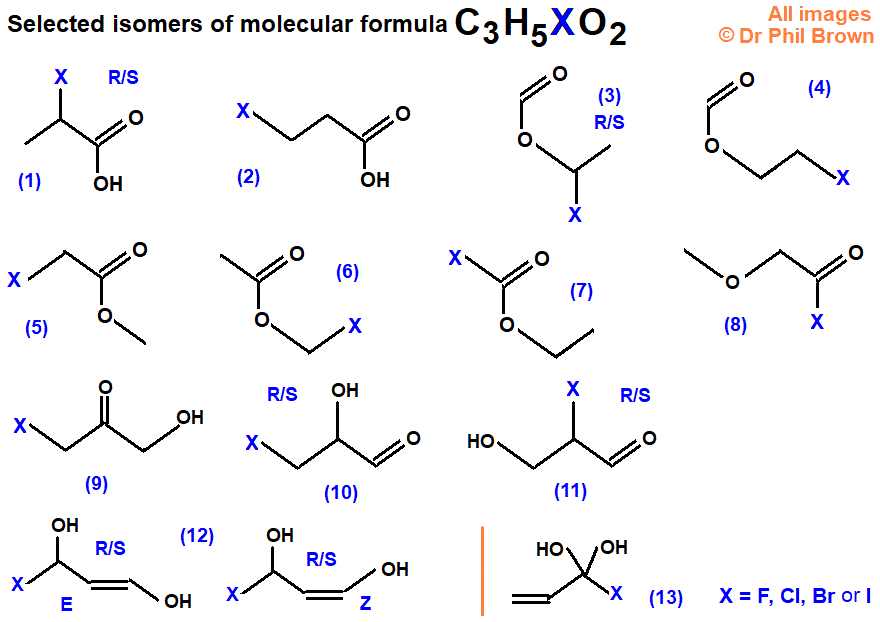
The isomers include halogen substituted carboxylic acids and esters, halogen
and hydroxy substituted aldehydes
and ketones and disubstituted alkenes (OH and X groups)
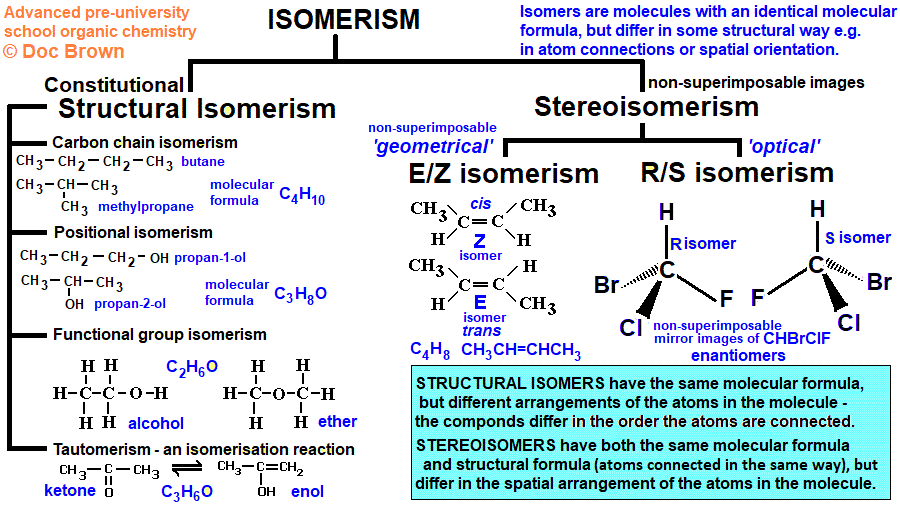
Structural isomerism
- isomers based on different connectivity's of the constituent atoms, so cannot
be spatially identical (but can be defined as having the same shape).
This includes (a) carbon chain variation (usually need a minimum of
4 atoms),
(b) change in position of a substituent or functional group and (c) functional group
isomerism where the atoms have a different connectivity configuration, usually with
significant differences in chemical and physical properties.
(b) positional isomers e.g. position of halogen
atoms or hydroxyl groups.
(c) many are functional group isomers e.g. acids
versus esters, hydroxy aldehydes/ketones versus halogenated alkene
diols.
Stereoisomerism - isomers
based on the same connectivity of the atoms, but 2D or 3D spatially different,
non-superimposable images (e.g. E/Z isomers or mirror image R/S optical isomers)
This is
where molecules have the same basic constitutional structural formula, but
isomers differ in the 2D/3D arrangement of the atoms.
E/Z
stereoisomerism was called 'geometrical isomerism' e.g. cis
and trans isomers of alkenes or disubstituted cyclic alkanes
where there are 2D/3D spatial variations that are not mirror images and not
super imposable.
There is at least on case of a pair of E/Z
geometrical isomers
R/S
stereoisomerism was called 'optical isomerism', the pairs of
isomers are called enantiomers which are 3D non-superimposable
mirror image forms of the molecule. The molecule must have a chiral centre
(a stereocentre), that is an asymmetric carbon atom with four
different atoms/groups attached to it.
I've identified six isomers that can form R/S
isomers (pairs of enantiomers).
Note
In all formulae e.g. condensed structural formulae and images,
X
= F, Cl, Br or I
PLEASE NOTE: Some of these molecules may be too unstable
to exist e.g. some of the iodo compounds, so arts of this page describe
some 'theoretical' isomers of
C3H5FO2
,
C3H5ClO2 , C3H5BrO2
and
C3H5IO2
Details of selected isomers of molecular formula
C3H5FO2 , C3H5ClO2
,
C3H5BrO2
and
C3H5IO2
(1) CH3CHXCOOH,
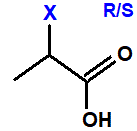 , condensed abbreviated formula, skeletal formula
Two functional groups: carboxylic acid
(COOH) and halogen (X)
A halogen substituted carboxylic acid with
an asymmetric carbon atom.
Carbon atom 2 is chiral, so R/S
stereoisomers will exist (enantiomers, diagram below)
2-fluoropropanoic acid, 2-chloropropanoic
acid, 2-bromopropanoic acid, 2-iodopropanoic acid
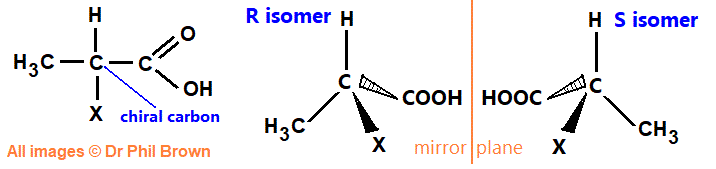
X = F, Cl, Br or I (and can be other groups
like OH, but NOT H or CH3 to exhibit R/S
(optical) isomerism.
From the CIP priority rule:
ZX >
8O6C > 6C > 1H
(Z = 9, 17, 35 and 53 for the halogens)
Indicating the R/S isomers e.g.
(2S)-2-chloropropanoic acid,
(R)-2-bromopropanoic acid etc.
e.g. 2-chloropropanoic acid ,
 , ,
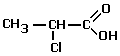 , ,

Number of low resolution
NMR chemical shift
δ
signal peaks: 3 1H
and 3 13C
(email
if disagree?)
1H NMR ratio of peak areas: 3 : 1 : 1 (for equivalent protons)
Index of
1H NMR spectra organic
compounds and
Index of
13C NMR spectra organic
compounds
(2)
XCH2CH2COOH,
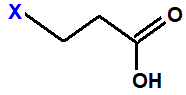 , condensed abbreviated formula, skeletal formula
Two functional groups: carboxylic acid
(COOH) and halogen (X)
A halogen substituted carboxylic acid.
3-fluoropropanoic
acid, 3-chloropropanoic acid, 3-bromopropanoic acid,
3-iodopropanoic acid
e.g. 3-chloropropanoic acid ,
 , ,
 , ,
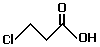
Number of low resolution
NMR chemical shift
δ
signal peaks: 3 1H
and 3 13C
(email
if disagree?)
1H NMR ratio of peak areas: 2 : 2 : 1 (for equivalent protons)
(3) HCOOCHXCH3,
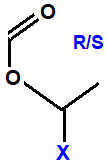 , condensed abbreviated formula, skeletal formula
Two functional groups: ester (COOC)
and halogen (X)
A halogen substituted ester.
R/S isomers because carbon atom 1 in the
halo-ethyl group is chiral (asymmetric carbon atom).
1-fluoroethyl methanoate, 1-chloroethyl
methanoate,
1-bromoethyl methanoate,
1-iodoethyl methanoate
Indicating the R/S isomers e.g. (R)-1-chloroethyl
methanoate, (S)-1-bromoethyl methanoate
Number of low resolution
NMR chemical shift
δ
signal peaks: 3 1H
and 3 13C
(email
if disagree?)
1H NMR ratio of peak areas: 1 : 1 : 3 (for equivalent protons)
(4) HCOOCH2CH2X,
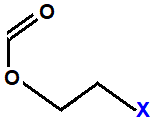 , condensed abbreviated formula, skeletal formula
Two functional groups: ester (COOC)
and halogen (X)
A halogen substituted ester.
2-fluoroethyl methanoate, 2-chloroethyl
methanoate, 2-bromoethyl methanoate, 2-iodoethyl methanoate
2-fluoroethyl formate, 2-chloroethyl
formate, 2-bromoethyl formate, 2-iodoethyl formate
Number of low resolution
NMR chemical shift
δ
signal peaks: 3 1H
and 3 13C
(email
if disagree?)
1H NMR ratio of peak areas: 1 : 2 : 2 (for equivalent protons)
(5)
XH2COOCH3,
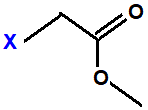 , condensed abbreviated formula, skeletal formula
Two functional groups: ester (COOC)
and halogen (X)
A halogen substituted ester.
methyl 2-fluoroethanoate, methyl
2-chloroethanoate,
methyl 2-bromoethanoate,
methyl 2-iodooethanoate
methyl 2-fluoroacetate, methyl
2-chloroacetate,
methyl 2-bromoacetate, methyl 2-iodooacetate
Number of low resolution
NMR chemical shift
δ
signal peaks: 2 1H
and 3 13C
(email
if disagree?)
1H NMR ratio of peak areas: 2 : 3 (for equivalent protons)
(6) CH3COOCH2X,
 , condensed abbreviated formula, skeletal formula
Two functional groups: ester (COOC)
and halogen (X)
A halogen substituted ester.
fluoromethyl ethanoate, chloromethyl
ethanoate, bromomethyl ethanoate, iodomethyl ethanoate
fluoromethyl acetate, chloromethyl
acetate, bromomethyl acetate, iodomethyl acetate
Number of low resolution
NMR chemical shift
δ
signal peaks: 3 1H
and 3 13C
(email
if disagree?)
1H NMR ratio of peak areas: 3 : 2 (for equivalent protons)
(7)
XCOOCH2CH3,
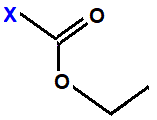 , condensed abbreviated formula, skeletal formula
Two functional groups: ester (COOC)
and halogen (X)
ethyl fluoromethanoate, ethyl
chloromethanoate, ethyl bromomethanoate, ethyl
iodomethanoate
ethyl fluoroformate, ethyl
chloroformate, ethyl bromoformate, ethyl iodoformate
Number of low resolution
NMR chemical shift
δ
signal peaks: 3 1H
and 3 13C
(email
if disagree?)
1H NMR ratio of peak areas: 2 : 3 (for equivalent protons)
(8) CH3OCH2COX,
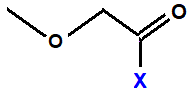 , condensed abbreviated formula, skeletal formula
Two functional groups: A methoxy (ether)
substituted acyl halide (acid halide)
2-methoxyethanoyl fluoride,
2-methoxyethanoyl chloride, 2-methoxyethanoyl bromide,
2-methoxyethanoyl iodide
2-methoxyacetyl fluoride,
2-methoxyacetyl chloride, 2-methoxyacetyl bromide,
2-methoxyacetyl iodide
Number of low resolution
NMR chemical shift
δ
signal peaks: 3 1H
and 3 13C
(email
if disagree?)
1H NMR ratio of peak areas: 3 : 2 (for equivalent protons)
(9)
XCH2COCH2OH,
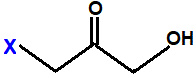 , condensed abbreviated formula, skeletal formula
Three functional groups: A di-substituted ketone,
halogen group and
alcohol group substituents in propanone.
1-fluoro-3-hydroxypropan-2-one,
1-chloro-3-hydroxypropan-2-one,
1-bromo-3-hydroxypropan-2-one, 1-iodo-3-hydroxypropan-2-one
Number of low resolution
NMR chemical shift
δ
signal peaks: 3 1H
and 3 13C
(email
if disagree?)
1H NMR ratio of peak areas: 2 : 2 : 1 (for equivalent protons)
(10)
XCH2CH(OH)CHO,
 , condensed abbreviated formula, skeletal formula
Three functional groups: A di-substituted aldehyde,
halogen group and
alcohol group substituents in propanal.
R/S isomers because carbon atom 2 is chiral.
3-fluoro-2-hydroxypropanal,
3-chloro-2-hydroxypropanal, 3-bromo-2-hydroxypropanal,
3-iodo-2-hydroxypropanal (or 2-hydroxy-3-iodopropanal)
Indicating the R/S isomers e.g.
(R)-3-bromo-2-hydroxypropanal,
(S)-3-chloro-2-hydroxypropanal
Number of low resolution
NMR chemical shift
δ
signal peaks: 4 1H
and 3 13C
(email
if disagree?)
1H NMR ratio of peak areas: 2 : 1 : 1 : 1 (for equivalent protons)
(11) HOCH2CHXCHO,
 , condensed abbreviated formula, skeletal formula
Three functional groups: A di-substituted aldehyde,
halogen group and alcohol group substituents in propanal.
R/S isomers because carbon atom 2 is chiral.
2-fluoro-3-hydroxypropanal,
2-chloro-3-hydroxypropanal, 2-bromo-3-hydroxypropanal,
2-iodo-3-hydroxypropanal
Indicating the R/S isomers e.g.
(R)-2-chloro-3-hydroxypropanal,
(S)-2-bromo-3-hydroxypropanal
Number of low resolution
NMR chemical shift
δ
signal peaks: 4 1H
and 3 13C
(email
if disagree?)
1H NMR ratio of peak areas: 1 : 2 : 1 : 1 (for equivalent protons)
(12) HOCHXCH=CHOH,
 , condensed abbreviated formula, skeletal formula
Two functional groups, 2 alcohol groups
(diol) and an alkene group, an unsaturated alcohol.
3-fluoroprop-1-ene-1,3-diol,
3-chloroprop-1-ene-1,3-diol, 3-bromoprop-1-ene-1,3-diol,
3-iodoprop-1-ene-1,3-diol
There are E/Z isomers via the C=C bond and
both, theoretically, have R/S isomers too because carbon atom 3 is chiral
(asymmetric carbon atom).
Indicating the E/Z isomers e.g.
(E)-3-chloroprop-1-ene-1,3-diol,
(Z)-3-bromoprop-1-ene-1,3-diol
From the CIP priority rule:
8O >
6C > 1H (where
X = halogen, and Z = 9, 17, 35 or 53)
This isomerism is very complex - university
level.
Number of low resolution
NMR chemical shift
δ
signal peaks: 5 1H
and 3 13C
(email
if disagree?)
1H NMR ratio of peak areas: 1 : 1 : 1 : 1 : 1 (for equivalent protons)
(13) CH2=CH-CX(OH)2,
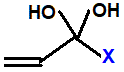 , condensed abbreviated formula, skeletal formula
Two functional groups, 2 alcohol groups
(diol) and an alkene group, an unsaturated alcohol.
Carbon atom 1 is chiral resulting in R/S
isomers
1-fluoroprop-2-ene-1,1-diol,
1-chloroprop-2-ene-1,1-diol, 1-bromoprop-2-ene-1,1-diol,
1-iodoprop-2-ene-1,1-diol
Number of low resolution
NMR chemical shift
δ
signal peaks: 3 1H
and 3 13C
(email
if disagree?)
1H NMR ratio of peak areas: 2 : 1 : 2
(1+1) (for equivalent protons)
BUT, for the 'end' =CH2 alkene protons,
you can get two chemical shifts close together, if there are two
different groups attached to the other carbon of the C=C bond i.e. R"R'C=CH2 where
R" and R' are different. This causes the
two =CH2 protons to experience slightly different fields.
(14 onwards) There are lots more isomers of C3H5XO2,
despite what you might read on the internet!
There are definitely more halogenated alkene-diols
like (12) and (13)
i.e. similar to (12) and (13), theoretically you can have 3-halocyclopropane-1,2-diol
molecules that can exhibit both R/S and E/Z isomers - a case of complex
stereoisomerism.
Similar to (9)
HOCHX-CO-CH3, which gives
1-halo-1-hydroxypropanone isomers
Similar to (10)
HOCHX-CH2-CHO, which gives
3-halo-3-hydroxypropanal isomers
Similar to (11)
X-CH2-CH(OH)-CHO, which gives
3-halo-2-hydroxypropanal isomers
You can also have theoretically,
3-halocyclopropane-1,2-diol isomers.
(?) Other isomers? If you spot any, let me know, I think
there are quit a lot of them!
Extra notes on uses of
selected isomers of
C3H5FO2 , C3H5ClO2
,
C3H5BrO2
and
C3H5IO2
These
extra notes focus on the uses of halogenated carboxylic acids and esters
Functional Group Overview for selected
isomers of
C3H5FO2 , C3H5ClO2
,
C3H5BrO2
and
C3H5IO2
|
Functional
Group |
General
Properties & Applications |
|
Carboxylic
Acids |
Acidic, reactive;
used in drug synthesis, polymers, and agrochemicals |
|
Esters |
Fruity-smelling;
used in flavours, fragrances, solvents, and plastics |
|
Aldehydes |
Reactive; used in
perfumes, resins, and as intermediates |
|
Ketones |
Stable; used as
solvents, in pharmaceuticals, and in polymer chemistry |
Applications by Molecular Formula
1. C3H5FO2
– Fluorinated Compounds
-
Carboxylic Acid (e.g., 2-fluoropropanoic acid):
-
Ester (e.g., methyl 2-fluoropropanoate):
C3H5FO2
– Fluoropropanoic Acid Isomers
Example Isomer: 2-Fluoropropanoic acid
Applications:
-
Pharmaceuticals: Used as a precursor in the
synthesis of antiviral and anticancer drugs, including intermediates for
NSAIDs.
-
Agrochemicals: Serves as a building block
for herbicides, fungicides, and insecticides.
-
Organic Synthesis: Acts as a reagent for
introducing fluorine into molecules, enhancing metabolic stability and
bioactivity.
-
Fragrance & Flavour Industry: Used in the
synthesis of aroma compounds.
-
Solvent Use: Occasionally employed in
specialized organic reactions.
2. C3H5ClO2
– Chlorinated Compounds
-
Carboxylic Acid (e.g., 2-chloropropanoic acid):
-
Ester (e.g., ethyl 2-chloropropanoate):
C3H5ClO2
– Chloropropanoic Acid Isomers
Example Isomer: 2-Chloropropanoic acid
Applications:
-
Pharmaceutical Intermediates: Used in the
synthesis of drugs and fine chemicals.
-
Agrochemicals: Functions as a precursor for
herbicides and plant growth regulators.
-
Organic Synthesis: Useful for preparing
esters and amides.
-
Industrial Chemicals: Involved in polymer
and resin production.
-
Caution: Corrosive and toxic; requires
careful handling.
3. C3H5BrO2
– Brominated Compounds
-
Carboxylic Acid (e.g., 3-bromopropanoic acid):
-
Ester (e.g., methyl 3-bromopropanoate):
C3H5BrO2
– Bromopropanoic Acid Isomers
Example Isomers: 2-Bromopropanoic acid,
3-Bromopropanoic acid
Applications:
-
Pharmaceuticals: Used in the synthesis of
antihypertensives, sedatives, and antiepileptic drugs.
-
Agrochemicals: Precursor for pesticides
such as diflufenacil and furalax.
-
Dyes & Polymers: Involved in the
manufacture of specialty dyes and polymeric materials.
-
Organic Synthesis: Introduces bromine
functionality for further derivatization.
-
Research: Studied for its potential in
metabolic and neurological disorder treatments.
4. C3H5IO2
– Iodinated Compounds
-
Carboxylic Acid (e.g., 3-iodopropanoic acid):
-
Ester (e.g., ethyl 3-iodopropanoate):
C3H5IO2
– Iodopropanoic Acid Isomers
Example Isomer: 3-Iodopropanoic acid
Applications:
-
Pharmaceuticals: Intermediate in the
synthesis of drugs targeting neurological and metabolic pathways.
-
Agrochemicals: Used in the development of
iodinated pesticides and herbicides.
-
Materials Science: Applied in the
production of polymers, resins, and specialty materials.
-
Organic Synthesis: Valuable for introducing
iodine into molecules, facilitating further functionalization.
-
Research & Development: Widely used in
chemical biology and medicinal chemistry labs.
Summary Table of some uses of selected isomers of
C3H5FO2 , C3H5ClO2
,
C3H5BrO2
and
C3H5IO2
|
Formula |
Functional
Group |
Example
Compound |
Applications |
|
C3H5FO2 |
Carboxylic Acid |
2-Fluoropropanoic
acid |
Drugs,
agrochemicals |
|
|
Ester |
Methyl
2-fluoropropanoate |
Flavours, solvents |
|
C3H5ClO2 |
Carboxylic Acid |
2-Chloropropanoic
acid |
Herbicides, pharma
intermediates |
|
|
Ester |
Ethyl
2-chloropropanoate |
Flavouring,
plasticizers |
|
C3H5BrO2 |
Carboxylic Acid |
3-Bromopropanoic
acid |
Neurology, drug
synthesis |
|
|
Ester |
Methyl
3-bromopropanoate |
Specialty
chemicals |
|
C3H5IO2 |
Carboxylic Acid |
3-Iodopropanoic
acid |
Radiolabeling,
imaging |
|
|
Ester |
Ethyl
3-iodopropanoate |
Organic synthesis,
tracers |
Associated organic chemistry links
Index of sets of isomers for a given
molecular formula
Isomerism: introduction, structural isomerism - chain,
positional, functional group, tautomerism
Stereoisomerism:
introduction, definition,
priority rules, E/Z isomerism (cis/trans isomerism)
Stereoisomerism - R/S isomerism (optical
isomerism) -
definition - examples explained
Index of all IR, mass, 1H NMR
and 13C NMR spectroscopy
pages
This is a big chemistry website, please allow time
to explore
Index of advanced
(pre-university) organic
chemistry revision notes
The chemistry of
alkanes and the petrochemical
industry
The
chemistry of alkenes
The
chemistry of organic halogen compounds
The
chemistry of
alcohols
The chemistry of aldehydes
and ketones
The
chemistry of carboxylic acids and derivatives
The chemistry of organo-nitrogen compounds
The chemistry of
aromatic compounds
Keywords or phrases: how many
isomers are there of molecular formula C3H5FO2 C3H5ClO2 C3H5BrO2 C3H5IO2? how to draw the
skeletal formula of C3H5FO2 C3H5ClO2 C3H5BrO2 C3H5IO2 isomers, how do you name the isomers of
molecular formula C3H5FO2 C3H5ClO2 C3H5BrO2 C3H5IO2? what is the molecular structure of the
isomers of C3H5FO2 C3H5ClO2 C3H5BrO2 C3H5IO2, what type of isomerism is exhibited by molecules
of formula C3H5FO2 C3H5ClO2 C3H5BrO2 C3H5IO2, how do you work out the isomers of molecular
formula C3H5FO2 C3H5ClO2 C3H5BrO2 C3H5IO2, what are the structural isomers of C3H5FO2 C3H5ClO2 C3H5BrO2 C3H5IO2, the carbon
chain isomers of C3H5FO2 C3H5ClO2 C3H5BrO2 C3H5IO2 in the homologous series how many structural isomers of
C3H5FO2 C3H5ClO2 C3H5BrO2 C3H5IO2 can you draw? how many structural isomers does C3H5FO2 C3H5ClO2 C3H5BrO2 C3H5IO2 have?
what are the possible isomers of C3H5FO2 C3H5ClO2 C3H5BrO2 C3H5IO2? revision notes on
isomerism of C3H5FO2 C3H5ClO2 C3H5BrO2 C3H5IO2 molecules, isomerism in
compounds of C3H5FO2 C3H5ClO2 C3H5BrO2 C3H5IO2 how to draw the
structural formula of isomers of C3H5FO2 C3H5ClO2 C3H5BrO2 C3H5IO2, how to draw the skeletal formula of
isomers of C3H5FO2 C3H5ClO2 C3H5BrO2 C3H5IO2, how to name the isomers of molecular formula C3H5FO2 C3H5ClO2 C3H5BrO2 C3H5IO2,
are there any R/S optical isomers
enantiomers of C3H5FO2 C3H5ClO2 C3H5BrO2 C3H5IO2 are there any E/Z isomers
cis trans stereoisomers of C3H5FO2 C3H5ClO2 C3H5BrO2 C3H5IO2
How do you work out the structure
of the isomers of molecular formula C3H5FO2 C3H5ClO2 C3H5BrO2 C3H5IO2? How do you draw the structural
formula and skeletal formula of the isomers of molecular formula
C3H5FO2 C3H5ClO2 C3H5BrO2 C3H5IO2? How do you name the isomers of molecular formula
C3H5FO2 C3H5ClO2 C3H5BrO2 C3H5IO2? How many positional isomers are
there of molecular formula C3H5FO2 C3H5ClO2 C3H5BrO2 C3H5IO2? Are there any functional group
isomers with a molecular formula C3H5FO2 C3H5ClO2 C3H5BrO2 C3H5IO2?
Does C3H5FO2 C3H5ClO2 C3H5BrO2 C3H5IO2 have any stereoisomers?
Website content © Dr
Phil Brown 2000+. All copyrights reserved on revision notes, images,
quizzes, worksheets etc. Copying of website material is NOT
permitted.
|
