|
Doc Brown's
Advanced Chemistry: Part 14.7
Isomers of a given molecular formula
22
constitutional structural isomers of molecular formula
C10H14
with a benzene ring
[Author
©
Dr
Phil Brown PhD:
Doc Brown's advanced level organic chemistry exam revision notes
suitable for students of UK advanced level chemistry courses, IB advanced
chemistry & US K12 grades
11-12 and AP honors chemistry courses: Molecular
spectroscopy and analysing the isomers of C10H14
[page updated Mar
1st
2026 *]
Index of sets of isomers for a given
molecular formula
email doc
brown - comments - query?
*
[privacy policy, cookies
and disclaimer]
Associated organic chemistry page links
This is a big chemistry website, please allow time
to explore it
Introduction to 22 aromatic constitutional-structural isomers of molecular formula
C10H14
with a benzene ring
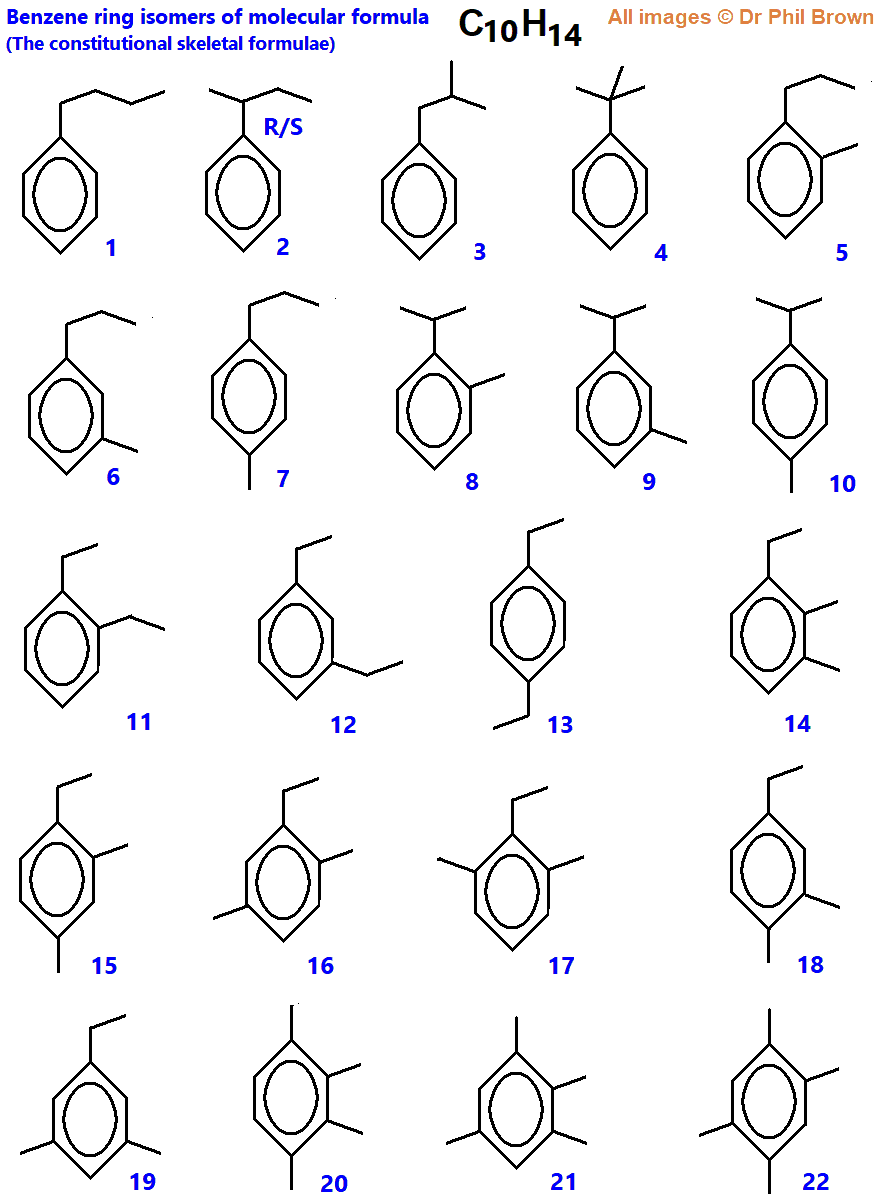
Introduction
to isomerism for aromatic compounds of molecular formula
C10H14
(see also summary
diagram)
Percent composition of
C10H14 based on atomic masses C= 12.01 H =
1.01 and Mr(C10H14) = 134.24
Element composition of
C10H14
aromatic molecules: carbon =
89.47%
hydrogen = 10.53%
Empirical formula =
C5H7
for molecular formula C10H14 of these aromatic
molecules
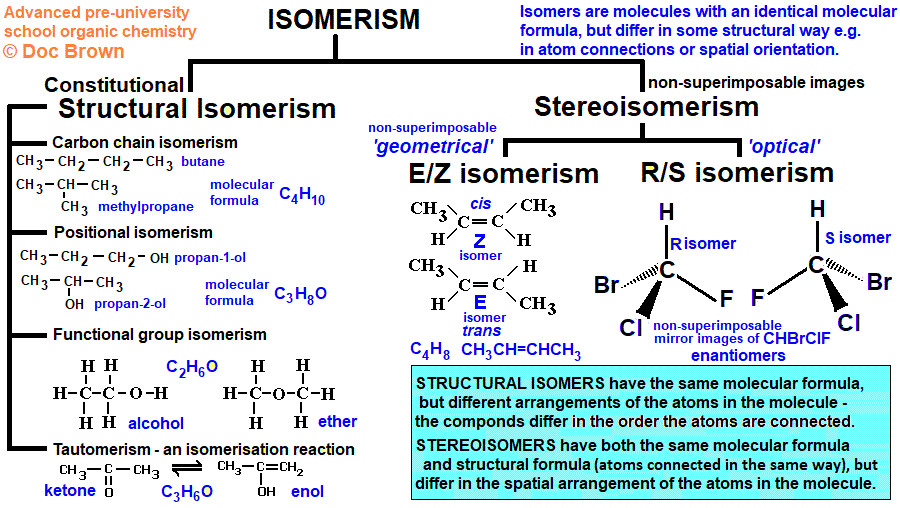
Structural isomerism
includes carbon chain variation (usually need a minimum of 4 C atoms),
change in position of a substituent or functional group and functional group
isomerism where the atoms have a different configuration, usually with
significant differences in chemical and physical properties.
The aromatic
isomerism of C10H14 described here is based on different carbon chain
arrangements, which, overlaps with the different positions of the alkyl
groups when there is more than one alkyl substituent in the C10H14 molecules
Stereoisomerism is
where molecules have the same basic constitutional structural formula, but
isomers differ in the 2D/3D arrangement of the atoms.
E/Z
stereoisomerism was called 'geometrical isomerism' e.g. cis
and trans isomers of alkenes or disubstituted cyclic alkanes
where there are 3D spatial variations due to restricted bond rotation that are not mirror images and not
super imposable.
Not applicable to the aromatic isomers of
C10H14 described
here.
R/S
stereoisomerism was called 'optical isomerism', the pairs of
isomers are called enantiomers which are 3D non-superimposable
mirror image forms of the molecule. The molecule must have a chiral centre
(a stereocentre), that is an asymmetric carbon atom with four
different atoms/groups attached to it.
There is
one example
of R/S optical isomerism No. (2) applicable to the aromatic isomers of
molecular formula C10H14 described here.
Details of the 22
structural-constitutional isomers of the benzene ring C9H12 aromatic molecules
The 22
C10H14
isomers I've identified are primarily considered as aromatic molecules -
aromatic hydrocarbons called arenes, in this case I've only
considered those molecules with a benzene ring.
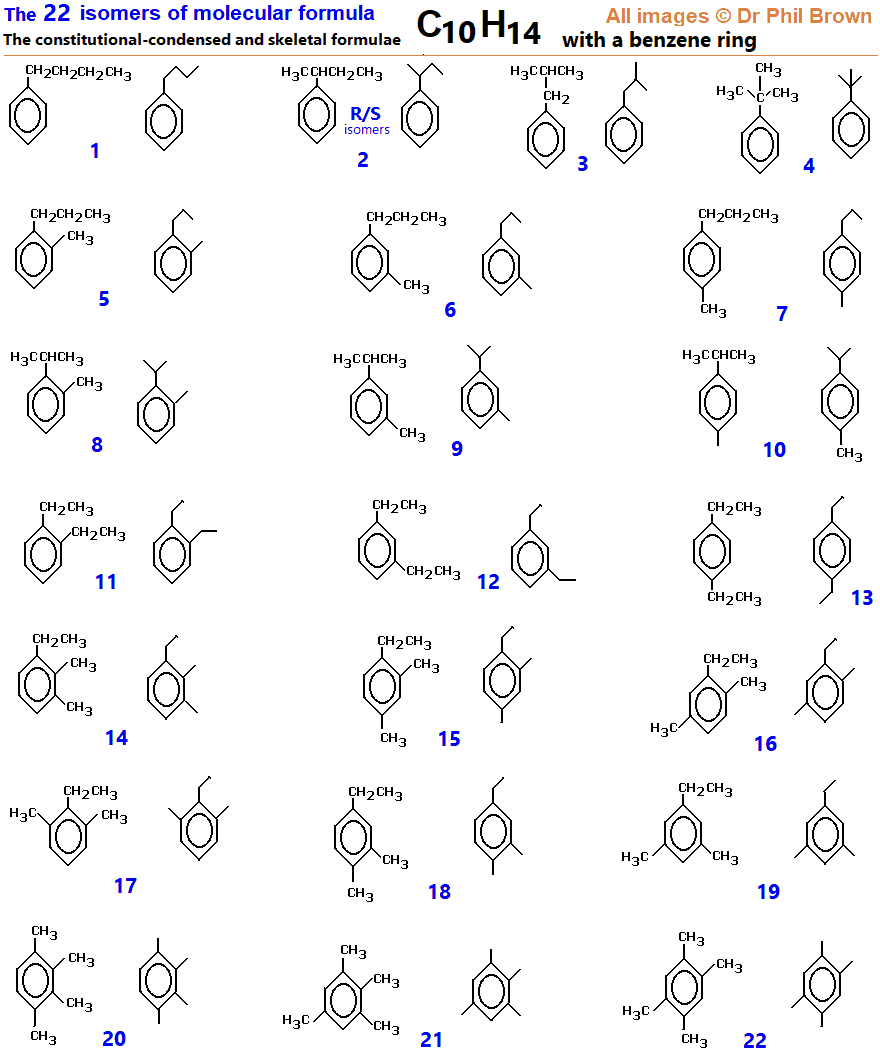
The abbreviated-condensed structural formula are shown
alongside the skeletal formula for the aromatic (benzene ring) isomers of
C10H14
(1) butylbenzene or 1-phenylbutane,

(2) (1-methylpropyl)benzene or 2-phenylbutane,

This is the only one of the 22 benzene ring
C10H14
isomers to exhibit
R/S optical isomerism.
The pair of enantiomers based on the first alkyl carbon
atom (chiral, asymmetric) directly attached to the benzene ring.
(3) (2-methylpropyl)benzene or
2-methyl-1-phenylpropane,

(4) (1,1-dimethylethyl)benzene,

(5)
1-methyl-2-propylbenzene,
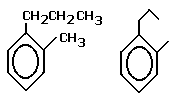
(6)
1-methyl-3-propylbenzene,

(7)
1-methyl-4-propylbenzene,

(8) 1-methyl-2-(1-methylethyl)benzene,
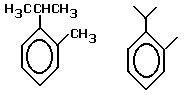
(9) 1-methyl-3-(1-methylethyl)benzene,

(10) 1-methyl-4-(1-methylethyl)benzene,
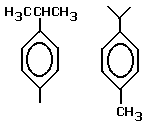
(11) 1,2-diethylbenzene,
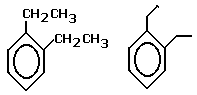
(12) 1,3-diethylbenzene,
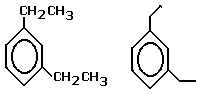
(13) 1,4-diethylbenzene,
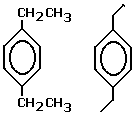
(14) 1-ethyl-2,3-dimethylbenzene,
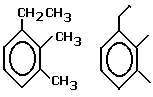
(15) 1-ethyl-2,4-dimethylbenzene,
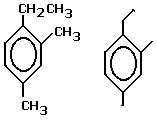
(16) 1-ethyl-2,5-dimethylbenzene or
2-ethyl-1,4-dimethylbenzene,
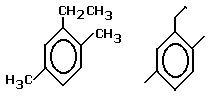
(17) 1-ethyl-2,6-dimethylbenzene or
2-ethyl-1,3-dimethylbenzene,
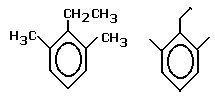
(18)
1-ethyl-3,4-dimethylbenzene or
4-ethyl-1,2-dimethylbenzene,

(19) 1-ethyl-3,5-dimethylbenzene or
3-ethyl-1,5-dimethylbenzene,
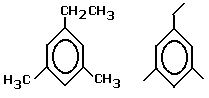
(20) 1,2,3,4-tetramethylbenzene,
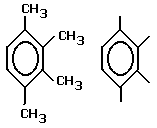
(21) 1,2,3,5-tetramethylbenzene,

(22) 1,2,4,5-tetramethylbenzene,

Other non-aromatic
isomers of C10H14
(i.e.
C10H14
isomers with no benzene ring)
There are potentially hundreds of other 'non-aromatic'
isomers of formula C10H14, though many of these isomers are highly reactive
and very unstable and some may not exist at all (except
theoretically!).
Gopalpur Nagendrappa of Bangalore University, India has come up
with 217 theoretical isomers of C6H6 at
https://www.ias.ac.in/article/fulltext/reso/006/05/0074-0078 wow !!!!,
so goodness knows how many theoretical isomers there are of formula
C10H14.
See also at the commercial molport website for isomers of
C10H14
https://www.molport.com/shop/molecular-formula/C10H14
BUT, beware, the website uses Kekule formulae for
benzene ring compounds and mixes condensed structural formulae with
skeletal formulae, so take care when interpreting these C9H14 isomer
formulae.
EXTRA NOTES on benzene ring isomers of C10H14
Overview of isomers of
C10H14
C10H14 aromatic arenes containing a single
benzene ring are alkylbenzenes whose substituents together contribute four
carbon atoms and eight hydrogens.
The principal structural families are: butylbenzene isomers
(one C4 alkyl on the ring) and ethyl‑propyl benzene isomers (one ethyl and
one propyl on the ring).
These isomers are nonpolar, lipophilic liquids with similar
core aromatic reactivity (electrophilic aromatic substitution), but they
differ in volatility, steric effects, and how they are used industrially.
Principal isomer families and names for
C10H14
(Each disubstituted combination produces ortho, meta, para
ring positional isomers when substituents are on different ring carbons;
nomenclature and position affect properties and applications.)
Key physical and chemical differences
of isomers of C10H14
-
Boiling point and volatility: more branched alkyl groups
(tert‑butyl, isopropyl) lower intermolecular packing and often slightly
lower boiling points than linear analogues; positional isomers on the ring
give modest bp differences.
-
Steric effects: bulky groups (tert‑butyl) strongly influence
regioselectivity in further reactions and reduce access to the ring.
-
Electronic effects: alkyl groups are weak electron donors by
hyperconjugation; having two substituents (ethyl+propyl) increases ring
activation toward electrophilic aromatic substitution relative to a single
butyl substituent.
-
Solubility and lipophilicity: all are nonpolar, good
solvents for nonpolar organics; branching slightly reduces density and
viscosity differences.
Typical uses and applications by isomer type for
C10H14
-
n‑Butylbenzene and linear ethyl‑n‑propyl isomers
-
Uses: solvent in coatings and
adhesives, intermediate in fine chemical synthesis, feedstock for
alkylation/hydrogenation steps in petrochemical processes.
-
Rationale: lower steric hindrance makes
them convenient alkylating or Friedel–Crafts starting materials and good
nonpolar solvents.
-
Branched isomers (isobutylbenzene, sec‑butylbenzene,
tert‑butylbenzene, ethyl‑isopropylbenzene)
-
Uses: precursors to fragrances and
specialty chemicals, intermediates for producing substituted phenols or
anilines after functional group transformation, laboratory reagents.
-
Rationale: branching alters door
character (important for aroma chemistry), gives different
reactivity/selectivity in catalysed transformations and provides steric
protection in multi‑step syntheses.
-
Disubstituted ethyl + propyl isomers (ortho/meta/para)
-
Uses: tuned intermediates for targeted
syntheses (para often preferred for symmetric functionalization),
components in complex formulations and as building blocks for
detergents, polymers, plasticisers after further modification.
-
Rationale: substitution pattern
controls directional chemistry for later transformations and physical
properties (melting/boiling).
-
General industrial roles across isomers
-
Fuel and petrochemical streams: present
as components in gasoline fractions or reformates, contributing to
octane characteristics.
-
Laboratory and R&D: test compounds for
mechanistic, spectroscopic, and catalysis studies because they are
simple alkylbenzenes with tunable sterics.
-
Safety and environmental note: all are
flammable volatile organics with potential health and environmental
hazards; handled with typical hydrocarbon precautions.
Comparison table of representative isomers of
C10H14
|
Isomer |
Structure type |
Typical
uses |
Key
property difference |
|
n‑Butylbenzene |
linear C4
side chain |
solvent; synthetic
intermediate |
higher boiling, less
steric hindrance |
|
sec‑Butylbenzene |
secondary
C atom attached |
intermediate for
synthesis |
moderate steric
hindrance; altered reactivity |
|
isobutylbenzene |
branched
primary with methyl branch |
fragrance
intermediate; specialty chemistry |
lower bp than linear;
distinct door profile |
|
tert‑Butylbenzene |
tertiary C
attached (bulky) |
sterically protected
intermediates; scent applications |
greatest steric bulk;
reduced ring accessibility |
|
ethyl‑n‑propylbenzene |
two linear
substituents |
petrochemical
intermediate; solvent |
increased activation
of ring; higher lipophilicity |
|
ethyl‑isopropylbenzene |
ethyl +
branched propyl |
fine chemical
precursors; tailored fragrances |
combined branching
effects, altered selectivity |
Sources: industry-standard roles for alkylbenzenes and
general organic reactivity knowledge.
Practical guidance for selecting an isomer for an application
-
For maximum reactivity in electrophilic aromatic
substitution choose more electron‑donating and less sterically hindered
isomers (linear alkyls, disubstituted activating patterns).
-
For steric protection or to direct reactions away from the
ring choose bulky substituents (tert‑butyl).
-
For fragrance or flavor intermediates test branched isomers
first because branching strongly changes door character.
-
For solvent use pick linear isomers for slightly higher
boiling point and solvency for long‑chain organics.
Short summary
of C10H14
All C10H14 arenes with a benzene ring
are useful nonpolar hydrocarbons acting as solvents, petrochemical
components, and chemical intermediates.
The main practical differences come from branching (steric
and boiling point effects) and substitution pattern (mono‑ versus
disubstituted; ortho/meta/para), which determine reactivity, selectivity in
downstream chemistry, and sensory properties for fragrance applications.
Learning objectives - questions to be answered?
What are the
structural-constitutional isomers of C10H14?
What arene isomers have the
formula C10H14?
Draw and name the alkylbenzene isomers of C10H14
What aromatic hydrocarbons have the formula C10H14?
What benzene ring
molecules have the formula C10H14?
Can you write out the names of the aromatic isomers of formula
C10H14?
What are the possible
isomers of C10H14 aromatic molecules?
How do you work out the structure
of the isomers of molecular formula C10H14 aromatic molecules?
How do you draw the structural
formula and skeletal formula of the isomers of molecular formula
C10H14 aromatic molecules?
How do you name the isomers of molecular formula
C10H14 aromatic molecules?
How many structural
isomers are there of molecular formula C10H14 aromatic molecules?
How many carbon chain
isomers are there of molecular formula C10H14 aromatic molecules?
How many positional isomers are
there of molecular formula C10H14 aromatic molecules?
Are there any functional group
isomers with a molecular formula C10H14 aromatic molecules?
Do C10H14 aromatic molecules have any stereoisomers?
Are there any E/Z (geometrical)
aromatic isomers with a molecular formula C10H14?
Are there any R/S (optical)
aromatic isomers
(enantiomers) with a molecular formula C10H14?
This page will answer these questions
for molecular formula C10H14 aromatic molecules
Associated organic chemistry links
Index of sets of isomers for a given
molecular formula
Molecular structure and nomenclature of aromatic
compounds
The chemistry of aromatic compounds
All my advanced Level pre-university
organic chemistry notes
IR, mass and H-1 and C-13 NMR
spectra of organic compounds
Isomerism: introduction, structural isomerism - chain,
positional, functional group, tautomerism
Stereoisomerism:
introduction, definition,
priority rules, E/Z isomerism (cis/trans isomerism)
Stereoisomerism - R/S isomerism (optical
isomerism) -
definition - examples explained
This is a big chemistry website, please allow time
to explore it
Summary diagram for
C10H14 benzene ring isomers and
diagram link to details of all types of isomerism
Both the structural formula and skeletal formula are shown
here.
|
Website content © Dr
Phil Brown 2000+. All copyrights reserved on revision notes, images,
quizzes, worksheets etc. Copying of Doc Brown's pre-university
advanced level chemistry website material is NOT
permitted. Exam revision summaries & references to science course specifications
are unofficial. These organic chemistry revision notes on
isomerism are
suitable for use of pre-university students studying AQA advanced level
chemistry, Edexcel advanced level chemistry, OCR advanced level
chemistry, IB advanced level chemistry, WJEC (Eduqas) advanced level
chemistry, CIE advanced level chemistry, US grade 11-12 AP honors
chemistry courses and they will also prove useful to
1st year undergraduate students of chemistry. |
Keywords or phrases: how many isomers are
there of molecular formula C10H14 aromatic molecules? how do you name the isomers of
molecular formula C10H14 aromatic molecules? what is the molecular structure of the
isomers of C10H14 aromatic molecules, what type of isomerism is exhibited by molecules
of formula C10H14 aromatic molecules, the carbon chain
isomers of C10H14 aromatic molecules, comparing
the spectra of isomers of molecular formula C10H14 aromatic
molecules how many structural isomers of
C10H14 aromatic molecules can you draw? how many structural isomers does
C10H14 aromatic molecules have?
what are the possible isomers of C10H14 aromatic molecules? revision notes on
isomerism of C10H14 aromatic molecules the molecular structure of
the isomers of C10H14 aromatic molecules how to draw the
structural formula of isomers of C10H14 aromatic molecules, how to draw the displayed
formula of isomers of C10H14 aromatic molecules, how to draw the
skeletal formula of isomers of C10H14 aromatic molecules, how to name the isomers of molecular formula
C10H14 aromatic molecules,
R/S optical isomers
enantiomers of C10H14 aromatic molecules cycloalkenes and alkynes R/S
optical isomers cis trans stereoisomers of C10H14 aromatic
molecules
E/Z geometrical isomers of molecular formula
C10H14 aromatic molecules (geometric cis/trans
isomers), molecules isomeric with molecular formula C10H14 aromatic
molecules, structural isomers of molecular
formula C10H14 aromatic molecules,
which types of isomerism are exhibited by molecules isomeric with
molecular formula C10H14 aromatic molecules alkyl positional isomers of
C10H14 aromatic molecules branched carbon chain alkene isomers of
C10H14 aromatic molecules,
positional isomers isomeric with molecular formula C10H14 aromatic
molecules,
which types of isomerism are exhibited by molecules isomeric with
molecular formula C10H14 aromatic molecules alkyl positional isomers of
C10H14 aromatic molecules cycloalkenes and alkynes branched carbon
chain cycloalkene isomers of molecular formula C10H14 aromatic
molecules
arenes of formula C10H14 aromatic hydrocarbons of formula C10H14
alkylbenzenes of formula C10H14
|
