|
Part 5.
The chemistry of
ALDEHYDES and KETONES - REDUCTION
[Author
©
Dr Phil Brown PhD:
Doc Brown's advanced level organic chemistry exam revision notes
suitable for students of UK A level chemistry courses & US K12 grade
11, grade 12 and AP honors chemistry courses: The chemistry of
aldehydes & ketones
[page updated
April 8th 2026 *]
Email doc
brown query? comment?
*
[privacy policy, cookies
and disclaimer]
All advanced A level organic
chemistry notes
All
revision notes on the chemistry of aldehydes and ketones
Part 5.5
Reduction of aldehydes, ketones and nitriles
Reduction of aldehydes to primary
alcohols and ketones to secondary alcohols
Examples of
nucleophilic addition of hydride to aldehydes and ketones to reduce
them to alcohols
These reactions are
essentially the reduction of the carbonyl group C=O to H-C-OH by the
nucleophilic addition of the equivalent of a hydride ion.
R2C=O + 2[H] ===> R2CHOH
(R = H or alkyl)
(1)
On reduction, aldehydes
give primary alcohols
RCHO
+ 2[H] ==> RCH2OH (R = H, alkyl or aryl)
e.g. (i) ethanal to ethanol:
CH3CHO + 2[H] ==> CH3CH2OH
or (ii)
 + 2[H] ===>

butanal + [hydrogen] ==>
butan-1-ol
The product will not exhibit
R/S isomerism, unless the original aldehyde exhibited R/S
isomerism.
The hydrogen, as a
hydride ion
(H-) attacks the δ+ carbon and is derived
from the reducing agent e.g.
NaBH4 sodium
tetrahydridoborate(III), (sodium borohydride)
The reduction of aldehydes and
ketones with NaBH4 can be carried out in water as the
solvent.
LiAlH4
lithium tetrahydridoaluminate(III), (lithium aluminium
hydride)
LiAlH4
is a more powerful reducing agent than NaBH4 and reacts
violently with water (and reacts with ethanol too), so the reaction must be carried out in an inert solvent
like ethoxyethane ('ether') - which must be dry!
The simplified equations above
apply. (mechanism lower down the page)
LiAlH4
is a more powerful reducing agent than NaBH4 because the
Al–H bond is weaker than the B–H bond. This fits in with the
aluminium atom having a larger radius than the boron atom giving a
longer weaker bond with hydrogen. Covalent radii: B = 0.080 nm (80
pm), Al = 0.125 nm (125 pm).
The initial product is the
salt is the alkoxide salt of the alcohol, but this is hydrolysed by
adding
dilute sulphuric acid which frees the alcohol.
R2CHO- + H+
===> R2CHOH
(R = H or alkyl)
(2)
On reduction, ketones
give secondary alcohols
ketone:
R2C=O
+ 2[H]
==> R2CHOH (R = alkyl or aryl)
e.g. (i) propanone to
propan–2–ol:
CH3COCH3 + 2[H] ==> CH3CH(OH)CH3
propan-2-ol does not exhibit R/S
isomerism, no chiral carbon in the molecule.
or (ii)
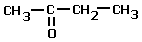 + 2[H] ===> + 2[H] ===>
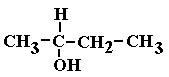
butan-2-one + [hydrogen]
==> butan-2-ol
The butan-2-ol has a chiral carbon
(asymmetric carbon atom) and can exhibit R/S isomerism ('optical
isomers', mirror image forms). It is likely to be a racemate (50:50)
mixture of the isomers because of the equal probability of nucleophilic
attack from 'above' or 'below' the plane of the >C=O bonding system (see
diagram below).
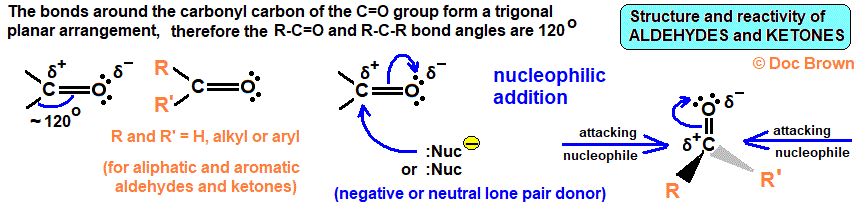
Note that butan-2 -one is an
unsymmetrical ketone, which will always give product that can exhibit
R/S isomerism, but symmetrical ketones will not give a product with a
chiral carbon atom and cannot exhibit R/S isomerism e.g.
pentan-3-one is reduced to
pentan-3-ol
CH3CH2COCH2CH3
+ 2[H] ===> CH3CH2CH(OH)CH2CH3
The notes on the reducing agent
methods are the same as for aldehydes above.
The reduction mechanism is very
complicated, but can be considered in a simplistic way as involving the
donation of a hydride ion (H-)
to the aldehyde/ketone.
An outline of the nucleophilic addition mechanism is
given below
(3)
Further comments on
methods of reduction and comparison with the reduction of alkenes
(i) The use of the reducing agent
NaBH4 is particularly important because it is a milder
reducing agent and selectively reduces an aldehyde or ketone group
and NOT a carboxylic acid group (unlike LiAlH4).
e.g. the reduction of a
carboxylic acid with an aldehyde of ketone functional group.
CH3-CO-CH2-COOH
+ 2[H] == NaBH4 ==> CH3-CH(OH)-CH2-COOH
CH3-CO-CH2-COOH
+ 6[H] == LiAlH4 ==> CH3-CH(OH)-CH2-CH2OH
+ H2O
O=CH-CO-CH2-COOH
+ 2[H] == NaBH4 ==>
HOCH2-CH(OH)-CH2-COOH
O=CH-CO-CH2-COOH
+ 6[H] == LiAlH4 ==>
HOCH2-CH(OH)-CH2-CH2OH
+ H2O
(ii) In industry, aldehydes and
ketones can be reduced with hydrogen gas and platinum catalyst
R2C=O + H2 == Pt ==> R2CHOH
(R = H or alkyl)
(iii) Alkenes can be reduced in the
same way, but they are not reduced by NaBH4 or LiAlH4
R2C=CR2 + H2 ==
Pt ==> R2CH-CHR2
(R = H or alkyl)
(iv) LiAlH4 is a reducing
agent that specifically reacts with polar pi bonds like those in
carbonyl compounds.
It will reduce the C=O not only
in aldehydes and ketones, but also in carboxylic acids (RCOOH) and
acid derivatives (e.g. RCOCl, RCOOR) and also the C≡N
group in nitriles.
(v) However, alkenes are not reduced
by NaBH4 or LiAlH4 because unlike the C=O bond,
the >C=C< double bond is not polar and will not be attacked by a
'hydride ion' - in fact, the pi bonding electrons of alkenes will tend
to repel nucleophiles.
TOP OF PAGE
What is the mechanism
for the reduction of aldehydes and ketones with sodium
tetrahydridoborate(III) or lithium tetrahydridoaluminate(III)?
Lithium
tetrahydridoaluminate(III)
(lithium aluminium hydride)
or sodium tetrahydridoborate(III) (sodium tetraborohydride)
reduce aldehydes to primary alcohols and ketones to secondary
alcohols.
very
simply the reaction is: RR'C=O + 2[H] ==> RR'CHOH
Aldehyde: R = H,
R' = H or alkyl)
or ketone: R and R' are either alkyl or
aryl, but NOT H.

mechanism 40
– nucleophilic addition of a hydride ion
(via
NaBH4 or LiAlH4) to an aldehyde or ketone
[mechanism
40 above] is a considerable simplification of the full mechanism.
R, R' = H, alkyl or aryl
In step
(1)
the AlH4– or BH4– ions
act as nucleophiles and donate the 'equivalent' of an electron
pair donating nucleophilic hydride ion
:H– to the positive carbon of the polarised carbonyl bond.
The hydrogen, as a
hydride ion (H-)
attacks the δ+ carbon.
A hydride ion is effectively the nucleophile - donating an
electron pair to a partially positive carbon atom (though the
full mechanism is quite complicated).
In step
(2)
the intermediate ion is a strong conjugate base and reacts with
any proton donor e.g. water (but can be an alcohol ROH or
acid H3O+) to form the alcohol
product.
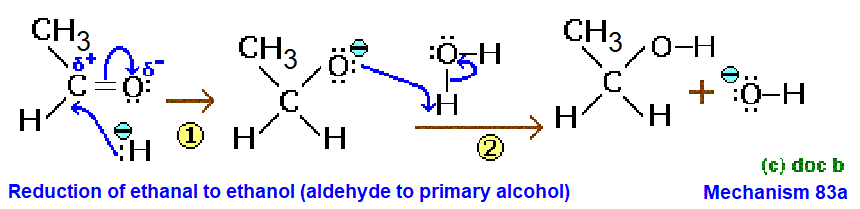
Mechanism 83a shows the reduction of
ethanal to ethanol (an aldehyde reduced to a primary alcohol) by a 'hydride
ion' derived from the reducing agents NaBH4 or LiAlH4.
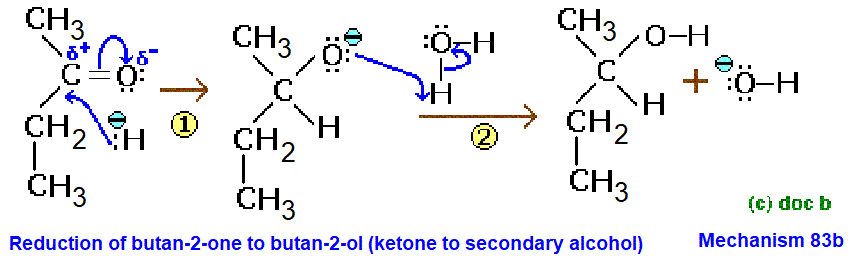
Mechanism 83b shows the reduction of
butan-2-one to butan-1-ol (a ketone reduced to a secondary alcohol) by a
'hydride ion' derived from the reducing agents NaBH4 or
LiAlH4.
The real
mechanism involves a step–wise replacement of the hydrogen atoms
on the reducing reagent with alkoxide groups (RR'CH–O–, e.g.
ethoxy CH3CH2–O– from reduced ethanal CH3CHO).
This happens because all the intermediates are themselves
nucleophilic agents. In the sequence X = B or Al and R2 = RR' for simplicity)
XH4–
+ R2C=O => [H3XO–CHR2]–
= R2C=O =>
[H2X(O–CHR2)2]–
= R2C=O =>
[HX(–OCHR2)3]– = R2C=O
=> [X(–OCHR2)4]–
Then the alkoxide complex reacts with any proton donor (depending on
reagent/reaction conditions e.g. the water/ethanol/ acid) to
free the alcohol.
[X(OCR2)4]–
+ water/acid/alcohol ===> 4R2CHOH + compound of X
TOP OF PAGE
Reduction of hydroxynitriles derived from hydrogen cyanide addition to aldehydes
and ketones
R2C=O + HC≡N
===> R2C(OH)C≡N
(R = H, alkyl or aryl)
RCH(OH)C≡N + 4[H] ===> RCH(OH)CH2NH2
Hydroxynitriles are reduced to hydroxylamines (which have
two functional groups - alcohol and amine).
The original hydroxynitrile also has two function group, the
hydroxy group is unchanged, but the nitrile group is reduced to the
amine/amino group.
The reaction can be done with the reducing agents:
LiAlH4
lithium tetrahydridoaluminate(III), (lithium aluminium
hydride)
Refluxing the nitrile with sodium metal in ethanol.
Hydrogen gas using a platinum catalyst
(industrial method)
Copying
of website material is NOT permitted. Exam revision summaries & references to
science course specifications are unofficial.
Website content © Dr Phil Brown 2000+. All
copyrights reserved on these organic chemistry exam revision
notes on mechanisms & reagents for reducing aldehydes & ketones, these A level chemistry revision notes are suitable for use of pre-university students studying AQA advanced level
organic chemistry revision notes on products of reducing aldehydes &
ketones, Edexcel advanced level
organic chemistry revision notes on mechanisms & reagents for
reducing aldehydes & ketones, OCR advanced level
organic chemistry revision notes on products of reducing aldehydes &
ketones, IB advanced level
organic chemistry revision notes on mechanisms & reagents for
reducing aldehydes & ketones, WJEC (Eduqas) advanced level
organic chemistry revision notes on products of reducing aldehydes &
ketones, CIE Cambridge advanced level
organic chemistry revision notes on mechanisms & reagents for
reducing aldehydes & ketones, CCEA advanced level organic chemistry revision
notes on products of reducing aldehydes & ketones, and useful for US grade 11
grade 12 AP honors organic chemistry courses involving mechanisms & reagents for
reducing aldehydes & ketones
Explaining the importance of products of reducing
aldehydes & ketones in organic chemistry, What you need to know about
mechanisms & reagents for reducing aldehydes & ketones for
organic chemistry, Explaining the use of products of reducing aldehydes &
ketones knowledge in organic chemistry, Examples of mechanisms & reagents for
reducing aldehydes & ketones explained when studying
organic chemistry, What is the significance of products of reducing aldehydes &
ketones in organic chemistry, What is the use of mechanisms & reagents for
reducing aldehydes & ketones in organic chemistry
Describing and explaining the theory of products of reducing aldehydes & ketones when studying organic chemistry, exam revision
notes for mechanisms & reagents for reducing aldehydes & ketones in exams, online help for products of reducing aldehydes &
ketones, revision notes for mechanisms & reagents for reducing aldehydes &
ketones, what do I need to learn about products of
reducing aldehydes & ketones for exams? revision summary for mechanisms &
reagents for reducing aldehydes & ketones, help to pass
exam questions on mechanisms & reagents for reducing aldehydes & ketones exam, how to
prepare for examination involving mechanisms & reagents for reducing
aldehydes & ketones?
|
