GCSE level organic chemistry exam revision notes: 7H to 7J
More on polymer uses, issues with using plastics, solutions and recycling & how to choose a polymer/plastic
for particular use and its application
[Author
©
Dr Phil Brown PhD:
Doc Brown's chemistry exam revision notes on
oil products &
organic chemistry - use of plastic/polymers,
suitable for students of UK GCSE Science level
AQA, Edexcel, OCR, WJEC and CCEA GCSE chemistry
courses, ~US grades 9-10 chemistry
[page updated Mar 16th 2026 *]
Sub-index for this page
All my
GCSE level chemistry revision
notes
All my GCSE level oil and organic chemistry revision
notes
All my advanced A level organic chemistry notes
email doc
brown - comments - query?
*
[privacy policy, cookies
and disclaimer]
 GCSE level m/c QUIZ on oil products & organic chemistry
(easier-foundation-level)
GCSE level m/c QUIZ on oil products & organic chemistry
(easier-foundation-level)
GCSE
level m/c QUIZ on oil products
& organic chemistry (harder-higher-level)
Sub-index
for this page
7H
More general comments on the uses of
polymer plastics
7I
Problems with using
polymer plastics: methods of recycling, disposing, pollution
e.g. PET, PVC etc.
7J
Highlighting three
specific problems associated with using and disposing of polymers or plastic
materials
7K
Biodegradable and compostable polymers -
these should break down due to bacterial activity
7L
The recycling case of PET/PVC and
other plastics - examples of reclamation
7M
Summary of advantages and disadvantages of recycling plastic polymers - the
'pros and cons'!
7N
Logistic exercise - choosing a plastic for a particular use
KEY POINTS for revision
(1)
Key points about the general usefulness of polymer applications
(2)
Key points about issues with using plastic polymers e.g. pollution,
disposal, recycling
(3)
Key points about the advantages and disadvantages of bioplastics
-biodegradable, compostable
(4)
Key points about the advantages and disadvantages of recycling plastic
polymers
(5)
key revision points on ideas of how to decide which polymer/plastic for
a particular use/application
|
All My synthetic
polymer-plastics revision notes pages (GCSE level)
Introduction
to addition polymers: poly(ethene), poly(propene), polystyrene, PVC, PTFE -
structure, uses
More on the
uses of plastics, issues with using plastics, solutions and recycling
methods
Introducing
condensation polymers: Nylon, Terylene/PET, comparing
thermoplastics, fibres, thermosets
AND Extra
notes for more advanced level organic chemistry students
Polymerisation of alkenes to addition polymers - structure, properties, uses of
poly(alkene) polymers
The manufacture, molecular structure, properties and uses of
polyesters
Amides
chemistry - a mention of
polyamides
The structure, properties and uses of
polyesters and polyamides involving aromatic monomers
The chemistry of amides
including Nylon formation, structure, properties and uses
Stereoregular polymers -
isotactic/atactic/syndiotactic poly(propene) - use of Ziegler-Natta
catalysts |
7H. More
general points on the USES OF
POLYMERS - Plastics
Polymers have many useful applications and new
uses and new polymers are being developed all the time
-
There are lots of examples!
- some described in
section 7B and more listed below (and described above) are on many
school syllabuses.
-
A wide range of
polymers are available for use in an even wider range of
applications, it seems endless these days from when I was a
chemistry student in the 1960s when some of the properties of these
new polymers were unthinkable! e.g. electrical conducting, light
sensitive etc.
-
Its important to realise
that polymer plastics are alternatives to traditional materials like
wood and metals and in many cases, if not completely, replacing them
on a large scale e.g. water pipes, window frames.
-
There physical
properties can range from being very rigid or
flexible-stretchy-elastic, very strong, easily moulded if gently
heated and pressed (thermoplastic) or set hard after moulding
and very heat resistant (thermoset).
-
Polymers vary
considerably in strength e.g. polyamides or nylons are much stronger
than poly(ethene) and can even be manufactured to provide a variety
of strengths and flexibilities (see example of
LDPE and HDPE commercial products of
'polythene').
-
Many metals have become
quite expensive so things made from plastics derived from oil and
quite cheap at the moment, but prices will rise as cheap oil gets
scarcer.
-
New
packaging materials which are light and stretchable.
-
Waterproof coatings for fabrics
-
Dental polymers for
tooth fillings
-
Wound dressings made
from hydrogels - polymers that hold water and keep wounds moist.
-
Smart
materials (including shape memory polymers)
eg 'memory foam' is a polymer that gets softer when it gets warmer
so you can make a mattress which adopts your body shape for
comfortable sleeping!
-
Elastic fibres that are
very stretchable to make tight fitting clothing eg Lycra fibres for
tights and sports clothing.
-
Heat resistant polymers
are usually thermosets e.g. like melamine resin (plastic plates),
but even thermoplastics like poly(propene) can be used in hot
situations e.g. plastic electric kettles.
-
Plastics are widely
used in the manufacture of cars and other road vehicles because
they are cheap to make of varied composition for a wide variety of
uses, they are light, durable and can be dyed any colour, they can
be flexible or rigid, and so can be used for e.g. used for internal
fittings e.g. dashboard cover, floor covers (can be rubber too),
door coverings, transparent and coloured covers over headlights and
brake lights, and the insulating sheathing for all the electrical
wiring.
-
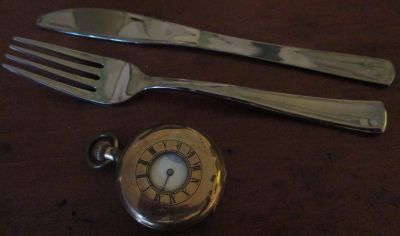 to redo photo
-
Plastics can be coated with all sorts of materials. This plastic
knife and fork are coated with a material that gives the impression
of being a silvery metal and is as bright and shiny as the brass case of the
old metal pocket watch.
-
Some polymer materials are
relatively soft and 'springy', these are called elastomers
e.g. rubber which can be stretched and deformed, but on release of
the tension, the material goes back to its original shape.
-
-
7I. Problems with using
polymer plastics: methods of recycling, disposing and pollution
7J Highlighting three
problems associated
with using and disposing of
polymers or plastic
materials
-
Polymers or plastics cannot be easily broken down by
micro-organisms
-
i.e. most, at the moment, most are NOT biodegradable
(non-biodegradable)
which leads to
waste disposal and other environmental problems eg
-
'Non-rotting' litter around the environment.
-
Land-fill sites are getting full
and recycling isn't as easy as it may seem. (see point 3.below)
-
Incineration i.e.
using waste plastic as fuel must be very efficient to avoid any other
pollution problem. (see point 2.)
-
Even our lakes, seas and
oceans are carrying waste plastic materials causing harmful effects on
wildlife.
-
Can we burn waste plastic?
-
When plastic materials burn they can
produce highly toxic gases such as carbon monoxide, hydrogen cyanide and
hydrogen chloride - particularly from PVC and other plastics containing
chlorine and nitrogen.
-
Combustion of waste plastics
contributes to global warming since carbon dioxide produced.
-
In a recycling-disposal
centre, you need very high
tech incinerators with sophisticated facilities to remove any
harmful gases or particles, plus monitoring technology - and then you
can release the smoke into the environment.
-
I've visited such a
recycling plant near Harrogate in North Yorkshire, England.
-
Its an impressive operation
and the 'organic' waste that cannot be recycled is burnt to provide
energy to generate electricity.
-
The plant generates 30MW of
electricity, the recycling centre runs off 5MW of electricity, so 25 MW
of power is put into the National Grid electricity supply.
-
Nothing is wasted, all
residues are found some use for!
-
The burning of plastic waste as a
fuel is sometimes referred to as 'energy recovery' and is appropriate if
you can do nothing else with combustible waste!
-
The toxic fumes from plastic
materials cause deaths in house fires and controversial problems with alleged inefficient waste incinerators as they will
definitely cause environmental problems if burned on waste tips!
-
 How
can we recycle plastics? What ways are used to recycle plastics? issues? How
can we recycle plastics? What ways are used to recycle plastics? issues?
-
It is highly desirable to
recycle plastics for several reasons
-
Less environmental impact
i.e. less unsightly pollution, reduction of volume of waste in land-fill
sites.
-
It conserves valuable oil
based resources, especially as oil is becoming increasingly expensive.
-
It is
difficult
to recycle plastics because of separation into the different types of plastics and their different physical properties.
-
BUT this should not prevent us from trying
and it would be beneficial to prolong the life of the finite crude
oil reserves AND reduce pollution and space in land-fill sites.
-
Research is ongoing to devise methods
of recycling plastics as 'new' chemical feedstock from which to
make useful organic chemical products.
-
There are problems in trying
to sort out the different plastics into useful categories, they are not
easy separate, you can't just use any old mixture of polymers.
-
At the moment, a lot may
have to be sorted by hand - lack of automation makes the sorting more
costly.
-
You also have the cost
of collecting domestic rubbish or industrial waste, transporting it
and sorting it all out, all of which costs money.
-
Manual sorting of plastic waste
is inefficient and labour intensive, but methods of sorting are
improving including optical scanning techniques to separate the
different types of plastic waster e.g. PET from HDPE and other
technologies can separate PVC from other plastics
-
However,
people are coming up with ideas. A company in Scarborough, England, is
collecting waste plastic. This is shredded and compressed into porous
pads and used for good 'underground' drainage layers for footpaths, golf
greens and sand bunkers etc. and has a good working life because the
material isn't biodegradable!
-
Clear soft drink bottles are
made from PET (polyethene/polyethylene terephthalate) which can be
recycled as fibre-fill for pillows and carpets.
-
This save 90% of the energy
costs compared to the original manufacturing process.
-
Energy costs are a big
economic recycling factor, its not just about making naturally occurring
resources like oil last longer.
-
However, it takes about
20,000 drinks bottles to make a tonne of recycled PET.
-
 In 1988 Australia issued
bank notes made from recycled poly(propene). These plastic notes
apparently have the advantage of being more difficult to forge and they
last longer! In 1988 Australia issued
bank notes made from recycled poly(propene). These plastic notes
apparently have the advantage of being more difficult to forge and they
last longer!
-
Other ideas include making
more durable plastic bags that can be used many times for shopping.
-
Ideally some recycled
thermoplastics and scrap material from a plastic product manufacturing
process, can be heated and remoulded in the same process or another
product.
-
You can also manufacture
plastics whose break down is initiated by exposure to sunlight. This is
particularly useful in agriculture where plastic bags of fertiliser are
in common use.
Test your self on GCSE level organic chemistry
QUIZ on oil products & organic chemistry
(easier-foundation-level)
QUIZ on oil products
& organic chemistry (harder-higher-level)
7K Biodegradable and compostable polymers -
these should break down due to bacterial activity
Degradable polymers will break
down in the environment from the effects of weathering or light
(particularly uv radiation), but very slowly due to their great
chemical stability.
Biodegradable polymers can be
broken down by the enzymes in microorganisms.
They often based on a polyester
structure (but NOT PET/Terylene) and are relatively easily hydrolysed
and broken down by the metabolic chemistry of microorganisms.
-
New bioplastics
are being developed which are
more biodegradable
or can be recycled, so will the
paper bag and cardboard package make a comeback? (in Ireland you have to
bring your own bag or buy one, and not necessarily a plastic one!), this
isn't a recycling process BUT it does reduce environmental pollution.
-
Hydrocarbon polymers like poly(ethene) or
poly(propene) containers have strong C-H and C-C bonds are strong and
non-polar so these polymers are not susceptible to chemical attack.
-
The same argument applies to PTFE with
its strong C-C and C-F bonds.
-
In fact the vast majority of synthetic
polymers are NOT biodegradable, because enzymes have not yet evolved in
microorganisms to break them down.
-
Polymers can be made more degradable by
including an additive that promotes breakdown by oxidation - makes the 'oxo-biodegradable'.
-
As well as this additive, thin films of
poly(ethene) and poly(propene) polymer formulations also include a
controlled amount of antioxidant that prevents the plastic breaking down too
soon! Once the antioxidant is used up, the polymer molecules will begin to
break down. This non-oxidation lifetime can be designed to be months or
years followed by the oxidative degradation in contact with the oxygen in
air, which itself may take months or years.
-
Where possible, these plastics are made
from renewable raw materials such as cellulose (from wood), lactic acid and
starch.
-
Bioplastics are manufactured by
non-hazardous methods and so better for the environment.
-
Waste bioplastic materials should
naturally degrade in the environment to water and carbon dioxide from
bacterial activity and not cause pollution and damage to the environment
e.g. avoiding unsightly litter and dangers to animals.
-
Compostable plastics have to meet strict
criteria and must break down to water, carbon dioxide, harmless
inorganic compounds and biomass residue i.e. degrade in the same way as any
other organic material added to a compost heap!
-
You can mix starch granules (very biodegradable) with plastics like poly(ethene) which enables
microorganisms to grow and feed in the plastic and may eventually help
biodegrade the plastic itself?
-
By breaking down the starch e.g. by
hydrolysis, the
microorganisms also break down the poly(ethene) into tiny particles
making less conspicuous litter, BUT, there is growing concern about the
effects of micro plastic particles on organisms in the environment.
-
You can make biobags and cutlery from
renewable and biodegradable cornstarch to replace non-biodegradable polythene bags. Many supermarket
bags are made from plant starch and since they are compostable, they can be
used as bin liners for collecting food waste - so they both compost
together!
-
Similarly, tableware such as plates, cups and food
bags can be manufactured from sugar cane fibre (a biodegradable natural polymer) replacing
non-biodegradable plastics like polystyrene.
-
Polylactic acid is biodegradable, can
be used for cold drink cups and biodegrades in 180 days.
-
Polyglycolic
acid is also biodegradable, it is quite easily broken down by hydrolysis
and decomposes in less than a month on a compost heap.
Extra advanced level note
Photodegradable polymers
These are synthetic polymers
specially designed to become weak and brittle when exposed to sunlight
for a long time - uv light of higher energy photons, has more effect
than visible light photons.
This can be facilitated by
incorporating light sensitive additives into the polymer formulation
that catalyse the breakdown of the polymer on absorption of uv
radiation.
Another way to achieve this effect is
to incorporate carbonyl bonds (>C=O) into the polymer chain structure.
The carbonyl groups in the
polymer chain absorb uv photons and break the polymer chain at that
point.
The initial product from
photodegradable polymers exposed to uv light, is a waxy mixture
which ultimately breaks down into carbon dioxide and water by
bacteria.
So the photodegradable polymer is
converted to biodegradable products!
Test your self on GCSE level organic chemistry
QUIZ on oil products & organic chemistry
(easier-foundation-level)
QUIZ on oil products
& organic chemistry (harder-higher-level)
7L The recycling case of PET/PVC and
other plastics - examples of reclamation
Recycling PET ('poly(ethylene
terephthalate)')
PET is a polyester used for
making plastic drinking bottles and made from the non-renewable resource
of crude oil.
If it can be recycled, you
save lots of energy and uses less of a valuable resource of organic
chemicals (oil) than if you were making a new quantity of PET.
To make PET, you have to
extract oil, fractionally distil it, chemically modify fractions to
produce molecules from which you can then make the monomers to
polymerise to make PET.
PET bottles can be recycled to make
other products including packaging materials, carpets and new bottles
themselves!
The PET objects must be
sorted out from other plastic waste.
They can then be shredded
and melted down to be moulded into other useful objects.
If PET wasn't recycled, it
would end up in a polluting space occupying land-fill site.
PET bottles can be recycled
e.g. in poorer countries, they can be filled with water unfit for
cooking and drinking, left out in bright sunlight. PET lets uv radiation
through which sterilises the heated water - the heat and uv radiation
kills many pathogens (bacteria, viruses, protozoa and worms).
Recycling PVC poly(chloroethene),
'polyvinyl chloride'
The recycling of PVC is
particularly awkward problem because its high content of chlorine in
the polymer structure and the process is uneconomic i.e. it costs
more to recycle than making 'new' PVC from the petrochemical
industry.
To avoid a build-up of PVC in
landfill sites, it has been incinerated, but this produces harmful
fumes that may enter the air environment e.g. fumes of highly acidic
fumes from hydrogen chloride, which are costly to remove from the
waste combustion gases.
However, there is a method being
developed that involves dissolving and separating PVC using a
solvent. High quality PVC is precipitated from the solvent for reuse
and the used solvent is recovered and recycled to be reused to
extract more PVC from waste.
Recycling Poly(ethene), 'polythene'
HDPE can be re-used to make hard
wearing tough plastic materials like waste bins, water butts and
plastic boxes/crates.
LDPE waste is recycled to make
plastic refuse sacks.
Recycling Poly(propene), 'polypropylene'
Poly(propene) can be recycled
by mechanical means. It can be sorted from other types of waste
plastic by hand - but, unfortunately, this is inefficient in
time/cosy and labour intensive.
However, the sorting can be done
automatically using infrared spectroscopy or flotation - the latter
uses the different densities of plastics to sort them.
After the separation, the
poly(propene) is shredded into flakes and processed into granules
which can be melted down and moulded into new items.
This process can be repeated
several times with significant degradation to the polymer structure
e.g. no loss of strength.
It is possible, in the absence of
air (oxygen), to thermally degrade waste poly(propene) at ~500oC
to produce a chemical feedstock similar to naphtha from the
fractional distillation of crude oil,
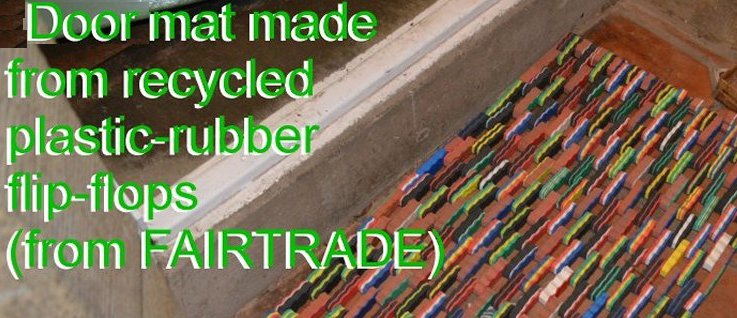
A nice example of recycling, a door
mat made from recycled plastic-rubber flip-flops, a present from a
friend who runs an outlet for the FAIRTRADE retail organisation.
See section
11. for the chemistry of making polyesters
like PET
Test your self on GCSE level organic chemistry
QUIZ on oil products & organic chemistry
(easier-foundation-level)
QUIZ on oil products
& organic chemistry (harder-higher-level)
7M
Summary of advantages and disadvantages of recycling plastic polymers - the
'pros and cons'!
|
Advantages |
Disadvantages |
|
1.
Reduces the quantity of oil needed - a finite resource |
1. Its
not easy, and expensive, to separate the different types of polymer
in a recycling centre - prior to be reformed in some way to make a
useful material |
|
2.
Reduces the quantity of non-biodegradable waste in land-fill sites |
2.
Mixing recycled plastics together reduces the quality of the plastic
material. |
|
3.
Reduces emissions of greenhouse gases if burned |
3.
Unlike with metals, its difficult to keep on recycling the same
polymer material e.g. the structure gets weaker |
|
4.
Recycling usually reduces the energy and resources needed to
replaced redundant materials |
4.
Processing waste plastic can produce obnoxious harmful gases - not
good for us or the environment - surely we have all smelt overheated
or burned plastic! |
|
5.
Recycling reduces costs, because of 4. above. |
|
See
also
Pollution
due to carbon monoxide etc.
Test your self on GCSE level organic chemistry
QUIZ on oil products & organic chemistry
(easier-foundation-level)
QUIZ on oil products
& organic chemistry (harder-higher-level)
7N.
Logistic exercise - choosing a plastic for a particular use
(this section is repeated
on the other GCSE
condensation polymer notes page)
How we use polymer compositions depends on
their properties, some are quoted in the data table below
So, below is a decision making
exercise on choosing a plastic for a particular job!
Note: NOT ALL the properties are
necessarily relevant to make the decision.
At the moment A to F match questions (a) to
(f) once only, but I may add further questions!
This exercise should provide a good challenge
and discussion for a class, any feedback comments appreciated.
|
Polymer product |
Production cost |
Chemical resistance |
Melting point |
Strength (rigidity) |
Transparency |
can be
made into fibres? |
|
A |
high |
high |
high |
high |
good |
no |
|
B |
low |
low |
high |
moderate |
poor |
no |
|
C |
low |
low |
low |
low |
opaque |
yes |
|
D |
low |
low |
low |
low |
poor |
no |
|
E |
high |
low |
high |
very
high |
opaque |
yes |
|
F |
low |
high |
high |
high |
poor |
no |
(a) Which plastic could
be used as for disposable tableware like plates for hot meals or coffee
cups?
(b) Which plastic could
be used as a moving plastic component in a machine?
(c) Which plastic could
used as containers for high volume production line of acids or alkalis?
(d) Which plastic could
be used as laboratory volume measuring instrument e.g. a syringe or
measuring cylinder
(e) Which plastic is
suitable for clothing fabrics?
(f) Which plastic would
be used for super-market carrier bags?
Answers near the end of the
page
Test your self on GCSE level organic chemistry
QUIZ on oil products & organic chemistry
(easier-foundation-level)
QUIZ on oil products
& organic chemistry (harder-higher-level)
(1)
Key points about the general usefulness of polymer applications
Polymers (especially plastics) are
synthetic or natural materials made from long chains of repeating units.
Their widespread use is due to their
versatile properties and adaptability across industries.
Key Advantages of
Polymers
- Lightweight:
Ideal for packaging, transport, and construction.
- Durable:
Resistant to corrosion, weathering, and many chemicals.
- Flexible or rigid:
Can be engineered for softness (e.g. cling film) or hardness (e.g. pipes).
- Electrical insulators:
Used in wiring, electronics, and safety equipment.
- Thermal insulators:
Useful in kitchenware, building insulation, and protective gear.
- Water-resistant:
Makes them suitable for waterproof clothing, containers, and coatings.
- Easily moulded:
Can be shaped into complex forms for medical devices, toys, and tools.
- Cost-effective:
Cheaper than many natural alternatives for mass production.
Student Tips
- Link properties to uses:
Always explain why a polymer is suitable for a specific
application.
- e.g. “Plastic pipes are used because
they are lightweight, waterproof, and resistant to corrosion.”
- Use comparative language:
“More flexible than metal”, “cheaper than glass”, etc.
- Avoid structural detail unless
asked: Focus on function,
not monomers or polymerisation.
- Practice application questions:
Many boards ask students to justify polymer use in unfamiliar contexts.
Common
Misconceptions
- “All plastics are the same”
→ Different polymers have different properties.
- “Plastics are always bad” →
Environmental issues are important, but not the focus here.
- “Polymers conduct electricity”
→ Most are insulators unless specially modified.
- “Polymers are naturally
occurring” → Most exam contexts refer to synthetic polymers.
(2)
Key points about issues with using plastic polymers e.g. pollution, disposal,
recycling
Plastic polymers pose environmental
challenges due to their durability and non-biodegradability.
You need to understand the sources,
impacts, and disposal methods of plastics, including recycling,
incineration, and landfill.
Core
Revision Summary: Plastic Polymers and Environmental Issues
What Are
Plastic Polymers?
- Polymers
are long-chain molecules made from monomers via
polymerisation.
- Most plastics are addition
polymers (e.g. poly(ethene), poly(propene)) made from
alkenes.
- Plastics are chemically inert
and non-biodegradable, meaning they persist in the
environment.
Environmental
Issues
- Landfill:
Plastics do not decompose, taking up space and potentially leaching
chemicals.
- Incineration:
- Releases CO2
(greenhouse gas).
- May produce toxic gases
(e.g. HCl from PVC).
- Risk of carbon monoxide
if incomplete combustion occurs.
- Ocean Pollution:
- Plastics harm marine life via
ingestion or entanglement.
- Microplastics can enter food chains.
- Visual pollution
and long-term ecosystem damage.
Disposal and
Recycling
- Landfill:
Cheap but unsustainable.
- Incineration:
Reduces volume, can generate energy, but pollutes.
- Recycling:
- Conserves resources and reduces
pollution.
- Requires sorting and cleaning.
- Not all plastics are recyclable due to
mixed compositions.
Student
Tips and Misconceptions
Tips
- Learn examples of polymers
and their monomers.
- Understand why plastics are
non-biodegradable (strong C–C bonds).
- Be able to compare disposal
methods with pros and cons.
- Use real-world examples
(e.g. PVC, PET) to anchor concepts.
Common
Misconceptions
- “All plastics can be recycled”
→ False. Some are thermosetting and cannot be remelted.
- “Burning plastics is clean”
→ False. It can release toxic gases.
- “Biodegradable means it disappears
quickly” → Misleading.
Biodegradation depends on conditions and time.
- “Recycling solves all problems”
→ Oversimplified. It reduces impact but doesn’t eliminate it.
Exam-Ready
Phrases and Concepts
- “Plastics are non-biodegradable due to
strong covalent bonds in their polymer chains.”
- “Incineration of plastics can release
harmful gases such as carbon monoxide and hydrogen chloride.”
- “Recycling reduces the need for raw
materials and lowers environmental impact.”
(3)
Key points about the advantages and disadvantages of bioplastics -biodegradable,
compostable
Bioplastics (biodegradable and
compostable polymers) are increasingly featured across GCSE/IGCSE chemistry
specifications.
Students must understand their
environmental impact, chemical structure, and disposal methods, along with
common misconceptions.
Test your self on GCSE level organic chemistry
QUIZ on oil products & organic chemistry
(easier-foundation-level)
QUIZ on oil products
& organic chemistry (harder-higher-level)
Summary
Revision Notes: Bioplastics in GCSE/IGCSE Chemistry
Core Concepts
Across Exam Boards
All major boards (WJEC, CCEA, CIE, AQA,
Edexcel, OCR Gateway, OCR 21st Century) include bioplastics under
organic chemistry, polymers, or
environmental chemistry. Key content includes:
- Definition of bioplastics:
Plastics derived from renewable biological sources (e.g. starch, cellulose).
- Biodegradable polymers:
Break down via microbial action into CO2,
water, and biomass.
- Compostable plastics:
A subset of biodegradable plastics that degrade under composting conditions
(heat energy, moisture, microbes).
- Addition versus condensation
polymerisation:
- Addition: Unsaturated monomers
(alkenes) form long chains.
- Condensation: Monomers with functional
groups (e.g. –OH, –COOH) form polymers with small molecule loss (e.g.
water).
- Environmental impact:
- Traditional plastics:
Non-biodegradable, persist in ecosystems.
- Bioplastics: Reduce landfill waste,
lower carbon footprint, but may require specific conditions to degrade.
Advantages of
Bioplastics
- Renewable feedstocks
(e.g. corn starch, sugarcane).
- Reduced reliance on fossil fuels.
- Lower carbon emissions
during production and disposal.
- Biodegradability
reduces long-term pollution.
- Compostable plastics
can enrich soil if properly processed.
Disadvantages
of Bioplastics
- Require industrial composting
(not always home-compostable).
- May contaminate recycling streams
if mixed with conventional plastics.
- Land use concerns:
Growing crops for plastic may compete with food production.
- Incomplete degradation
in natural environments (e.g. oceans).
- Cost and scalability:
Often more expensive than petrochemical plastics.
Student Tips
& Misconceptions
Common
Misconceptions
- “Biodegradable plastics break
down anywhere.”
➤ Reality: Many need specific conditions (temperature,
microbes) to degrade.
- “All bioplastics are
compostable.”
➤ Compostable plastics are a subset of biodegradable
plastics.
- “Bioplastics solve all pollution
problems.”
➤ They reduce impact but still require proper disposal and
infrastructure.
Exam Tips
- Use precise terminology:
distinguish between biodegradable, compostable, recyclable.
- Link polymer structure to
disposal method (e.g. inert C–C bonds resist degradation).
- Practice life cycle
assessments: compare environmental impact from production to
disposal.
- Know examples: poly(lactic
acid) (PLA), polycaprolactone (PCL), starch-based
polymers.
- Understand addition versus
condensation polymerisation mechanisms.
(4)
Key points about the advantages and disadvantages of recycling plastic
polymers
Recycling plastics is a key topic across all GCSE
and IGCSE chemistry specifications.
Students must understand the chemical,
environmental, and societal implications of recycling polymers, including
life cycle assessments and sustainability.
Summary
Revision Notes: Recycling Plastics & Polymers
Core
Concepts Across Exam Boards
All major boards (WJEC, CCEA, CIE, AQA, Edexcel, OCR
Gateway, OCR 21st Century) include recycling under polymers,
environmental chemistry, or using resources.
Key content includes:
Advantages
of Recycling Plastics
-
Reduces landfill waste and ocean
pollution
-
Conserves non-renewable resources (e.g.
crude oil)
-
Lowers energy use compared to producing
new plastics
-
Decreases greenhouse gas emissions
-
Supports circular economy and
sustainable development
Disadvantages
of Recycling Plastics
-
Sorting is difficult and costly
-
Contamination can reduce quality of
recycled products
-
Not all plastics are recyclable (e.g.
thermosetting polymers)
-
Downcycling: Recycled plastics may be
of lower quality
-
Energy still required for collection,
transport, and processing
Life
Cycle Assessment (LCA) & Sustainability
-
LCA evaluates environmental impact from
raw material extraction to disposal.
-
Stages: Raw materials → Manufacture →
Use → Disposal
-
Sustainability: Efficient use of
resources, minimal waste, and reduced environmental harm.
-
Recycling improves LCA outcomes by
reducing raw material use and emissions.
Student
Tips & Misconceptions
Common Misconceptions
-
“All plastics can be recycled.”
➤ Only thermoplastics can be remelted and reshaped;
thermosets cannot.
-
“Recycling uses no energy.”
➤ Recycling uses less energy than making new plastics,
but still requires energy.
-
“Recycled plastics are always high quality.”
➤ Recycled polymers may be weaker or more brittle due
to chain degradation.
Exam Tips
-
Use specific examples: e.g. PET
bottles, HDPE containers.
-
Link polymer structure to recyclability
(e.g. cross-links in thermosets prevent remelting).
-
Practice LCA comparisons: new
versus
recycled plastic.
-
Understand why recycling is not always
chosen (cost, contamination, infrastructure).
-
Use balanced arguments in
evaluation questions (e.g. “Evaluate the benefits of recycling
polymers”).
(5) key revision points on ideas on deciding which
polymer/plastic for a particular use/application
To choose a polymer for a specific use, students
must match the polymer’s properties to the demands of the application.
This is a common exam theme across all major GCSE/IGCSE boards. Below is
a structured, board-aligned summary with examples, tips, and
misconceptions.
Test your self on GCSE level organic chemistry
QUIZ on oil products & organic chemistry
(easier-foundation-level)
QUIZ on oil products
& organic chemistry (harder-higher-level)
Key
Revision Notes: Choosing Polymers for Applications
Core
Idea
Polymers are chosen based on their physical
properties, which arise from their structure and bonding.
These properties must suit the intended use.
Factors
to Consider
|
Property |
Why It Matters |
Example
Application |
|
Strength |
Withstands force
without breaking |
Nylon in ropes or
seatbelts |
|
Flexibility |
Bends without
breaking |
Poly(ethene) in
plastic bags |
|
Durability |
Resists wear and
tear |
Poly(propene) in
carpets |
|
Transparency |
Allows light
through |
Poly(ethene) in
cling film |
|
Waterproofing |
Prevents water
penetration |
PVC in raincoats |
|
Chemical
resistance |
Withstands
acids/alkalis |
PTFE (Teflon) in
non-stick pans |
|
Biodegradability |
Breaks down
naturally |
PLA in compostable
packaging |
Typical
Board-Specific Content Highlights
| Required
Understanding |
| Compare
properties of polymers to their uses (e.g. LDPE versus HDPE); link
to structure (branching, cross-links) |
| Describe how
polymer properties relate to monomer structure and bonding;
environmental impact of disposal |
| Identify polymers
from monomers; explain choice of polymer for a use based on
properties |
| Link polymer
structure to properties and uses; include thermosoftening versus
thermosetting plastics |
| Evaluate
materials for specific uses; compare polymers with alternatives
(e.g. paper versus plastic) |
| Understand how
polymer properties affect their use; environmental issues with
disposal |
| Describe uses of
polymers based on properties; include examples like
poly(ethene), poly(propene), PVC |
Student Tips
-
Use comparative language: e.g.
“Poly(propene) is more flexible than poly(styrene), making it better
for...”
-
Link structure to property: e.g. “LDPE
has branched chains → weaker forces → flexible.”
-
Know common polymers and uses:
-
Poly(ethene): plastic bags, bottles
-
Poly(propene): food containers, ropes
-
PVC: pipes, window frames
-
Polystyrene: packaging, insulation
-
Thermosoftening versus Thermosetting:
Common Misconceptions to Avoid
-
All plastics are the same: Different
polymers have different structures and properties.
-
Plastic is always bad: Some polymers are
recyclable or biodegradable.
-
Thermosetting plastics can be remoulded:
They cannot be reshaped once set.
-
Polymer names are interchangeable: Know
the difference between poly(ethene), poly(propene), etc.
Exam-Style Prompt
Examples
-
“Explain why poly(propene) is used for food containers
rather than poly(styrene).”
-
“Compare the properties of LDPE and HDPE and suggest
suitable uses for each.”
-
“Evaluate the use of biodegradable polymers in
packaging.”
Website content © Dr
Phil Brown 2000+. All copyrights reserved on revision notes, images,
quizzes, worksheets etc. Copying of website material is NOT
permitted. Exam revision summaries & references to science course specifications
are unofficial. Doc Brown's GCSE revision notes on oil
products and organic chemistry for UK IGCSE and GCSE level and US grade 9 and grade 10
examinations.
Doc Brown's school chemistry revision: GCSE
chemistry, IGCSE chemistry, O level chemistry & ~US grades 9-10 school science courses or equivalent for ~14-16 year old
chemistry students AND Doc Brown's Advanced A Level
Organic Chemistry Revision Notes - Help in Revising Advanced Organic Chemistry
INDEX of GCSE level notes on Products from
oil and Organic
Chemistry
|
Explaining importance of problems & methods
of recycling plastics issues
in GCSE level chemistry, What you need to know about problems & methods
of recycling plastics issues for
GCSE level
chemistry,
Explaining use of problems & methods of recycling plastics issues knowledge in GCSE level chemistry, Examples of
problems & methods of recycling plastics issues
explained when studying GCSE level chemistry, What is the significance
of problems & methods of recycling plastics issues in GCSE level chemistry, describing
explaining theory of problems & methods of recycling plastics issues when studying GCSE level chemistry, exam revision
notes for problems & methods of recycling plastics issues, online help for understanding
problems & methods of recycling plastics issues in GCSE
chemistry, what do I need to learn about problems & methods of recycling
plastics issues? what do I need to know
about problems & methods of recycling plastics issues for GCSE chemistry exams, how to prepare for questions on
problems & methods of recycling plastics issues in GCSE
chemistry examination? problems & methods of recycling plastics issues for
syllabus-specifications
for students taking the IGCSE/GCSE level chemistry examinations, summary
revision notes key points on problems & methods of recycling plastics
issues for students studying AQA
igcse/gcse chemistry notes on problems & methods of recycling plastics issues, Edexcel gcse
chemistry notes on problems & methods of recycling plastics issues, OCR 21st century GCSE
chemistry notes on problems & methods of recycling plastics issues, OCR gateway
GCSE chemistry notes on problems & methods of recycling plastics
issues, WJEC gcse chemistry notes on problems & methods of recycling
plastics issues, CCEA
gcse chemistry notes on problems & methods of recycling plastics issues, CIE Cambridge igcse
chemistry, notes on
problems & methods of recycling plastics issues useful for US grade 9-10 chemistry student courses
Test your self on GCSE level organic chemistry
QUIZ on oil products & organic chemistry
(easier-foundation-level)
QUIZ on oil products
& organic chemistry (harder-higher-level)
|
 For searching