|
GCSE level organic chemistry exam
revision notes: Part 6.
CRACKING oil fraction HYDROCARBONS
to produce more useful
products e.g. petrol and alkenes
[Author
©
Dr Phil Brown PhD:
Doc Brown's chemistry exam revision notes on
oil products & organic chemistry
- cracking oil fractions - why? how? and uses of cracking products?, suitable for students of UK GCSE Science level
AQA, Edexcel, OCR, WJEC and CCEA GCSE chemistry
courses, ~US grades 9-10 chemistry
[page updated Mar 16th 2026 *]
6. Cracking – a problem of supply and demand, more of the right fuels and other products
All my
14-16 GCSE level chemistry revision
notes
All my GCSE level oil and organic chemistry revision
notes
All my advanced A level organic chemistry notes
email doc
brown - comments - query?
*
[privacy policy, cookies
and disclaimer]
 GCSE level m/c QUIZ on oil products & organic chemistry
(easier-foundation-level)
GCSE level m/c QUIZ on oil products & organic chemistry
(easier-foundation-level)
GCSE
level m/c QUIZ on oil products
& organic chemistry (harder-higher-level)
For extra Advanced A Level notes on
cracking see
Modification of alkanes by
cracking, isomerisation and reforming
|
 6. CRACKING
a problem of Supply and Demand in the Oil
Industry! 6. CRACKING
a problem of Supply and Demand in the Oil
Industry!
6a.
Why do we need cracking?
There
isn't enough petrol in the original crude oil and crude oil doesn't have alkenes in
it for plastics but cracking reactions can help supply them! AND no left
over waste oil!
 Alkanes can be 'cracked' in a thermal decomposition
reaction to make more smaller more useful molecules because, quite simply,
we need a lot more petrol and diesel than is in crude oil AND the cracking
process make alkene molecules (NOT in oil) from which we
make many industrial chemicals and in particular polymer - plastic products. Alkanes can be 'cracked' in a thermal decomposition
reaction to make more smaller more useful molecules because, quite simply,
we need a lot more petrol and diesel than is in crude oil AND the cracking
process make alkene molecules (NOT in oil) from which we
make many industrial chemicals and in particular polymer - plastic products.
Cracking converts longer alkane hydrocarbon molecules into smaller alkane
& alkene molecules
|
The SUPPLY and
DEMAND for various fractions of crude oil
A comparison of
typical percentages we get, and what we want, from the fractions of
crude oil |
|
Crude oil fraction |
Carbon atoms in hydrocarbon |
Approximate % in crude oil |
Approximate % required -
and no alkenes !!! |
|
Gas, LPG etc. |
1 - 4 |
2-4 |
4 |
|
Petrol-gasoline |
5-10 |
6-13 |
20-26 big mis-match |
|
Naphtha |
7-14 |
10-12 |
5 mis-match |
|
Paraffin-kerosene |
9-16 |
12-15 |
8 mis-match |
|
Diesel-gas oil |
15-19 |
13-20 |
20-25 mis-match |
|
Mineral oils fuel/heavy oils, waxes, bitumen etc. |
20-40+ |
40-50 |
38 |
-
The figures in the table are quite
variable depending on the source of oil and what the chemical
industry markets want.
-
When crude oil has been
distilled into useful fractions it is found that the quantities produced
do not match the ratio required for commercial needs e.g. we have an
insatiable appetite for petrol and diesel in our cars and there are too
many left-overs of the larger molecules which do not make good fuels or have
other uses
-
e.g. fuel oil, lubricating
oil, naphtha, wax and bitumen in crude oil exceed demand.
-
The data table above gives
you an idea of the imbalance between what we get from crude oil and what
industry and domestic consumers actually want.
-
The data in the table was
gleaned from several internet sources and cab a bit variable, so I've
quoted typical ranges, so don't expect the figures to add up to a 100%.
-
The table shows that the hydrocarbon
demands don't match the composition of crude oil particularly the
demands for petrol and diesel.
-
You can see there is quite a
deficiency of gas (half required), petrol (< third required), but a
surplus of naphtha, heavy oils, waxes etc., so these heavier fractions
are cracked to make more of the smaller molecules we need.
-
Kerosene can be cracked to
make more petrol and heavy oil and waxes can be cracked to
make more petrol and diesel, AND all cracking makes the incredibly
useful hydrocarbon molecules called alkenes.
-
So, the excess of these
bigger hydrocarbon molecules can be converted to smaller ones by
cracking them apart!
-
Also,
alkenes
are NOT found in crude oil and they are one of the most valuable
types of organic molecule in the chemical industry e.g. to make polymers
(plastics like poly(ethene)) or ethanol (an alcohol).
-
The two deficiencies
are remedied by the process of cracking which converts useless big
long 'sticky' molecules into useful smaller ones!
-
Therefore cracking is an
important economic process in the petrochemical industry to make the best and most varied use of
the resource we call crude oil.
6b. How do we crack the fractions from oil
distillation?
| Type of
Cracking |
Conditions - affect the yields of different hydrocarbons |
| Higher temperature
thermal cracking |
High temperature
(≈ 700–900°C), high pressure, no catalyst, more extreme
conditions employed |
| Lower temperature
catalytic cracking |
Lower temperature
(≈ 500°C), use of a zeolite catalyst
allows the use of a lower temperature, more controlled cracking |
-
CRACKING
is done by heating some of the less used fractions of bigger molecules to a
high
temperature vapour and passing over a suitable hot
catalyst at
high pressure.
-
Sometimes the fraction is heated with steam to a
very high temperature without a catalyst.
-
Using different conditions i.e. by varying with/without steam,
temperature, pressure or catalyst you can control the composition of the mixture
and make a variety of different hydrocarbon products.
-
The cracking reaction is an
example of a thermal decomposition, that is, breaking a molecules
down with heat, by heating them to high temperature.
-
The high temperature and
catalyst are needed to facilitate the cracking reaction because you have
to break the very strong carbon-carbon covalent bonds in the alkane
molecule.
-
This is an
endothermic thermal
decomposition reaction.
-

-
You can safely demonstrate cracking
in the laboratory by heating paraffin grease over an aluminium oxide (or
porcelain chips)
catalyst at 400–700oC, and collecting the smaller gaseous
hydrocarbon molecules over water – readily shown to be flammable.
-
This experiment needs to be
done as a teacher demonstration – most carefully!
-
The mineral wool (or
glass wool) is soaked in paraffin oil or any other heavy oil, even
paraffin grease will do.
-
This and the
mineral
catalyst are set up as shown in a pyrex boiling tube.
-
The catalyst is strongly
heated and the heat will also vapourise some of the oil/grease whose
vapour will then pass over the catalyst to 'cracked' i.e. broken down
by the combined effect of the heat and catalyst.
-
Some of the hydrocarbon liquid
molecules
collected in the bottle AND some of the gases in the inverted test tube from the cracking process should
decolourise bromine water – the simple test for
alkenes.
-
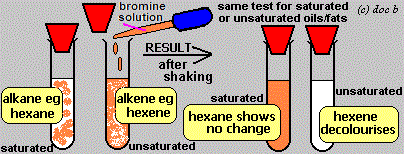 Test for alkenes
-
See
The chemistry of ALKENES – unsaturated
hydrocarbons – reaction with bromine
-
The experimental setup
above allows the safe collection of the very short molecules e.g.
methane, ethane, ethene, propene and propane gases and liquid
alkanes and alkenes of at least five carbon atoms in the chain.
-
The bottle is a safety
measure, if the gases inside the pyrex tube cool down, they
contract, but any water sucked back from the gas collection system
is trapped in this bottle. This means no cold water gets into the
hot pyrex tube to crack it and a cause a nasty accident! We just
want to crack the hydrocarbon molecules!
-
The cracking reaction is an example of
thermal
decomposition – a reaction that breaks down molecules into
smaller ones using heat and it takes place on the very hot surface of
the catalyst.
-
The equations below illustrate the process, small molecules are used to
show the overall molecular change clearly BUT in practice the 'starter'
molecules are likely to be more like the larger alkane hydrocarbon
molecules shown in equations (3) and (4).
Cracking reaction (1)
butane  ethane
+ ethene ethane
+ ethene
C4H10
C2H6 + C2H4
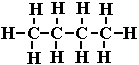
 

this is probably not used commercially, but
illustrates the principle of cracking with small simple molecules to give a
smaller alkane and an alkene eg
ethene to make
the plastic poly(ethene)
Cracking reaction (2)
butane
methane +
propene
C4H10
CH4
+ C3H6

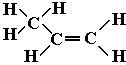
this is probably not used commercially, but
illustrates the principle of cracking with small simple molecules to give a
smaller alkane methane and an
alkene propene to
make the plastic poly(propene)
Cracking reaction (3)
octane
hexane +
ethene
C8H18
C6H14
+ C2H4
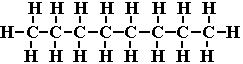
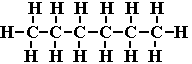
this cracking reaction is used commercially to make a volatile petrol fuel molecule
hexane
plus
ethene for polymerisation to make poly(ethene)
Cracking reaction (4)
dodecane
hexane + propene
C12H26
C6H14 + 2C3H6
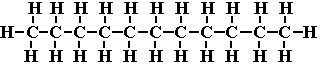
2
this reaction is
used commercially to crack a naphtha/kerosene molecule into a petrol molecule
plus two alkene propene molecules from which you make the plastic poly(propene)
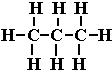
Cracking reactions (5)
Other catalytic cracking reactions at high
temperature produce hydrogen as well e.g.
ethane
ethene + hydrogen
C2H6
C2H4
+ H2

or
propane
propene + hydrogen
C3H8
C3H6
+ H2
|
6c. Other products derived from the
compounds in crude oil, many derived from the products of cracking
-
Petrol, diesel
and alkenes for manufacturing polymers–plastics and alcohols
have already been mentioned, but there are many other important organic compounds
derived from oil.
-
The petrochemical industry
produces lots of basic organic molecules from which molecules with specific
uses can be made into valued commercial products.
-
The structural materials, pharmaceutical and
food industries etc. have all developed a wide range of products in attempt
to enhance our lifestyle and quality of life and most commercial products depend very much on chemical 'feedstock' from the
petrochemical and oil industry
-
These include many drugs–medicines,
polymers–plastics, dyes for fabrics, soaps–detergents etc. etc.!
-
For notes on polymers see:
-
POLYMERS, plastics,
poly(ethene), poly(propene), uses, problems, recycling
-
e.g. making poly(ethene) from ethene
-
For
extra Advanced A Level Chemistry notes on cracking see
Test your self on GCSE level organic chemistry
QUIZ on oil products & organic chemistry
(easier-foundation-level)
QUIZ on oil products
& organic chemistry (harder-higher-level)
Key
points about cracking - why?, how? and uses of cracking products
Here’s a comprehensive and exam-board-aligned revision summary
on cracking of oil fractions, tailored for GCSE and
IGCSE Chemistry students across WJEC, CCEA, CIE, AQA,
Edexcel, OCR Gateway, and OCR 21st Century specifications.
Cracking of Oil Fractions – GCSE/IGCSE Chemistry
Revision
How
and Why Are Oil Fractions Cracked?
- Cracking is the process of breaking down
long-chain hydrocarbons into shorter, more useful molecules.
- Reasons for cracking:
- High demand for short-chain alkanes
(e.g. petrol) and alkenes (e.g. ethene).
- Long-chain hydrocarbons (from fractional
distillation) are less useful: thick, viscous, and burn
poorly.
- Cracking balances supply and demand in the
petrochemical industry.
Conditions for Cracking
| Type of Cracking |
Conditions |
| Thermal cracking |
High temperature (≈ 700–900°C), high
pressure |
| Catalytic cracking |
Lower temperature (≈ 500°C),
zeolite catalyst |
Products of Cracking
- Alkanes (smaller saturated hydrocarbons): e.g.
ethane, propane
- Alkenes (unsaturated hydrocarbons): e.g. ethene,
propene
- Hydrogen (in some cases)
General equation:
Long-chain alkane → Short-chain alkane + Alkene
Example:
decane → octane + ethene
C10H22 → C8H18 + C2H4
Uses of Cracking Products
| Product Type |
Example |
Use |
| Alkanes |
Petrol (e.g. octane) |
Fuels for cars, heating, aviation |
| Alkenes |
Ethene, propene |
Feedstock for polymers
(plastics), ethanol production |
| Hydrogen |
H2 |
Fuel cells, ammonia synthesis (Haber
process) |
Key Revision Points
- Cracking is a chemical change (not physical).
- It is an example of thermal decomposition.
- Alkenes produced can be tested using bromine
water (decolourises).
- Unsaturated = contains C=C double bond
(alkenes).
- Cracking helps meet economic and industrial demand.
Student Tips & Common Misconceptions
| Tip / Misconception |
Clarification |
| "Cracking is just
breaking molecules in half" |
Cracking produces
specific alkanes and alkenes, not random halves. |
| "Cracking only makes
fuels" |
It also makes alkenes
used in plastics and chemicals. |
| "Alkenes are fuels" |
Alkenes are mainly used in
polymer production, not as fuels. |
| Tip:
Learn to balance cracking
equations |
Practice writing equations like:
C8H18 → C6H14
+ C2H4 |
| Tip:
Know how to test for
alkenes |
Use bromine water:
orange → colourless. |
| Tip:
Understand why cracking is
needed |
Link to supply/demand
and economic value. |
Multiple Choice Quizzes and Worksheets
 KS4 Science GCSE/IGCSE m/c QUIZ on Oil Products
(easier–foundation–level)
KS4 Science GCSE/IGCSE m/c QUIZ on Oil Products
(easier–foundation–level)
 KS4 Science GCSE/IGCSE m/c QUIZ on Oil Products
(harder–higher–level)
KS4 Science GCSE/IGCSE m/c QUIZ on Oil Products
(harder–higher–level)
 KS4 Science GCSE/IGCSE m/c QUIZ on other aspects of Organic Chemistry
and
 3 linked easy Oil Products gap–fill quiz worksheets
ALSO gap–fill ('word–fill') exercises
originally written for ...
... AQA GCSE Science
Useful products from
crude oil AND
Oil, Hydrocarbons
& Cracking
etc.
... OCR 21st C GCSE Science
Worksheet gap–fill C1.1c Air
pollutants etc ...
... Edexcel GCSE Science
 Crude Oil and its Fractional distillation
etc ... Crude Oil and its Fractional distillation
etc ...
... each set are interlinked,
so clicking on one of the above leads to a sequence of several quizzes
revision study notes for 14-16
school chemistry AQA Edexcel OCR IGCSE/GCSE 9-1 chemistry science topics
modules for studying the need for cracking Oil fractions in the oil
industry, reaction conditions for cracking. balanced equations for cracking,
uses of cracking products alkenes to manufacture alcohols and alkenes for
making polymers plastics smaller alkane molecules for petrol
All my advanced A level organic chemistry notes
Website content © Dr
Phil Brown 2000+. All copyrights reserved on revision notes, images,
quizzes, worksheets etc. Copying of website material is NOT
permitted. Exam revision summaries & references to science course specifications
are unofficial. Doc Brown's GCSE revision notes on oil
products and organic chemistry for UK IGCSE and GCSE level and US grade 9 and grade 10
examinations
INDEX of GCSE level notes on Products from
oil and Organic
Chemistry
|
Explaining importance of explaining
cracking hydrocarbons for more petrol & alkenes
in GCSE level chemistry, What you need to know about explaining cracking
hydrocarbons for more petrol & alkenes for
GCSE level
chemistry,
Explaining use of explaining cracking hydrocarbons for more petrol &
alkenes knowledge in GCSE level chemistry, Examples of explaining
cracking hydrocarbons for more petrol & alkenes
explained when studying GCSE level chemistry, What is the significance
of explaining cracking hydrocarbons for more petrol & alkenes in GCSE level chemistry, describing
explaining theory of explaining cracking hydrocarbons for more petrol &
alkenes when studying GCSE level chemistry, exam revision
notes for explaining cracking hydrocarbons for more petrol & alkenes, online help for understanding
explaining cracking hydrocarbons for more petrol & alkenes in GCSE
chemistry, what do I need to learn about explaining cracking
hydrocarbons for more petrol & alkenes? what do I need to know
about explaining cracking hydrocarbons for more petrol & alkenes for GCSE chemistry exams, how to prepare for questions on
explaining cracking hydrocarbons for more petrol & alkenes in GCSE
chemistry examination? explaining cracking hydrocarbons for more petrol
& alkenes for
syllabus-specifications
for students taking the IGCSE/GCSE level chemistry examinations, summary
revision notes key points on explaining cracking hydrocarbons for more
petrol & alkenes for students studying AQA
igcse/gcse chemistry notes on explaining cracking hydrocarbons for more petrol &
alkenes, Edexcel gcse
chemistry notes on explaining cracking hydrocarbons for more petrol
& alkenes, OCR 21st century GCSE
chemistry notes on explaining cracking hydrocarbons for more petrol
& alkenes, OCR gateway
GCSE chemistry notes on explaining cracking hydrocarbons for more
petrol & alkenes, WJEC gcse chemistry notes on explaining cracking
hydrocarbons for more petrol & alkenes, CCEA
gcse chemistry notes on explaining cracking hydrocarbons for more petrol
& alkenes, CIE Cambridge igcse
chemistry, notes on
explaining cracking hydrocarbons for more petrol & alkenes useful for US grade 9-10 chemistry student courses
Test your self on GCSE level organic chemistry
QUIZ on oil products & organic chemistry
(easier-foundation-level)
QUIZ on oil products
& organic chemistry (harder-higher-level)
|
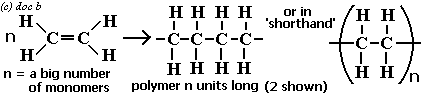 See also link below
 For searching