[Author
©
Dr Phil Brown GRIC, PhD:
Doc Brown's chemistry exam revision notes on
the ionic bonds of
magnesium chloride &
calcium chloride,
suitable for students of UK GCSE Science level
AQA, Edexcel, OCR, WJEC
Eduqas
and CCEA GCSE chemistry
courses, ~US grades 9-10 chemistry, also useful for more advanced
pre-university A level chemistry courses
[ionic bonding page
RE-EDIT]
GCSE Foundation
tier (easier)
m/c QUIZ on structure, properties & chemical bonding
of materials
GCSE Higher
tier (harder) m/c QUIZ on structure, properties and chemical bonding of
materials
All my
GCSE level chemistry revision
notes
All my advanced level chemistry revision notes
All my
structure and bonding notes
Part 2
Ionic Bonding: compounds and properties
email doc
brown
*
[privacy, cookies and disclaimer]
Mg (2.8.2) + 2Cl (2.8.7)
==> Mg2+ (2.8) 2Cl– (2.8.8)
can be summarised electronically
as [2,8,2] + 2[2,8,7] ==> [2,8]2+ [2,8,8]–2
via electron transfer
so both the magnesium and chloride
ions have a full outer shell of electrons like a noble gas
ONE 
 atom combines with
 TWO
TWO  atoms
to form
atoms
to form 

Note in this electron diagram,
only the original outer electrons are shown above.
The outer electrons of the
magnesium atoms (2.8.2) are transferred to the outer shell of the chlorine atom
(2.8.7) giving it a complete octet shell of outer electrons, just like a noble
gas (2.8.8). At the same time, the magnesium ion also attains a stable noble gas
electron structure (2.8).
NOTE
You can draw two separate
chloride ions, but in these examples square brackets and a number subscript
have been used, as in ordinary chemical formula.
The valency of Mg is 2 and chlorine 1, i.e.
the numerical charges of the ions.
Beryllium fluoride BeF2, magnesium bromide MgBr2,
calcium chloride CaCl2 or barium iodide BaI2
etc. will all be electronically similar.
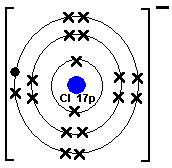

represents
the full electronic structure diagram of the magnesium ion [2.8] and the chloride ion
[2.8.8], hence the full electronic structure of magnesium chloride.
Note
that the 'blob' and 'x' electrons are identical, but their use is just a
useful visual device to show how the ion is formed. The blue circle
represents the nucleus.
The electronic dot & cross for the ionic bonding in
the ionic compound magnesium chloride

is the
simplified Lewis dot and cross diagram for the formation of magnesium chloride
Melting point of magnesium chloride is 714oC
(see extra comments after calcium chloride diagrams)
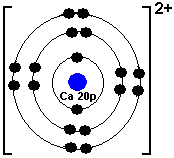
Ca is 2.8.8.2, Cl is 2.8.7, F is 2.7
rest of dot and cross diagrams are up to you, but calcium chloride is
shown below.
The calcium atoms transfer their
two outer electrons to the outer shell of two chlorine atoms
 calcium
chloride
calcium
chloride
The two outer electrons of the
calcium atoms (2.8.8.2) are transferred to the outer shell of two chlorine atoms
(2.8.7) until it has a complete octet shell of outer electrons, just like a noble
gas (2.8.8).
At the same time, the calcium ion also attains a stable noble gas
electron structure (2.8.8). The blue circle represents the nucleus.

is the
Lewis diagram for the formation of calcium chloride
Extra
comments on magnesium chloride and calcium chloride
Melting point of calcium chloride is 772oC
and magnesium chloride is 714oC - very high and expected for a giant ionic lattice
of a typical ionic compound with a strongly bonded 3D crystal lattice of
alternating positive (calcium/magnesium) and negative ions (chloride) that
strongly attract each other.
This means the solid magnesium/calcium chloride particles need much higher kinetic energies
of vibration to break apart from the giant ionic lattice to form a liquid.
This means the solid magnesium/calcium chloride particles need much higher kinetic energies
of vibration to break apart from the giant ionic lattice to form a liquid.
Molten magnesium/calcium chloride
will conduct electricity because the ions are free to move to carry the
current and will undergo electrolysis to extract magnesium/calcium (or
any group 2 metal and release chlorine (or any free Group 7 halogen
element) from a similar salt.
See also
Using the ionic bonding model to describe and explain the
properties of ionic compounds
|
Pd |
metals |
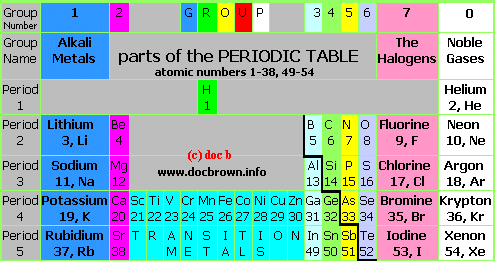
Part of the modern Periodic Table
Pd = period,
Gp = group |
metals => non–metals |
|
Gp1 |
Gp2 |
Gp3 |
Gp4 |
Gp5 |
Gp6 |
Gp7 |
Gp0 |
|
1 |
1H
Note that H does not readily fit into any group
|
2He |
|
2 |
3Li |
4Be |
atomic number
Chemical Symbol e.g. 4Be |
5B |
6C |
7N |
8O |
9F |
10Ne |
|
3 |
11Na |
12Mg |
13Al |
14Si |
15P |
16S |
17Cl |
18Ar |
|
4 |
19K |
20Ca |
21Sc |
22Ti |
23V |
24Cr |
25Mn |
26Fe |
27Co |
28Ni |
29Cu |
30Zn |
31Ga |
32Ge |
33As |
34Se |
35Br |
36Kr |
|
5 |
37Rb |
38Sr |
39Y |
40Zr |
41Nb |
42Mo |
43Tc |
44Ru |
45Rh |
46Pd |
47Ag |
48Cd |
49In |
50Sn |
51Sb |
52Te |
53I |
54Xe |
|
6 |
55Cs |
56Ba |
Transition Metals |
81Tl |
82Pb |
83Bi |
84Po |
85At |
86Rn |
|
A
Group 2 Alkaline Earth Metal
combining with a Group 7
Halogen non–metal |
Predicting formulae and names for
combing a group 2 metal with a group 7 non-metal halogen
| Gp2\7 |
F |
Cl |
Br |
I |
| Mg |
magnesium fluoride
MgF2 |
magnesium chloride
MgCl2 |
magnesium bromide
MgBr2 |
magnesium iodide
MgI2 |
| Ca |
calcium fluoride
CaF2 |
calcium chloride
CaCl2 |
calcium bromide
CaBr2 |
calcium iodide
CaI2 |
| Sr |
strontium fluoride
SrF2 |
strontium chloride
SrCl2 |
strontium bromide
SrBr2 |
strontium iodide
SrI2 |
| Ba |
barium fluoride
BaF2 |
barium chloride
BaCl2 |
barium bromide
BaBr2 |
barium iodide
BaI2 |
All the formula highlighted in yellow can
be described in the same way as magnesium chloride or calcium chloride
The Group 2 Alkaline Earth Metal atom
loses two electrons to form a doubly charged positive ion
The Group 7 Halogen atom gains one
electron to form a singly charged negative ion
Note that these formulae are empirical formula - the
simplest whole number ratio of atoms in the formulae
All of these solid fluorides,
chlorides, bromides and iodides consist of a giant ionic lattice.
All the comments about magnesium
chloride and calcium chloride apply to ALL of the ionic compounds
tabulated above.
Know where the elements of compounds like magnesium chloride and calcium chloride are in the
periodic table.
Know that when a metal element chemically combines
with a non-metal element, an ionic compound like magnesium/calcium chloride is formed.
Be able to work out the electron arrangement of the
metallic element and non-metallic element in
magnesium/calcium chloride or similar compound.
Be able to work out the electron configuration of
the ions in group 2 halide from reasoning the electron transfers involved.
Be able to draw the dot and cross electronic diagram
for the ionic structure of group 2 halide salts.
Be able to deduce the charges on the ions and work
out the formula of the ionic compound
of group 2 halide salts.
 metals \ non-metals (zig-zag line)
 For searching