|
Electricity in the
home: 1.4
Examples of electrical power
ratings of appliances in the home and rate of energy transfer
[Author
©
Dr WP Brown PhD:
Doc Brown's physics exam revision notes suitable for students of UK
IGCSE & GCSE level physics courses, ~ US grades 9-10 physics,
electricity page updated
Feb 3rd 2026 *]
[KEY
POINTS and learning objectives for this page, after initial notes]
*
[email doc b]
[privacy policy, cookies
and disclaimer] *
School/college GCSE level physics exam revision notes
How much electrical energy is used by an appliance in
the home?
INDEX for physics notes on
electricity in the home
1.4 Power
ratings of appliances in the home and rate of energy transfer
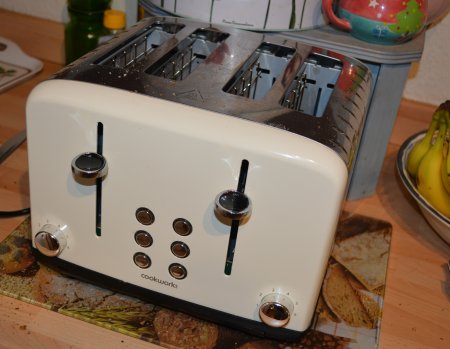
On the underside of this toaster is the label with
the 'electrical' technical details.
You are informed the toaster works a power supply
of 220-240 V AC at a frequency of 50 or 60 Hz.
AC means alternating current.
Power rating is a measure
of the rate of energy transfer.
The power rating of the toaster is 1900 to 2300 W, depending on
the voltage (p.d. across the heating element).
The power is similar for
all frequencies of 50-60 Hz.
1W =
1J/s in terms of the rate of energy transfer = power.
This means the heating element is transferring
energy at the rate of 1900 to 2300 J/s
From the information you can work out the current
flowing through the heating element.
From: P = I x V, I = P / V. e.g. for a p.d. of 230
V and a power rating of 2100 W:
Current I = 2100 / 230 =
8.2 A (2 sf)
This appliance would be protected with a 10 A
or 13 A fuse. For more details see
calculate a safe fuse rating.
Examples of power ratings of things you find
in the home - listed from the least powerful to the most powerful.
|
Appliance/machine |
Power
rating W (J/s) |
|
TV monitor |
25 |
|
light bulb |
50 |
|
small LED TV |
85 |
|
refrigerator |
100 |
|
food blender |
160 |
|
microwave cooker |
600 |
|
electric kettle |
1200 |
|
dishwasher |
1200 |
|
vacuum cleaner |
1400 |
|
microwave cooker |
1600 |
|
hairdryer |
1800 |
|
steam iron |
2000 |
|
hot water immersion
heater |
3000 |
Be careful NOT to equate power with the
cost of using an appliance.
Time is the other factor, the longer you
use an appliance, the more its use costs.
Some higher power appliances like the
microwave or iron are only used for short times.
Computers, light bulbs and TV screens,
might be on for many hours and the cost mounts up as more energy
is transferred/work done!
The general word equation is:
energy
used = power x time
(see later section on
kilowatt-hour
calculations)
Most appliances are labelled with a power
rating, which is the maximum power output with which it can
be used safely.
The power rating tells you the maximum amount
of energy transferred from one energy store to another per second
when the appliances is being used.
e.g. a 700 W iron means 700 J of energy
are being transferred (used) every second.
A 3 kW heater transfers to the thermal
energy store of a room at the rate of 3000 J/second.
The power rating is useful information for
the consumer.
The lower the power rating, the less
electricity it uses, saving money - cheaper to run - as long as the
appliance can still do what you want it to do.
e.g. if 500 W iron can do the work in the
same time as a 750 W iron, then the 500 W iron is the more
efficient and cheaper way to do your ironing!
750 - 500 = 250, so 250 J/s is saved to
the thermal energy store of the clothes being ironed.
Whatever the power rating, its the efficiency
of the appliance that is really important - what percentage of
energy input is transferred in doing useful work.
However, beware!, just because an appliance has a higher power
rating, it doesn't mean it is more efficient than a lower power
appliance.
A higher powered appliance might waste
more energy i.e. has lower % efficiency in terms of the
electrical energy doing useful work.
Reminder: Power of appliance = current x
potential difference
P (W or
J/s) = I
(A) x V
(V)
For more questions see
electrical power calculations
section.
Apart from electrical power
calculations for electrical appliances, this formula is
needed to
calculate a safe fuse rating.
INDEX of ELECTRICITY Notes 1. Electricity in the home
and also
see
Conservation of energy,
energy transfers-conversions, efficiency, calculations,
Sankey diagrams
and for more on power calculations
see
Types of energy & stores, calculations of
mechanical work done and power
Key points for electricity in physics courses -
Information
sources for Doc Brown's key points: IGCSE-GCSE physics are based on textbooks
& syllabus-specifications for students taking the UK AQA,
Edexcel, OCR 21st Century Science, OCR Gateway science suite, WJEC, CCEA and
CIE GCSE
physics 9-1 level science examinations.
Here's a structured set of summary revision notes on
electrical power ratings of
appliances and the rate of energy transfer,
aligned with the GCSE/IGCSE Physics specifications
across WJEC, CCEA, CIE, AQA, Edexcel, and OCR.
What Is Power Rating?
- Power
is the rate of energy transfer or the rate at
which work is done.
- It tells you how much energy
an appliance uses per second.
- Measured in watts (W)
or kilowatts (kW).
- 1 W = 1 J/s
and 1 kW = 1000 J/s of energy transferred
For more on equations and questions see
electrical power calculations.
Example Power Ratings of Home Appliances
| Appliance |
Typical Power Rating |
Energy Conversion |
| Mobile phone charger |
5 W |
Electrical → Chemical |
| LED light bulb |
10 W |
Electrical → Light + Thermal |
| Ceiling fan |
50 W |
Electrical → Kinetic |
| Microwave oven |
1000 W (1 kW) |
Electrical → Thermal + Kinetic |
| Kettle |
2500 W (2.5 kW) |
Electrical → Thermal |
| Electric shower |
5000 W (5 kW) |
Electrical → Thermal |
| Hairdryer |
2000 W (2 kW) |
Electrical → Thermal + Kinetic |
| Washing machine |
2200 W (2.2 kW) |
Electrical → Kinetic + Thermal |
The higher the power rating,
the faster the energy is transferred.
Typical Exam Board Specification Contents
|
Key Topics
Covered |
| Power ratings, energy transfer,
cost of electricity, appliance efficiency |
| Power calculations, energy use,
domestic electricity |
| Power and energy equations,
appliance ratings, practical applications |
| Power in kW, energy in kWh, cost
calculations, appliance examples |
| Power rating, energy transfer,
fuse ratings, safety |
| Electrical energy, power, energy
transfer in appliances |
Top Tips for Students
- Memorise common appliance
ratings: These often
appear in calculation questions.
- Practice unit conversions:
Especially between W and kW, and seconds to hours.
- Understand energy transfer:
Be able to describe what energy forms are involved.
- Use real-life context:
Think about how long you use appliances and their cost.
- Label units clearly:
Always include correct units in answers to avoid losing marks.
- Apply equations:
Rearranging and substituting values is a key exam skill.
Keywords, phrases and learning objectives for appliance power rating of an
appliance
Appreciate the different power ratings of appliances
in the home and their relative rate of energy transfer.
Know that power in watts is the rate of energy
transfer in joules per second.
Know how to use the
power = current x p.d.
equation e.g. how to calculate the current flowing knowing the power
rating and mains voltage.
WHAT NEXT?
TOP of page
INDEX for physics notes on
electricity in the home
ALL my Electricity and Magnetism Physics Notes
email doc
brown - comments - query?
INDEX of all my PHYSICS NOTES
BIG website and using the [SEARCH
BOX] below, maybe quicker than navigating the
many sub-indexes
Basic Science Quizzes for
UK KS3 science students aged ~12-14, ~US grades 6-8
Biology * Chemistry
* Physics for UK
GCSE level students aged ~14-16, ~US grades 9-10
Advanced Level Chemistry
for pre-university age ~16-18 ~US grades 11-12, K12 Honors
Based on the syllabus-specifications
for students taking the IGCSE/GCSE level physics examinations summary
revision notes and key points on power ratings of devices/appliances for students taking the AQA
igcse/gcse physics notes on power ratings of devices/appliances, Edexcel gcse
physics notes on power ratings of devices/appliances, OCR 21st century GCSE
physics notes on power ratings of devices/appliances, OCR gateway
GCSE physics notes on power ratings of devices/appliances, WJEC gcse physics notes on
power ratings of devices/appliances, CCEA
gcse physics notes on power ratings of devices/appliances for students taking CIE Cambridge igcse
physics, or any other GCSE or IGCSE level physics exams notes on
power ratings of devices/appliances, useful for US grade 9-10 physics courses,
Explaining the importance of energy transfer from power ratings of
appliances/devices in GCSE level physics, What you need to know
about energy transfer from power ratings of appliances/devices for
GCSE level physics, Explaining what is the use of energy transfer
from power ratings of appliances/devices knowledge in GCSE level
physics, Examples of energy transfer from power ratings of
appliances/devices explained when studying GCSE level physics, What
is the significance of energy transfer from power ratings of
appliances/devices in GCSE level physics, Describing and explaining
the theory of energy transfer from power ratings of
appliances/devices when studying GCSE level physics, revision notes
for energy transfer from power ratings of appliances/devices in
exams, online exam help for energy transfer from power ratings of
appliances/devices, revision notes for energy transfer from power
ratings of appliances/devices, what do I need to learn about energy
transfer from power ratings of appliances/devices for by GCSE
physics exam? revision summary for energy transfer from power
ratings of appliances/devices, help in teaching energy transfer from
power ratings of appliances/devices, learning notes for energy
transfer from power ratings of appliances/devices, help to
understand the energy transfer from power ratings of
appliances/devices topic in preparation GCSE physics exam question,
how to prepare for questions involving energy transfer from power
ratings of appliances/devices
SITEMAP
Website content © Dr
Phil Brown 2000+. All copyrights reserved on Doc Brown's physics revision notes, images,
quizzes, worksheets etc. Copying of website material is NOT
permitted. Exam revision summaries and references to GCSE science course specifications
are unofficial.
INDEX of ELECTRICITY Notes 1. Electricity in the home
|