|
GCSE level Biology exam revision note on ecology & surveying
Part
Surveying ecology : Part 3.
Biodiversity surveying: Method 2. Using transects
[Author
©
Dr Phil Brown PhD:
Doc Brown's biology exam revision notes suitable for students of UK
IGCSE & GCSE level biology courses & ~ US grades 9-10 biology
[survey page updated
April 16th 2026 *]
[email doc
b: comment? query?]
*
[privacy & cookies policies & disclaimer] * ]SEARCH]
[Key
points and learning objectives for this page, after the main body of
notes]
INDEX
of biology notes on ecological surveying and biodiversity
(3) Biodiversity surveying: Method 2
Surveying using transects in ecology
A belt transect is a path/gradient along which one counts and records occurrences
of the species of study.
You might wish to study how the distribution of
organisms changes by sampling across a transect.
A transect is used to survey a wider area in a
more systematic way than just doing a few quadrats.
e.g you can use a sequence of quadrats along a
transect to find out how organisms are distributed across a change in
habitat due to an abiotic factor - bright light to shade, damp to
dry ground, change in soil composition (due to underlying differences in
geology e.g. limestone and sandstone)
Below is a photograph of a field of wild flowers.
I've drawn on the photograph how you use a 1 m2
quadrat along the line of a transect to survey the species of
wild flowers from the hedge at the top to the bottom of the field.
You can visually see that the distribution
(concentration) of white and yellow flowers changes as you come down the
field and these can be accurately counted to give you quantitative
data.
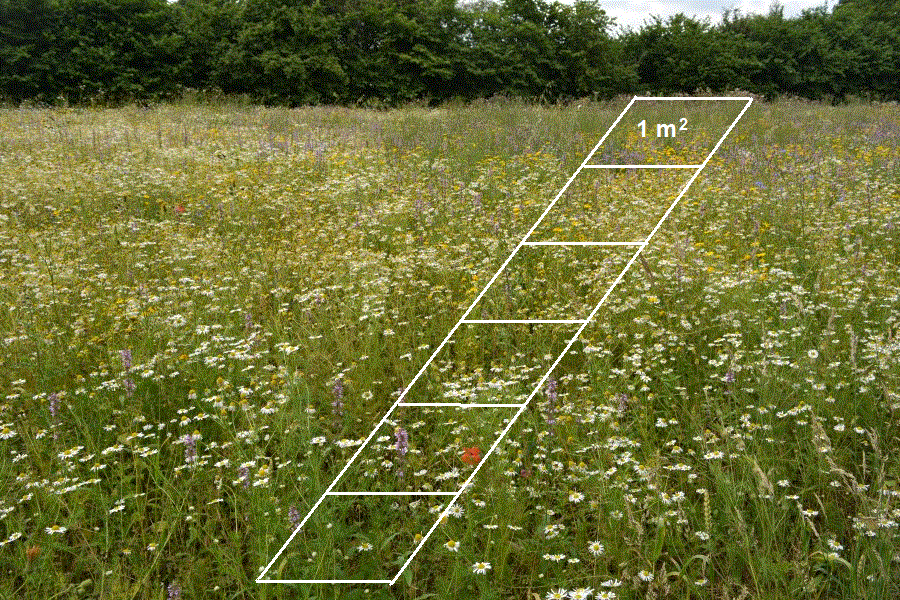
Photo of the Cornfield wild flower project
Hutton-le-Hole - Ryedale Folk
Museum (August 2019) well worth a visit.
 20 cm x 20 cm squares in the 1 m2 quadrat
You can count the number of each species in 1 m2
(100 x 100 = 10,000 cm2) areas or randomly sample the smaller
0.04 m2 (20 x 20 = 400 cm2) areas.
Doing a transect survey
In the preceding section I've described how to
use a quadrat.
Here you lay out a long string line from the
starting point to the end point.
Using a long tape measure you measure out 1,
2, 3 m etc. and place a 1 m2 quadrat at these points.
Count the organisms e.g. plant species you are
interested in and then move the quadrat on 1 m further down the
line.
You can survey every metre or 2 or 3 metres if
its a very long transect.
From your results you can plot graphs
of organism density (species/m2) versus
distance down the transect (m).
You could also measure the light intensity
down the transect using a light meter, at the same distance
intervals you were measuring the plant density.
You can then compare the two graphs and
see if there is any connection between the plant species density and
the intensity of light falling on the transect.
The calculations are just the same as I've shown
in the preceding (section 2)
Quadrats section.
Key points - ecological surveying using transects
Based
on the syllabus-specifications for students taking the UK AQA, Edexcel and
OCR GCSE level biology examinations (~US grades 9-10 biology).
Revision notes
specifically for biology students on Surveying Using Transects
- a vital fieldwork technique in ecology for investigating the
distribution of organisms.
What Is a Transect?
A transect
is a straight line across a habitat along which observations or
measurements are taken.
It helps study how the
distribution of organisms changes in relation to
abiotic factors (like light, moisture, or temperature).
Why Use a Transect?
-
To study how
species vary across a changing environment (e.g., from a shaded
area to a sunny patch).
-
To identify
patterns of distribution related to gradients or
zonation (e.g., seashore to inland, forest edge to open field).
Types of Transects
-
Line Transect
-
A tape measure is laid
out in a straight line.
-
You record any
organism that touches the line at set intervals or continuously.
-
Used for quick
surveys where
visibility is good.
-
Belt Transect
-
Place quadrats
at regular intervals along the transect line (e.g., every 1 meter).
-
In each quadrat, count
or estimate species abundance.
-
Provides more
detailed data, ideal
for measuring changes in population density.
How to Carry Out a Belt
Transect
-
Mark a straight
line across the study area
using a tape measure or rope.
-
Place quadrats
at fixed intervals (e.g., every metre).
-
In each quadrat:
-
Record abiotic
factors at each point if necessary (e.g., light intensity with
a light meter).
-
Repeat for
reliability and compare patterns across the
transect.
What You Might Measure
-
Species
distribution (where
species are found or absent).
-
Abundance
(how many individuals or % cover).
-
Environmental
gradient (e.g., soil pH,
temperature, moisture).
Exam Tips
-
Link species
distribution to abiotic factors.
Example: “The moss species were more abundant in areas of higher
moisture.”
-
Understand why a
belt transect gives more data than a line transect.
-
Be prepared to
draw or interpret graphs showing changes in distribution along
the transect.
-
Use appropriate
terminology like “zonation,” “gradient,” and “sampling.”
Keywords, phrases and learning objectives for this part on ecological surveying
and biodiversity
Be able to describe surveying using transects to
measure the abundance and biodiversity
of species in an ecosystem.
WHAT NEXT?
TOP OF PAGE
INDEX
of biology notes on ecological surveying
INDEX of all my BIOLOGY NOTES
This is a BIG website, so try using the [SEARCH
BOX], it maybe quicker than the many indexes!
email doc
brown - comments - query?
Basic Science Quizzes for
UK KS3 science students aged ~12-14, ~US grades 6-8
Biology * Chemistry
* Physics for UK
GCSE level students aged ~14-16, ~US grades 9-10
Advanced Level Chemistry
for pre-university age ~16-18 ~US grades 11-12, K12 Honors
Find your GCSE/IGCSE
science course for more help links to all science revision notes
Revision notes on explaining how to do
& use line transects & belt transects based on the syllabus-specifications
for students taking IGCSE/GCSE level biology examinations, summary
revision notes and key points on explaining how to do & use line
transects & belt transects for students taking the AQA
igcse/gcse biology notes on explaining how to do & use line transects & belt
transects, Edexcel gcse
biology notes on explaining how to do & use line transects & belt
transects, OCR 21st century GCSE
biology notes on explaining how to do & use line transects & belt
transects, OCR gateway
GCSE biology notes on explaining how to do & use line transects &
belt transects, WJEC gcse biology notes on explaining how to do &
use line transects & belt transects, CCEA
gcse biology notes on explaining how to do & use line transects & belt
transects for students taking CIE Cambridge igcse
biology, exam revision notes on
explaining how to do & use line transects & belt transects, useful for US grade 9-10 biology courses,
importance of ecology biodiversity
survey using transects
in GCSE level biology, What you need to know about ecology biodiversity
survey using transects for
GCSE level
biology,
Explaining the use of ecology biodiversity survey using transects knowledge in GCSE level biology, Examples of
ecology biodiversity survey using transects explained
when studying GCSE level biology, What is
significant about ecology biodiversity survey using transects, describing the theory of
ecology biodiversity survey using transects when studying
GCSE level biology, revision notes for ecology biodiversity survey using
transects in exams, online exam help
for ecology biodiversity survey using transects, revision notes about
ecology biodiversity survey using transects, what do I need to learn about
ecology biodiversity survey using transects for
by GCSE biology exam?
help to understand the ecology biodiversity survey using transects topic in preparation for GCSE biology exam
question, how to
prepare for questions involving ecology biodiversity survey using
transects in a GCSE biology examination?
SITEMAP Website content © Dr
Phil Brown 2000+. All copyrights reserved on Doc Brown's biology revision notes, images,
quizzes, worksheets etc. Copying of website material is NOT
permitted. Exam revision summaries and references to science course specifications
are unofficial.
|
