HOME PAGE * SEARCH * UK KS3 level Science Quizzes for students aged ~13-14

UK GCSE level BiologyChemistryPhysics ~14-16 * Advanced pre-university Chemistry ~16-18

UK GCSE level age ~14-16, ~US grades 9-10 Biology revision notes

GCSE level biology exam revision notes on basic genetics

Genetics: 3.7 How to interpret a family tree of inheritance

[Author © Dr Phil Brown PhD: Doc Brown's biology exam revision notes suitable for students of UK IGCSE & GCSE level biology courses & ~ US grades 9-10 biology [genome-3 updated Mar 18th 2026 *]

[Key points and learning objectives for this page, after the main body of notes]

Index of biology notes on aspects of basic genetics (and links to other genetics notes)

[email doc b: comment? query?] * [privacy & cookies policies & disclaimer] * ]SEARCH]


(3.7) Examples of interpreting family trees - family pedigrees

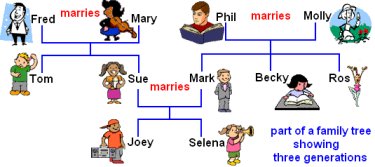
Ex 1. The inheritance of freckles

family tree family pedegree for inheriting freckles inherited characteristic

The tendency to form freckles in sunlight is genetically inherited.

(a) If Molly and Mark have freckles who might you predict to also have freckles in the 3rd generation?

Joey or Selena

(b) If only Phil has freckles in the 1st generation and only Joey in the 3rd generation who is most likely to have freckles in the 2nd generation?

Mark

(c) If only Fred and Sue have freckles in the first two generations, who is most likely to have freckles in the 3rd generation?

Joey or Selena

(d If Fred and Selena have freckles, who most likely to have freckles too?

Sue


How to use a test cross to identify an unknown genotype

The unknown genotype can be determined by observing the phenotypes of the resulting offspring.

If crossing the unknown dominant phenotype (PP or Pp genotype) individual with the recessive phenotype individual produces only dominant phenotypes (no recessive), then the unknown individual is homozygous dominant.


2. for future use


Key points Source of information is based on textbooks & syllabus-specifications for students taking the AQA GCSE, Edexcel GCSE and OCR GCSE level biology examinations (~US grades 9-10).

Key points on how to interpret a family tree of inheritance

Interpreting a Family Tree of Inheritance and Using a Test Cross

Understanding inheritance patterns is crucial for studying genetics.

Family trees (pedigree diagrams) and test crosses help identify the transmission of genetic traits and the genotype of individuals.


1. How to Interpret a Family Tree of Inheritance

A family tree (pedigree diagram) visually represents the inheritance of traits and genetic disorders over generations. Scientists use these diagrams to study dominant, recessive, and sex-linked traits.

Key Symbols Used in Family Trees:

These are more elaborate symbols than the family tree illustrated above.

Symbol Meaning
□ (Square) Male
○ (Circle) Female
Shaded Shape Affected individual (shows the trait or disorder)
Unshaded Shape Unaffected individual
Half-Shaded Shape Carrier (only applicable to recessive disorders)
Horizontal Line Represents marriage/partnership
Vertical Line & Branches Connects parents to children

Steps to Interpret a Family Tree:

  1. Identify Generations: The top row is the oldest generation, and younger generations follow below.

  2. Determine Inheritance Pattern:

    • Dominant trait: Appears in every generation.

    • Recessive trait: May skip generations and appear only when both parents carry the allele.

    • Sex-linked trait: If mostly males are affected, it may be X-linked recessive (e.g., hemophilia).

  3. Identify Carriers: Unaffected parents producing affected children suggests recessive inheritance.


2. How to Use a Test Cross to Identify an Unknown Genotype

A test cross helps determine whether an individual with a dominant phenotype has a homozygous dominant (AA) or heterozygous (Aa) genotype.

Steps to Perform a Test Cross:

  1. Cross the individual with an unknown genotype (A?) with a homozygous recessive (aa) individual.

  2. Analyze offspring outcomes:

    • If all offspring show the dominant trait, the tested individual is likely homozygous dominant (AA).

    • If some offspring show the recessive trait, the tested individual is heterozygous (Aa).

Punnett Square Example – Testing a Dominant Trait (A?):


A (Dominant)

A (Dominant) OR a (Recessive)

a (Recessive)

Aa (Dominant)

aa (Recessive)

Genetic Outcomes:

  • 100% Dominant Offspring → Individual tested is AA (homozygous dominant).

  • 50% Dominant & 50% Recessive Offspring → Individual tested is Aa (heterozygous).


3. Importance in Human Genetics

Interpreting pedigrees and using test crosses are vital for:

  • Identifying Genetic Disorders: Used in medical research to track conditions like cystic fibrosis and sickle cell anemia.

  • Genetic Counseling: Helps families assess risks before having children.

  • Studying Evolution & Natural Selection: Reveals inheritance patterns in populations.

  • Advancing Genetic Research: Supports selective breeding and personalized medicine.

Mastering pedigree analysis and test crosses enhances understanding of inheritance.


Summary of learning objectives and key words or phrases

In terms of genetic inheritance, be able to interpret a family tree e.g. the inheritance of freckles


WHAT NEXT?

TOP OF PAGE

INDEX of biology notes on aspects of basic genetics (also links to other sections on genetics)

INDEX of all my BIOLOGY NOTES

BIG website, try using the [SEARCH BOX], maybe quicker than the many indexes!

Basic Science Quizzes for UK KS3 science students aged ~12-14, ~US grades 6-8

BiologyChemistryPhysics for UK GCSE level students aged ~14-16, ~US grades 9-10

Advanced Level Chemistry for pre-university age ~16-18 ~US grades 11-12, K12 Honors

Find your GCSE/IGCSE science course for more help links to all science revision notes

email doc brown - comments - query?


Explaining importance of human genetics of how to interpret a family tree in GCSE level biology, What you need to know about human genetics of how to interpret a family tree for GCSE level biology, Explaining use of human genetics of how to interpret a family tree knowledge in GCSE level biology, Examples of human genetics of how to interpret a family tree explained when studying GCSE level biology, What is the significance of human genetics of how to interpret a family tree in GCSE level biology, describing explaining theory of human genetics of how to interpret a family tree when studying GCSE level biology, exam revision notes for human genetics of how to interpret a family tree, online help for understanding human genetics of how to interpret a family tree in GCSE biology, what do I need to learn about human genetics of how to interpret a family tree? what do I need to know about human genetics of how to interpret a family tree for GCSE biology exams, how to prepare for questions on human genetics of how to interpret a family tree in GCSE biology examination? human genetics of how to interpret a family tree for syllabus-specifications for students taking the IGCSE/GCSE level biology examinations, summary revision notes key points on human genetics of how to interpret a family tree for students studying AQA igcse/gcse biology notes on human genetics of how to interpret a family tree, Edexcel gcse biology notes on human genetics of how to interpret a family tree,  OCR 21st century GCSE biology notes on human genetics of how to interpret a family tree, OCR gateway GCSE biology notes on human genetics of how to interpret a family tree, WJEC gcse biology notes on human genetics of how to interpret a family tree, CCEA gcse biology notes on human genetics of how to interpret a family tree, CIE Cambridge igcse biology, notes on human genetics of how to interpret a family tree useful for US grade 9-10 biology student courses


SITEMAP Website content © Dr Phil Brown 2000+. All copyrights reserved on Doc Brown's biology revision notes, images, quizzes, worksheets etc. Copying of website material is NOT permitted. Exam revision summaries and references to science course specifications are unofficial.

TOP OF PAGE