|
GCSE level biology exam revision notes on basic genetics
Genetics:
3.5 Explaining the inherited genetic disorder of cystic
fibrosis - possible genetic outcomes
explained with diagrams and Punnett Squares
[Author
©
Dr Phil Brown PhD:
Doc Brown's biology exam revision notes suitable for students of UK
IGCSE & GCSE level biology courses & ~ US grades 9-10 biology
[genome-3 updated
Mar 18th 2026 *]
[Key
points and learning objectives for this page, after the main body of
notes]
Index of biology notes on aspects of basic genetics (and links to other
genetics notes)
[email doc
b: comment? query?]
*
[privacy & cookies policies & disclaimer] * ]SEARCH]
(3.5)
Cystic fibrosis
Know and understand that some disorders like cystic
fibrosis are
inherited.
You need to be able to evaluate the outcomes
of pedigree analysis when screening for genetic disorders e.g. cystic
fibrosis.
The genetically inherited disorder called cystic
fibrosis is
described and genetically explained below, and there are serious medical consequences.
Genomics and
cystic fibrosis inherited disease
It is now known most of our characteristics
are controlled by more than one gene and this is also true for the genetically inherited
disease cystic fibrosis.
Single-gene disorders like cystic
fibrosis comply with what is called 'Mendelian inheritance'
and genetic diagrams and Punnett squares are quite easy to work out
- as I hope you will see below.
(Most diseases with a 'genetic connection' like
diabetes, obesity and cardiovascular diseases (heart disease)
involve the interaction of many genes including non-coding sections
of the genome's DNA and environmental factors e.g. lifestyle choice
- diet and exercise.)
Cystic fibrosis is a genetic disorder
of cell membranes, the
disease is passed down through families.
Cystic fibrosis can be caused by
the deletion of only three bases, but this has a dramatic effect on the
phenotype.
The faulty gene should code for a
protein that controls the movement of salt and water in and out of
cells.
Unfortunately, the protein
produced by the faulty gene doesn't work properly and leads to
excess mucous production.
Cystic fibrosis causes this thick, sticky
mucus to build up in the air passages, lungs, digestive tract, pancreas and other areas of the body
- affected people suffer from breathing and digestion difficulties
and patients are on a complex mixture of medications.
It is one of the most common chronic lung diseases in children and young
adults and sadly, it is a life-threatening disorder caused by a defective gene
which causes the body to produce abnormally thick and sticky fluid, called
mucus.
The thick mucus builds up in the breathing passages of the lungs
(causing lung infections) and in the pancreas, the organ that helps to break
down and absorb food (causing digestion problems).
The parents may be carriers of the cystic
fibrosis disorder without actually having the disorder themselves.
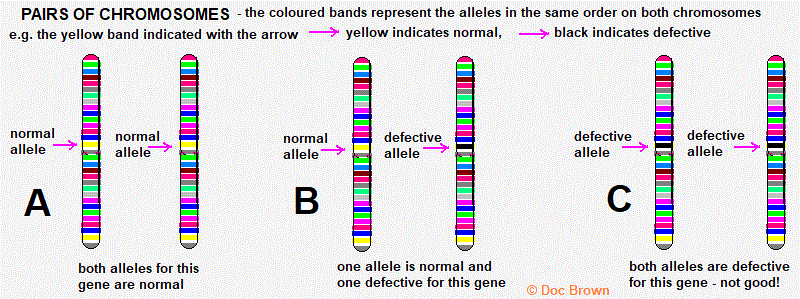
In the above diagram, imagine the
'arrowed' yellow band represents
the allele that codes for the essential protein required to avoid
suffering from cystic fibrosis.
A
represents the normal dominant alleles in the pair of chromosomes
(notated as FF below in the genetic analysis).
This person is not a carrier or
sufferer of cystic fibrosis.
B
represents a dominant normal and a defective recessive allele (notated
as Ff below in the genetic analysis).
This person is a carrier, but not
a sufferer of cystic fibrosis because normal is dominant.
C
represents a person with a pair of defective recessive alleles (notated
as ff below in the genetic analysis).
This person is both a carrier and
sufferer of cystic fibrosis - the double recessive gene prohibits
the production of the vital protein.
It is caused by a recessive allele
(denoted by f) of a
gene and can therefore be passed on by parents, neither of whom has the
disorder.
About 1 in 25 people carry the
recessive allele of f cystic fibrosis.
About in 3000 newborn babies have
the condition.
In order to be affected by cystic
fibrosis, you must inherit the double recessive gene ff.
Punnett square and genetic
diagram for cystic fibrosis
|
Punnett square genetic table for cystic fibrosis |
|
1. Genotypes of parents: Ff x Ff, normal but both carriers |
|
Gametes: F, f, F
and f (alleles) |
|
Genotypes
of children |
F |
f |
|
F |
FF |
Ff |
|
f |
Ff |
ff |
FF = homozygous
alleles (dominant)
Ff = heterozygous alleles
ff = homozygous alleles (recessive)
Cystic fibrosis is caused by a recessive
allele f (so it needs genotype ff, a double recessive allele,
for the person to suffer from cystic fibrosis.
For someone to suffer from cystic
fibrosis, they must inherit the faulty allele (f) from both
parents.
The genetic diagrams above and below show that
when both
parents are carriers of the recessive allele, but NOT affected (Ff,
heterozygous), there is a 3 in 4 (75%) chance
of having a normal child (FF non-carrier or Ff carrier) and a
1 in 4 (25%) chance of having a child with cystic fibrosis (recessive and
homozygous ff sufferer and
carrier).
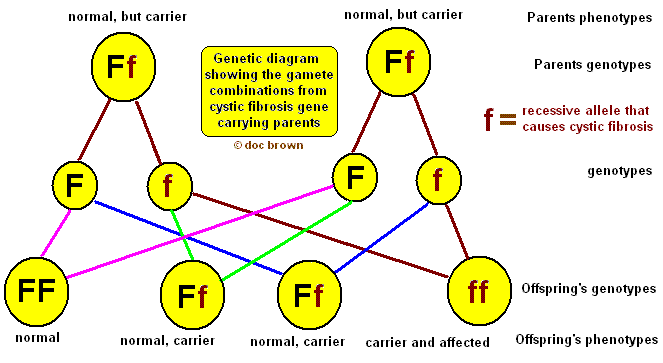
Genetic diagram for normal, but carrier of
cystic fibrosis and another
normal, but carrier of cystic fibrosis.
Five other possible parental crosses
involving the recessive allele f for cystic fibrosis
I've shown below the analyses for
cystic fibrosis using a basic Punnett square of the two pairs of gametes
of the parents and the four possible genotypes of offspring (children).
|
2. genotypes of parents: Ff x ff |
Comments on cross 2.
for cystic fibrosis
A carrier crossed with someone suffering from
cystic fibrosis.
All the offspring will be carriers of the
recessive gene f.
2 in 4 chance (50%) of the offspring being
affected by cystic fibrosis. |
|
genotypes
of children |
F |
f |
|
f |
Ff |
ff |
|
f |
Ff |
ff |
|
3. genotypes of parents: FF x Ff |
Comments on cross 3.
for cystic fibrosis
A non-carrier crossed with a carrier of the
cystic fibrosis recessive gene f.
2 in 4 chance (50%) of the offspring will be
carriers of the recessive gene f.
Non of the offspring will be affected by
cystic fibrosis. |
|
genotypes
of children |
F |
F |
|
F |
FF |
FF |
|
f |
Ff |
Ff |
|
4. genotypes of parents: FF x ff |
Comments on cross 4.
for cystic fibrosis
A non-carrier crossed with someone suffering from
cystic fibrosis.
All the offspring will be carriers of the
recessive gene f.
Non of the offspring will be affected by
cystic fibrosis. |
|
genotypes
of children |
F |
F |
|
f |
Ff |
Ff |
|
f |
Ff |
Ff |
Extra note on
cystic fibrosis:
(i) For 5. DD x DD, all offspring will be
DD non affected, similarly, for 6. ff x ff, all offspring
will be ff affected and carriers.
(ii) For couples who may carry the recessive gene,
certain crosses carry an increased risk that their child might suffer
from cystic fibrosis.
Genetic screening for potentially harmful
alleles may inform potential parents of the risk, but this may in
itself lead to agonising decisions.
For lots more examples of genetic analysis of
offspring see the
index with lots of diagrams and
explanations.
Key points
Source of information is based on textbooks & syllabus-specifications for students taking the AQA
GCSE, Edexcel GCSE and OCR
GCSE level biology examinations (~US grades 9-10).
Key
points in understanding the genetics of cystic fibrosis
Cystic Fibrosis:
Inherited Genetic Disorder and Genetic Outcomes
Cystic fibrosis (CF)
is a recessive genetic disorder affecting the
lungs, digestive system, and sweat glands.
It is caused by a
mutation in the CFTR gene and leads to excessive
thick mucus production, resulting in respiratory and digestive
complications.
1.
Causes of
Cystic Fibrosis
Cystic fibrosis is
caused by a mutation in the CFTR (Cystic Fibrosis
Transmembrane Conductance Regulator) gene, located on
chromosome 7.
-
The CFTR gene controls
the movement of chloride ions in and out of cells,
helping to maintain the balance of salt and water.
-
Mutations disrupt this
process, causing thick mucus to build up in organs like the lungs
and pancreas.
2.
Genetic
Inheritance and Possible Outcomes
CF follows a
recessive inheritance pattern, meaning an individual must
inherit two faulty CFTR alleles (one from each parent) to develop
the disease.
Punnett Square
Example – Carrier Parents (Both Heterozygous, Ff):
| |
F (Normal) |
f (CF Mutation) |
| F (Normal) |
FF (Healthy) |
Ff (Carrier) |
| f (CF Mutation) |
Ff (Carrier) |
ff (Cystic Fibrosis) |
Genetic Outcomes:
-
25% (FF) –
Normal, no CF mutation
-
50% (Ff) –
Carrier, but unaffected
-
25% (ff) – Has
cystic fibrosis
Key Terms:
-
Homozygous
recessive (ff):
Individual develops cystic fibrosis.
-
Heterozygous
(Ff): Carrier but does
not show symptoms.
-
Homozygous
dominant (FF): No
mutation, fully healthy.
If one parent is a
carrier (Ff) and the other parent does not carry the mutation (FF),
none of the offspring will have CF, but 50% may be carriers.
3.
Importance in
Understanding Human Genetics
Studying cystic
fibrosis enhances knowledge in:
-
Disease
Screening & Genetic Testing:
Detecting CF carriers in families before pregnancy.
-
Medical
Advancements & Treatment:
Developing gene therapies and personalized medicine.
-
Inheritance &
Genetic Counseling:
Assisting families in understanding reproductive risks.
-
Evolutionary
Biology: Understanding
how recessive diseases persist in human populations.
Cystic fibrosis is a
key example of recessive genetic disorders, highlighting the role of
inheritance, genetic variation, and medical research in human
biology.
Summary of learning objectives and key words or phrases
Know how to explain the genetics cause of the serious
medical condition of cystic fibrosis.
Using genetics explain the inherited genetic disorder cystic fibrosis,
including a
faulty gene allele, know how to work out the possible genetic outcomes
from Punnett squares and cross bred diagrams for cystic fibrosis.
For cystic fibrosis you need to be able to construct genetic diagrams of monohybrid
crosses and predict the outcomes of monohybrid crosses and be able to use
the terms homozygous (same alleles eg FF, ff) genes or heterozygous
(different alleles eg Ff), understand the phenotype (gene expression - the outcome!)
from the
genotypes (gene type) for cystic fibrosis.
Know how do you draw monohybrid genetic diagrams for
cystic fibrosis.
Know how to
construct Punnett squares for monohybrid crosses for cystic fibrosis.
Be able to predict and/or
explain the outcome of crosses between individuals for each possible
combination of dominant and recessive alleles of the same gene for the
genetic disorder cystic fibrosis and explain the observed phenotypes
from the genotype carriers of cystic fibrosis
WHAT NEXT?
TOP OF PAGE
INDEX
of biology notes on aspects of basic genetics (also links to
other sections on genetics)
INDEX of all my BIOLOGY NOTES
BIG website, try using the [SEARCH
BOX], maybe quicker than the many indexes!
Basic Science Quizzes for
UK KS3 science students aged ~12-14, ~US grades 6-8
Biology * Chemistry
* Physics for UK
GCSE level students aged ~14-16, ~US grades 9-10
Advanced Level Chemistry
for pre-university age ~16-18 ~US grades 11-12, K12 Honors
Find your GCSE/IGCSE
science course for more help links to all science revision notes
email doc
brown - comments - query?
Explaining importance of explaining the
genetics of inheriting cystic fibrosis
in GCSE level biology, What you need to know about explaining the
genetics of inheriting cystic fibrosis for
GCSE level
biology,
Explaining use of explaining the genetics of inheriting cystic fibrosis knowledge in GCSE level biology, Examples of
explaining the genetics of inheriting cystic fibrosis
explained when studying GCSE level biology, What is the significance of
explaining the genetics of inheriting cystic fibrosis in GCSE level biology, describing
explaining theory of explaining the genetics of inheriting cystic
fibrosis when studying GCSE level biology, exam revision
notes for explaining the genetics of inheriting cystic fibrosis, online help for understanding
explaining the genetics of inheriting cystic fibrosis in GCSE
biology, what do I need to learn about explaining the genetics of
inheriting cystic fibrosis? what do I need to know about
explaining the genetics of inheriting cystic fibrosis for GCSE biology exams, how to prepare for questions on
explaining the genetics of inheriting cystic fibrosis in GCSE
biology examination? explaining the genetics of inheriting cystic
fibrosis for
syllabus-specifications
for students taking the IGCSE/GCSE level biology examinations, summary
revision notes key points on explaining the genetics of inheriting
cystic fibrosis for students studying AQA
igcse/gcse biology notes on explaining the genetics of inheriting cystic
fibrosis, Edexcel gcse
biology notes on explaining the genetics of inheriting cystic
fibrosis, OCR 21st century GCSE
biology notes on explaining the genetics of inheriting cystic
fibrosis, OCR gateway
GCSE biology notes on explaining the genetics of inheriting cystic
fibrosis, WJEC gcse biology notes on explaining the genetics of
inheriting cystic fibrosis, CCEA
gcse biology notes on explaining the genetics of inheriting cystic
fibrosis, CIE Cambridge igcse
biology, notes on
explaining the genetics of inheriting cystic fibrosis useful for US grade 9-10 biology student courses
SITEMAP Website content © Dr
Phil Brown 2000+. All copyrights reserved on Doc Brown's biology revision notes, images,
quizzes, worksheets etc. Copying of website material is NOT
permitted. Exam revision summaries and references to science course specifications
are unofficial.
|
