(1) Introduction
to the cell cycle, cell division, DNA and chromosomes
The primary purpose of cell division is to replicate each parent cell, by
dividing into two cells by mitosis and to maintain the original cell's genome.
 In order for an
multi-cellular organism to grow, its cells
must divide in two to produce new cells.
In order for an
multi-cellular organism to grow, its cells
must divide in two to produce new cells.
The cell cycle is divided into two
main phases (mitosis and interphase), which alternate with each other. This
actual cell division is called mitosis
and is part of the cell cycle - simplified diagram..
Mitosis occurs in stages and the
rest of the life of the cell is described as the interphase.
Most cells have a nucleus, which must go
through a series of changes so that each new cell has its own nucleus containing
all the necessary genetic material (chromosomes-genes-DNA). Without a nucleus, a cell cannot survive.
Growth of multicellular organisms
must involve an
increase in the number of body cells, which must be able to make copies of
themselves ....
... since new cells
from mitosis are not only needed for growth of new tissue, but also
replace damaged or dead cells and mitosis is also important
in asexual reproduction.
All new cells can only be created from existing
cells when they divide.
New body cells are created as part of the cell cycle
(diagram above, more detailed description below).
At the end of the cell cycle two new
cells, identical to the original cell, are created and each with the
same, and correct, number of chromosomes.
During interphase the cell grows larger, the numbers of organelles increase, and
each chromosome is copied.
Then during mitosis the chromosome copies separate,
the nucleus divides, and the cell divides to produce two new cells that are
genetically identical to one another (diagram and details below).
A more detailed diagram and description of the cell cycle.

The cell cycle consists of the
interphase, (divided into three phases) and the actual cell division by
mitosis.
The cell must grow and prepare for
mitosis - e.g. duplicating DNA and making more protein.
In gap phase 1 (G1) the
cell grows, and in the process making more sub-cellular structures -
organelles including mitochondria and ribosomes.
In the synthesis phase (S)
the cell replicates the DNA so when it splits by mitosis the two daughter
cells will have identical DNA. Further growth occurs and the DNA is
checked for errors and repairs made if necessary.
In the gap phase 2 (G2) the
cell continues to grow and the proteins needed for cell division are made.
In the mitosis phase (M) the cytoplasm divides in two, hence
the cell itself can now divide into two identical daughter cells
(cytokinesis - division of the cell's cytoplasm) - therefore have the same
genetic make-up - same genome.
A cell might spend about 1/6th of its
life undergoing the actual cell-dividing mitosis.
Typically in human cells actively
dividing, the whole cell cycle takes about an hour.
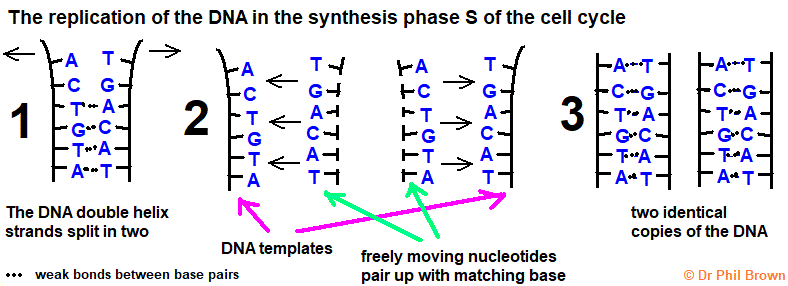
Diagram of the replication of DNA in the
synthesis phase S of the cell cycle
1. The DNA double helix molecules splits
in two, and the two strands then act as templates.
2. Freely moving nucleotides can be
matched up to form the weak bonds between the complimentary base pairs.
3. Two identical strands of DNA
produced, both identical in their original sequence of bases.
For more on DNA see
DNA and RNA structure and Protein Synthesis
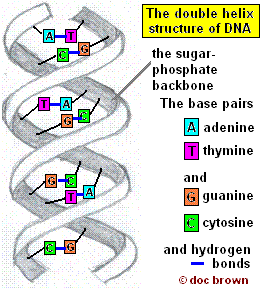 Reminders:
DNA
DNA is the acronym for
deoxyribonucleic acid and these giant molecules have all the coded
instructions for reproduction and developing an organism and keeping the
organism alive!
In the nucleus of a cell the DNA
is collected together in huge sections called chromosomes.
Shorter sections of chromosomal
DNA are called genes contain the code instructions to make specific proteins
or differentiate the functions of specific cells etc. (etc. meaning
everything!).
See
DNA and RNA structure and Protein Synthesis gcse
biology revision notes
Chromosomes and genetic
information
The majority of cells in your
body have a nucleus containing all the genetic information
required for growth and development.
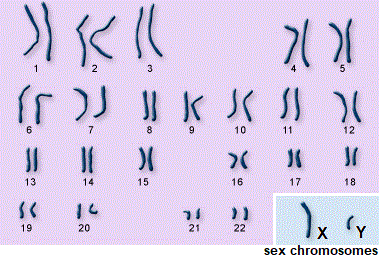 The genetic 'instructions
codes' are in
coiled up bundles of DNA molecules known as chromosomes.
The genetic 'instructions
codes' are in
coiled up bundles of DNA molecules known as chromosomes.
Every chromosome has a large
number of genes which determine all your different
characteristics.
Body cells usually have
two
copies of each chromosome (diploid cells) one set from the organism's 'mother'
(from female) and a 2nd set from the organism's 'father' (from
male).
The human body cell has 23
pairs of chromosomes (illustrated above).
When a cell divides by mitosis (details below)
two identical copies of the original
cell are made and each of the nuclei of the new diploid cells contains
the same number of chromosomes as the original cell.
Key points -
Summary of ideas
Based on
the syllabus-specifications for students taking the AQA, Edexcel and OCR
GCSE level biology examinations (~US grades 9-10).
The Cell Cycle Overview
The cell cycle is
the process by which cells grow, replicate their DNA, and divide to form new
cells. It is essential for growth, repair, and reproduction in
organisms.
The cycle consists of
three main stages:
-
Interphase
– The cell grows and prepares for division.
-
Mitosis
– The nucleus divides.
-
Cytokinesis
– The cytoplasm and cell membrane divide, forming two identical daughter
cells.
Stage 1: Interphase
-
Longest phase
of the cell cycle.
-
The cell grows,
increases the number of organelles (e.g., mitochondria, ribosomes), and
replicates its DNA.
-
The DNA is copied so that each
new cell will have a complete set of genetic instructions.
-
The chromosomes are
duplicated, forming two identical copies called chromatids,
which remain attached at the centromere.
Stage 2: Mitosis
Mitosis is the process of
nuclear division, ensuring that each daughter cell receives an
identical set of chromosomes.
Phases of Mitosis:
-
Prophase
– Chromosomes condense and become visible. The nuclear membrane starts to
break down.
-
Metaphase
– Chromosomes align at the center of the cell.
-
Anaphase
– Chromatids are pulled apart to opposite ends of the cell.
-
Telophase
– Two new nuclei form around the separated chromatids.
Stage 3: Cytokinesis
-
The cytoplasm
and cell membrane divide.
-
Two genetically
identical daughter cells are formed.
-
Each daughter cell enters
interphase, ready to begin the cycle again.
Importance of the Cell
Cycle
-
Growth
– Allows organisms to increase in size.
-
Repair
– Replaces damaged or dead cells.
-
Asexual reproduction
– In unicellular organisms, mitosis produces offspring.
Summary of learning objectives and key words or phrases
Interpret and explain diagrams of the cell cycle in terms of DNA
and chromosome replication, the phase sequence in the cell cycle - interphase,
gap phase, synthesis phase and the mitosis cell division phase.
WHAT NEXT?
TOP OF PAGE
Index for biology notes on
cell division
INDEX of all my BIOLOGY NOTES
HOME PAGE of Doc Brown's Science
website
UK KS3 Science Quizzes for
KS3 science students aged ~11-14, ~US grades 6, 7 and 8
Biology * Chemistry
* Physics UK
GCSE level students aged ~14-16, ~US grades 9-10
Advanced Level Chemistry
for pre-university age ~16-18 ~US grades 11-12, K12 Honors
Find your GCSE/IGCSE
science course for more help links to all science revision notes
email doc
brown - comments - query?
Doc Brown's school biology revision notes: GCSE biology, IGCSE
biology, O level biology, ~US biology science grade 8, grade 9 and
grade 10 school science courses or equivalent for ~14-16 year old students of
biology IGCSE AQA GCSE Biology Edexcel GCSE Biology IGCSE OCR Gateway Science
Biology OCR 21st Century Science Biology Some of these biology revision notes
might be suitable for UK KS3 Science-Biology courses for ages 12-14 (~US biology
science grades 6, grade 7 and
grade 8),
Explaining the importance of
phases of the cell cycle
in GCSE level biology, What you need to know about phases of the cell
cycle for
GCSE level
biology,
Explaining the use of phases of the cell cycle knowledge in GCSE level biology, Examples of
phases of the cell cycle explained
when studying GCSE level biology, What is
the significance of phases of the cell cycle in GCSE level biology, describing and
explaining the theory of phases of the cell cycle when studying GCSE level biology, revision
notes for phases of the cell cycle in exams, online help for understanding
phases of the cell cycle, exam revision
notes for phases of the cell cycle, what do I need to learn about phases
of the cell cycle? revision summary for phases of the cell cycle, learning notes for
phases of the cell cycle, help to pass the phases of the cell cycle
topic in an exam question, how to prepare for questions on phases of the
cell cycle in a GCSE
biology examination?
Based on the syllabus-specifications
for students taking the IGCSE/GCSE level biology examinations summary
revision notes and key points on phases of the cell cycle for students taking the AQA
igcse/gcse biology notes on phases of the cell cycle, Edexcel gcse
biology notes on phases of the cell cycle, OCR 21st century GCSE
biology notes on phases of the cell cycle, OCR gateway
GCSE biology notes on phases of the cell cycle, WJEC gcse biology notes on
phases of the cell cycle, CCEA
gcse biology notes on phases of the cell cycle for students taking CIE Cambridge igcse
biology, or any other GCSE or IGCSE level biology exams notes on
phases of the cell cycle, useful for US grade 9-10 biology courses
