CAMBRIDGE 20.

Trinity College

Cambridge University

Eastern England East Anglia Cambridgeshire Images & Notes

CAMBRIDGE INDEX

[Author & photographer © Dr Phil Brown PhD (plus text help from AI these days), page updated May 16th 2026]

A history of Trinity College, Cambridge  *  Email: chem55555@hotmail.com

* Doc Brown's Science Website biology chemistry physics *

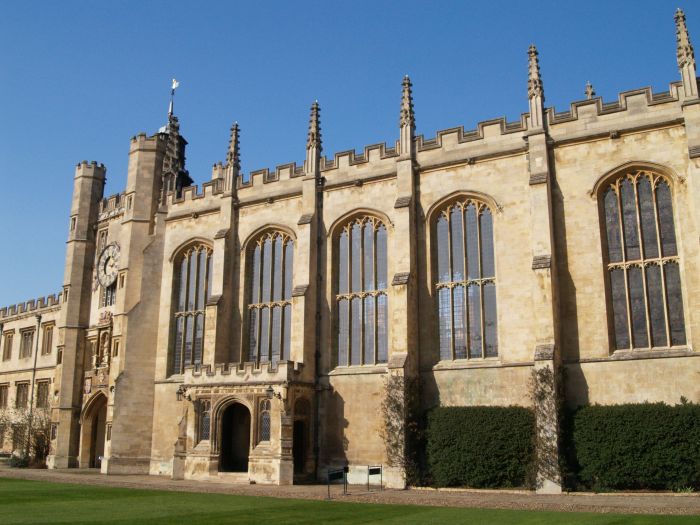
Trinity College:  main gate


Trinity College:


Trinity College:  inside main gate


Trinity College:  detail on inside main gate


Trinity College:  inside main gate, Chapel on left


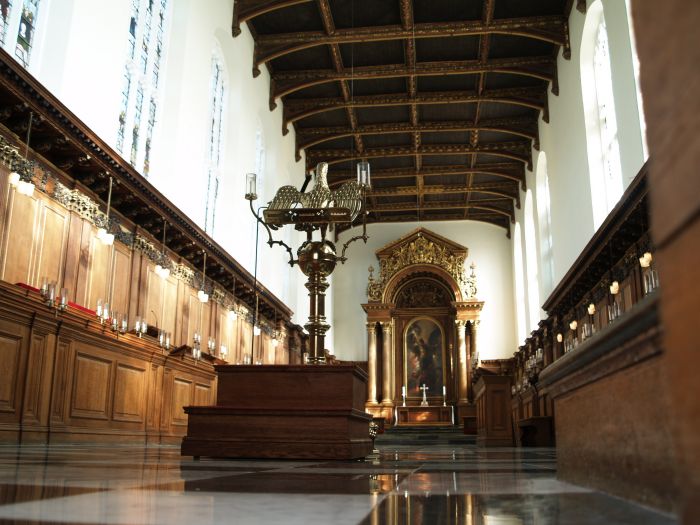
Trinity College:  Chapel


Trinity College:  entrance to Chapel


Trinity College:  Chapel


Trinity College:  altar and painting above


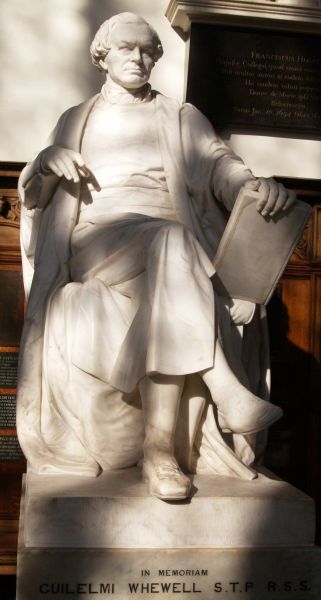
Trinity College:  'ante room' under the clock tower of the Chapel has several statues

Trinity College:


Trinity College:


Trinity College:  Francis Bacon and Isaac Newton


A history of Trinity College, Cambridge

Trinity College, Cambridge began in 1546 as Henry VIII’s grand consolidation of two medieval colleges, King’s Hall (founded 1317/1337) and Michaelhouse (founded 1324). From these origins it grew into the largest and wealthiest Cambridge college, famous for its architecture, scholarship, and an extraordinary roll‑call of alumni.


Origins and Foundation (1317–1546)

King’s Hall

  • Established by Edward II in 1317 and refounded by Edward III in 1337.
  • Occupied the northern part of what is now Great Court.

Michaelhouse

  • Founded in 1324 by Hervey de Stanton, Chancellor of the Exchequer.
  • Occupied the southern part of Great Court.

Henry VIII’s Foundation (1546)

  • In one of his final acts, Henry VIII merged King’s Hall and Michaelhouse to create The College of the Holy and Undivided Trinity.
  • He endowed it richly with lands from dissolved monasteries, making it far wealthier than its predecessors.

Growth and Early Development (1546–1700)

Rapid Expansion

By 1564 Trinity already accounted for a quarter of all resident members of the University, reflecting its swift rise in prestige.

Thomas Nevile’s Transformation (1593–1615)

Appointed Master by Elizabeth I, Thomas Nevile reshaped the college into its present architectural form:

  • Created Great Court, unifying the disparate medieval buildings.
  • Replaced decaying Michaelhouse structures with the Hall.
  • Built Nevile’s Court, later completed with the Wren Library.

Nevile’s work remains the defining architectural identity of Trinity.


The Wren Library and the 17th Century

Sir Christopher Wren’s Library (1676–1695)

  • Completed the west side of Nevile’s Court.
  • Houses treasures including an 8th‑century manuscript of St Paul’s Epistles.

Isaac Newton

  • Entered Trinity in 1661; remained until 1696.
  • Completed his most important scientific work while resident.

Architecture: A Guided Overview

⭐ Great Gate (early 16th century)

  • Originally part of King’s Hall.
  • Features a statue of Henry VIII (famously holding a chair leg in place of his sceptre—an 18th‑century student prank).

⭐ Great Court

  • Often claimed to be the largest enclosed courtyard in Europe.
  • Includes the Clock Tower, Chapel, Hall, and Nevile’s range.

⭐ Trinity Chapel (1550s–1560s)

  • Built under Mary I and Elizabeth I.
  • Intended as the spiritual centre for the Master, Fellows, and Scholars.

⭐ Nevile’s Court

  • A harmonious cloistered court facing the river.
  • Completed with the Wren Library.

⭐ New Court (19th century)

  • Built across Trinity Street.
  • Part of the college’s Victorian expansion.

⭐ Modern Additions

  • Blue Boar Court and Burrell’s Field (late 20th century).
  • Wolfson Building (1972), a modernist addition.

Academic Prestige and Achievements

Trinity has produced:

  • 34 Nobel Prize winners (more than any other Oxbridge college).
  • 4 Fields Medallists, 1 Turing Award winner, 1 Abel Prize winner.

It consistently ranks at or near the top of the Tompkins Table for academic performance.


Notable People of Trinity College

Early Figures

  • Francis Bacon – philosopher and statesman.
  • Edward Coke – jurist and legal reformer.
  • Earl of Essex – favourite of Elizabeth I.

Poets and Writers

  • George Herbert, Andrew Marvell, John Dryden – 17th‑century poets.
  • Lord Byron, William Thackeray, Alfred, Lord Tennyson – 19th‑century literary giants.

Scientists and Mathematicians

  • Isaac Newton – physicist and mathematician.
  • James Clerk Maxwell – electromagnetic theory.
  • Ernest Rutherford – nuclear physics pioneer.
  • Niels Bohr – quantum physicist.
  • Srinivasa Ramanujan – mathematician.
  • Charles Babbage – computing pioneer.

Philosophers

  • Bertrand Russell and Ludwig Wittgenstein (famously expelled then re‑admitted).

Political Leaders

  • Six British Prime Ministers, including Earl Grey (Reform Act 1832).
  • Members of the Royal Family, including King Charles III (as Prince of Wales).

The College Today

  • Home to over 1,000 students and 180+ Fellows.
  • Endowment of £2.02 billion (2023), the largest of any Oxbridge college.
  • The Choir of Trinity College is internationally renowned.
  • The Wren Library remains open to the public and scholars.

Summary

Trinity College, Cambridge is a fusion of:

  • Medieval origins (King’s Hall, Michaelhouse)
  • Tudor ambition (Henry VIII’s foundation)
  • Renaissance and Baroque architecture (Nevile, Wren)
  • Victorian expansion
  • Modern academic excellence

Its alumni list reads like a Who’s Who of science, literature, politics, and philosophy, and its architectural ensemble—Great Court, Nevile’s Court, Wren Library—makes it one of the most beautiful and historically significant colleges in Europe.


Phil and Molly's Eastern England Homepage    previous page <-> next page  


Eastern England and East Anglia images pictures photos © Phil Brown docspics photographs docspics England images pictures © Phil Brown travel tours top tourist destinations tourist information weekend breaks mini-breaks family holidays restaurants touring coach trips pleasure cruises, Walks, Holidays in Cambridge, Cambridgeshire, Top tourist attractions in Cambridge, bargain accommodation, self-catering cottages flats, luxury hotels, B&B, pubs with history & character, lively bars, good places to eat, dining out, restaurants, walking, cycling, coach tours, Cambridge museums, art galleries, historic buildings, castles, historic Cambridge churches, medieval houses, abbeys, heritage steam railways, historic medieval towns, pretty villages, visual arts exhibitions, self-catering cottages & holiday flats in Cambridge, rural lanes to cycle along in the Fen country, Cambridge Colleges, famous University Town

CAMBRIDGE INDEX

A history of Trinity College, Cambridge

  Email: chem55555@hotmail.com

ENGLISH MIDLANDS Scenes and Notes NENE VALLEY RAILWAY YORKSHIRE WOLDS scenes & notes DUBLIN Scenes and Notes LONDON Scenes and Notes Scenes from PARIS, capital city of France YORKSHIRE DALES and North Pennines scenes and notes ENGLISH MIDLANDS Scenes and Notes
Email Docs Pics CAMBRIDGE City England Images & Notes City of OXFORD Scenes & Notes HUNGARY BUDAPEST Gyor Pictures and Notes Scenes and notes from SOUTHERN ENGLAND YORK Scenes and Notes SCOTLAND - SCOTTISH Scenes and Notes LAKE DISTRICT PICTURES of England's Northern Lakeland Wells & Walsingham Light Railway

TOP OF PAGE