|
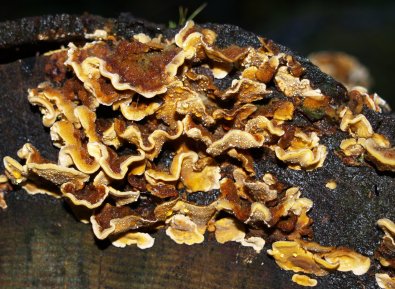
NATURE SCENES: 54. Very different forms of fungus. Fungi come
in a variety of forms
 Enter
anything of interest
Enter
anything of interest
|
*
 *
*
Left? Right
Amanita muscaria
commonly known as the fly
agaric or fly
amanita mushroom
 
*
previous page *
next picture *
NATURE SCENES photographs docspics
pictures photos images © Phil
Brown * The Natural World - Natural
History |
Amanita muscaria
From Wikipedia, the free encyclopedia
Jump to navigationJump to search
Amanita muscaria
2006-10-25 Amanita muscaria crop.jpg
Showing three stages as the mushroom expands
Scientific classification
Kingdom: Fungi
Division: Basidiomycota
Class: Agaricomycetes
Order: Agaricales
Family: Amanitaceae
Genus: Amanita
Species: A. muscaria
Binomial name
Amanita muscaria
(L.) Lam. (1783)
Subspecies and varieties
A. muscaria subsp. flavivolvata Singer Amanita muscaria 1 fly agaric or fly
amanita mushroom Amanita muscaria 2 fly agaric or fly amanita mushroom
A. muscaria var. guessowii Veselý Amanita muscaria 3 fly agaric or fly amanita
mushroom
A. muscaria var. inzengae Neville & Poumarat Amanita muscaria 4 fly agaric or
fly amanita mushroom Amanita muscaria 2 fly agaric or fly amanita mushroom
Amanita muscaria
View the Mycomorphbox template that generates the following listMycological
characteristics
gills on hymenium
cap is flat
or convex
hymenium is free
stipe has a ring and volva
spore print is white
ecology is mycorrhizal
edibility: poisonous
or psychoactive
Amanita muscaria, commonly known as the fly agaric or fly amanita, is a
basidiomycete mushroom, one of many in the genus Amanita. It is also a muscimol
mushroom. Native throughout the temperate and boreal regions of the Northern
Hemisphere, Amanita muscaria has been unintentionally introduced to many
countries in the Southern Hemisphere, generally as a symbiont with pine and
birch plantations, and is now a true cosmopolitan species. It associates with
various deciduous and coniferous trees.
Arguably the most iconic toadstool species, the fly agaric is a large
white-gilled, white-spotted, usually red mushroom, and is one of the most
recognisable and widely encountered in popular culture.
Although classified as poisonous, reports of human deaths resulting from its
ingestion are extremely rare. After parboiling—which weakens its toxicity and
breaks down the mushroom's psychoactive substances—it is eaten in parts of
Europe, Asia, and North America. Amanita muscaria is noted for its
hallucinogenic properties, with its main psychoactive constituents being the
compounds ibotenic acid and muscimol. The mushroom was used as an intoxicant and
entheogen by the peoples of Siberia, and has a religious significance in these
cultures. There has been much speculation on possible traditional use of this
mushroom as an intoxicant in other places such as the Middle East, Eurasia,
North America, and Scandinavia.
Contents
1 Taxonomy and naming
1.1 Classification
1.1.1 Controversy
2 Description
3 Distribution and habitat
4 Toxicity
4.1 Pharmacology
4.2 Symptoms
4.3 Treatment
4.4 Psychoactive use
4.5 Siberia
4.6 Other reports of use
4.7 Vikings
5 Fly trap
6 In religion
6.1 Soma
6.2 Christianity
7 Culinary use
8 Cultural depictions
8.1 Literature
9 See also
10 References
10.1 Works cited
11 External links
Taxonomy and naming
The name of the mushroom in many European languages is thought to be derived
from its use as an insecticide when sprinkled in milk. This practice has been
recorded from Germanic- and Slavic-speaking parts of Europe, as well as the
Vosges region and pockets elsewhere in France, and Romania. Amanita muscaria 5
fly agaric or fly amanita mushroom :198 Albertus Magnus was the first to record
it in his work De vegetabilibus some time before 1256, Amanita muscaria 6 fly
agaric or fly amanita mushroom commenting vocatur fungus muscarum, eo quod in
lacte pulverizatus interficit muscas, "it is called the fly mushroom because it
is powdered in milk to kill flies." Amanita muscaria 7 fly agaric or fly amanita
mushroom
Showing the partial veil under the cap dropping away to form a ring around the
stipe
The 16th-century Flemish botanist Carolus Clusius traced the practice of
sprinkling it into milk to Frankfurt in Germany, Amanita muscaria 8 fly agaric
or fly amanita mushroom while Carl Linnaeus, the "father of taxonomy", reported
it from Småland in southern Sweden, where he had lived as a child. Amanita
muscaria 9 fly agaric or fly amanita mushroom He described it in volume two of
his Species Plantarum in 1753, giving it the name Agaricus muscarius, Amanita
muscaria 10 fly agaric or fly amanita mushroom the specific epithet deriving
from Latin musca meaning "fly". Amanita muscaria 11 fly agaric or fly amanita
mushroom It gained its current name in 1783, when placed in the genus Amanita by
Jean-Baptiste Lamarck, a name sanctioned in 1821 by the "father of mycology",
Swedish naturalist Elias Magnus Fries. The starting date for all the mycota had
been set by general agreement as January 1, 1821, the date of Fries's work, and
so the full name was then Amanita muscaria (L.:Fr.) Hook. The 1987 edition of
the International Code of Botanical Nomenclature changed the rules on the
starting date and primary work for names of fungi, and names can now be
considered valid as far back as May 1, 1753, the date of publication of
Linnaeus's work. Amanita muscaria 12 fly agaric or fly amanita mushroom Hence,
Linnaeus and Lamarck are now taken as the namers of Amanita muscaria (L.) Lam..
The English mycologist John Ramsbottom reported that Amanita muscaria was used
for getting rid of bugs in England and Sweden, and bug agaric was an old
alternative name for the species. Amanita muscaria 7 fly agaric or fly amanita
mushroom French mycologist Pierre Bulliard reported having tried without success
to replicate its fly-killing properties in his work Histoire des plantes
vénéneuses et suspectes de la France (1784), and proposed a new binomial name
Agaricus pseudo-aurantiacus because of this. Amanita muscaria 5 fly agaric or
fly amanita mushroom :200 One compound isolated from the fungus is 1,3-diolein (
1,3-Di(cis-9-octadecenoyl)glycerol), which attracts insects. Amanita muscaria 13
fly agaric or fly amanita mushroom It has been hypothesised that the flies
intentionally seek out the fly agaric for its intoxicating properties. Amanita
muscaria 14 fly agaric or fly amanita mushroom An alternative derivation
proposes that the term fly- refers not to insects as such but rather the
delirium resulting from consumption of the fungus. This is based on the medieval
belief that flies could enter a person's head and cause mental illness. Amanita
muscaria 15 fly agaric or fly amanita mushroom Several regional names appear to
be linked with this connotation, meaning the "mad" or "fool's" version of the
highly regarded edible mushroom Amanita caesarea. Hence there is oriol foll "mad
oriol" in Catalan, mujolo folo from Toulouse, concourlo fouolo from the Aveyron
department in Southern France, ovolo matto from Trentino in Italy. A local
dialect name in Fribourg in Switzerland is tsapi de diablhou, which translates
as "Devil's hat". Amanita muscaria 5 fly agaric or fly amanita mushroom :194
Classification
Amanita muscaria is the type species of the genus. By extension, it is also the
type species of Amanita subgenus Amanita, as well as section Amanita within this
subgenus. Amanita subgenus Amanita includes all Amanita with inamyloid spores.
Amanita section Amanita includes the species which have very patchy universal
veil remnants, including a volva that is reduced to a series of concentric rings
and the veil remnants on the cap to a series of patches or warts. Most species
in this group also have a bulbous base. Amanita muscaria 16 fly agaric or fly
amanita mushroom Amanita muscaria 17 fly agaric or fly amanita mushroom Amanita
section Amanita consists of A. muscaria and its close relatives, including A.
pantherina (the panther cap), A. gemmata, A. farinosa, and A. xanthocephala.
Amanita muscaria 18 fly agaric or fly amanita mushroom Modern fungal taxonomists
have classified Amanita muscaria and its allies this way based on gross
morphology and spore inamyloidy. Two recent molecular phylogenetic studies have
confirmed this classification as natural. Amanita muscaria 19 fly agaric or fly
amanita mushroom Amanita muscaria 20 fly agaric or fly amanita mushroom
Controversy
Amanita muscaria var. formosa is now a synonym for Amanita muscaria var.
guessowii. Amanita muscaria 3 fly agaric or fly amanita mushroom
Amanita muscaria varies considerably in its morphology, and many authorities
recognize several subspecies or varieties within the species. In The Agaricales
in Modern Taxonomy, German mycologist Rolf Singer listed three subspecies,
though without description: A. muscaria ssp. muscaria, A. muscaria ssp.
americana, and A. muscaria ssp. flavivolvata. Amanita muscaria 16 fly agaric or
fly amanita mushroom
However, a 2006 molecular phylogenetic study of different regional populations
of A. muscaria by mycologist József Geml and colleagues found three distinct
clades within this species representing, roughly, Eurasian, Eurasian
"subalpine", and North American populations. Specimens belonging to all three
clades have been found in Alaska; this has led to the hypothesis that this was
the centre of diversification for this species. The study also looked at four
named varieties of the species: var. alba, var. flavivolvata, var. formosa
(including var. guessowii), and var. regalis from both areas. All four varieties
were found within both the Eurasian and North American clades, evidence that
these morphological forms are polymorphisms rather than distinct subspecies or
varieties. Amanita muscaria 21 fly agaric or fly amanita mushroom Further
molecular study by Geml and colleagues published in 2008 show that these three
genetic groups, plus a fourth associated with oak–hickory–pine forest in the
southeastern United States and two more on Santa Cruz Island in California, are
delineated from each other enough genetically to be considered separate species;
thus A. muscaria as it stands currently is evidently a species complex. Amanita
muscaria 22 fly agaric or fly amanita mushroom The complex also includes at
least three other closely related taxa that are currently regarded as species:
Amanita muscaria 1 fly agaric or fly amanita mushroom A. breckonii is a
buff-capped mushroom associated with conifers from the Pacific Northwest,
Amanita muscaria 23 fly agaric or fly amanita mushroom and the brown-capped A.
gioiosa and A. heterochroma from the Mediterranean Basin and from Sardinia
respectively. Both of these last two are found with Eucalyptus and Cistus trees,
and it is unclear whether they are native or introduced from Australia. Amanita
muscaria 24 fly agaric or fly amanita mushroom Amanita muscaria 25 fly agaric or
fly amanita mushroom
Amanitaceae.org now only recognize three varieties but says that they will be
segregated into their own taxa in the near future, the varieties are: Amanita
muscaria 26 fly agaric or fly amanita mushroom
Image Reference name Common name Synonym Description
Amanita muscaria 26643.JPG Amanita muscaria var. flavivolvata Amanita muscaria 1
fly agaric or fly amanita mushroom American fly agaric red, with yellow to
yellowish-white warts. It is found from southern Alaska down through the Rocky
Mountains, through Central America, all the way to Andean Colombia. Rodham
Tulloss uses this name to describe all "typical" A. muscaria from indigenous New
World populations.
Flickr - Nicholas T - Forrest H. Dutlinger Natural Area (Revisited) (19).jpg
Amanita muscaria var. guessowii Amanita muscaria 3 fly agaric or fly amanita
mushroom American fly agaric (yellow variant) Amanita muscaria var. formosa has
a yellow to orange cap, with the centre more orange or perhaps even reddish
orange. It is found most commonly in northeastern North America, from
Newfoundland and Quebec south all the way to the state of Tennessee. Some
authorities (cf. Jenkins) treat these populations as A. muscaria var. formosa,
while others (cf. Tulloss) recognise them as a distinct variety.
Amanita muscaria var. inzengae Amanita muscaria 27 fly agaric or fly amanita
mushroom Inzenga's fly agaric it has a yellow to orange-yellow cap with
yellowish warts and stem which may be tan.
Description
A white-fleshed mushroom with a red skin cut in half
Cross section of fruiting body, showing pigment under skin and free gills
A large, conspicuous mushroom, Amanita muscaria is generally common and numerous
where it grows, and is often found in groups with basidiocarps in all stages of
development. Fly agaric fruiting bodies emerge from the soil looking like white
eggs. After emerging from the ground, the cap is covered with numerous small
white to yellow pyramid-shaped warts. These are remnants of the universal veil,
a membrane that encloses the entire mushroom when it is still very young.
Dissecting the mushroom at this stage will reveal a characteristic yellowish
layer of skin under the veil; this is helpful in identification. As the fungus
grows, the red colour appears through the broken veil and the warts become less
prominent; they do not change in size, but are reduced relative to the expanding
skin area. The cap changes from globose to hemispherical, and finally to
plate-like and flat in mature specimens. Amanita muscaria 28 fly agaric or fly
amanita mushroom Fully grown, the bright red cap is usually around 8–20 cm (3–8
in) in diameter, although larger specimens have been found. The red colour may
fade after rain and in older mushrooms.
The free gills are white, as is the spore print. The oval spores measure 9–13 by
6.5–9 μm; they do not turn blue with the application of iodine. Amanita muscaria
29 fly agaric or fly amanita mushroom The stipe is white, 5–20 cm (2.0–7.9 in)
high by 1–2 cm (0.5–1 in) wide, and has the slightly brittle, fibrous texture
typical of many large mushrooms. At the base is a bulb that bears universal veil
remnants in the form of two to four distinct rings or ruffs. Between the basal
universal veil remnants and gills are remnants of the partial veil (which covers
the gills during development) in the form of a white ring. It can be quite wide
and flaccid with age. There is generally no associated smell other than a mild
earthiness. Amanita muscaria 30 fly agaric or fly amanita mushroom Amanita
muscaria 31 fly agaric or fly amanita mushroom
Although very distinctive in appearance, the fly agaric has been mistaken for
other yellow to red mushroom species in the Americas, such as Armillaria cf.
mellea and the edible Amanita basii—a Mexican species similar to A. caesarea of
Europe. Poison control centres in the U.S. and Canada have become aware that
amarill (Spanish for 'yellow') is a common name for the A. caesarea-like species
in Mexico. Amanita muscaria 4 fly agaric or fly amanita mushroom Amanita
caesarea can be distinguished by its entirely orange to red cap which lacks the
numerous white warty spots of the fly agaric. Furthermore, the stem, gills and
ring of A. caesarea are bright yellow, not white. Amanita muscaria 32 fly agaric
or fly amanita mushroom The volva is a distinct white bag, not broken into
scales. Amanita muscaria 33 fly agaric or fly amanita mushroom In Australia, the
introduced fly agaric may be confused with the native vermilion grisette
(Amanita xanthocephala), which grows in association with eucalypts. The latter
species generally lacks the white warts of A. muscaria and bears no ring.
Amanita muscaria 34 fly agaric or fly amanita mushroom
Distribution and habitat
A. muscaria in a Pinus radiata plantation, near Mount Field National Park,
Tasmania
Amanita muscaria is a cosmopolitan mushroom, native to conifer and deciduous
woodlands throughout the temperate and boreal regions of the Northern
Hemisphere, Amanita muscaria 21 fly agaric or fly amanita mushroom including
higher elevations of warmer latitudes in regions such as Hindu Kush, the
Mediterranean and also Central America. A recent molecular study proposes that
it had an ancestral origin in the Siberian–Beringian region in the Tertiary
period, before radiating outwards across Asia, Europe and North America. Amanita
muscaria 21 fly agaric or fly amanita mushroom The season for fruiting varies in
different climates: fruiting occurs in summer and autumn across most of North
America, but later in autumn and early winter on the Pacific coast. This species
is often found in similar locations to Boletus edulis, and may appear in fairy
rings. Amanita muscaria 35 fly agaric or fly amanita mushroom Conveyed with pine
seedlings, it has been widely transported into the southern hemisphere,
including Australia, Amanita muscaria 36 fly agaric or fly amanita mushroom New
Zealand, Amanita muscaria 37 fly agaric or fly amanita mushroom South Africa
Amanita muscaria 38 fly agaric or fly amanita mushroom and South America, where
it can be found in the southern Brazilian states of Paraná Amanita muscaria 21
fly agaric or fly amanita mushroom and Rio Grande do Sul. Amanita muscaria 39
fly agaric or fly amanita mushroom
Ectomycorrhizal, Amanita muscaria forms symbiotic relationships with many trees,
including pine, spruce, fir, birch, and cedar. Commonly seen under introduced
trees, Amanita muscaria 40 fly agaric or fly amanita mushroom A. muscaria is the
fungal equivalent of a weed in New Zealand, Tasmania and Victoria, forming new
associations with southern beech (Nothofagus). Amanita muscaria 41 fly agaric or
fly amanita mushroom The species is also invading a rainforest in Australia,
where it may be displacing the native species. Amanita muscaria 40 fly agaric or
fly amanita mushroom It appears to be spreading northwards, with recent reports
placing it near Port Macquarie on the New South Wales north coast. Amanita
muscaria 42 fly agaric or fly amanita mushroom It was recorded under silver
birch (Betula pendula) in Manjimup, Western Australia in 2010. Amanita muscaria
43 fly agaric or fly amanita mushroom Although it has apparently not spread to
eucalypts in Australia, it has been recorded associating with them in Portugal.
Amanita muscaria 44 fly agaric or fly amanita mushroom
Toxicity
a tall red mushroom with a few white spots on the cap
Mature. The white spots may wash off with heavy rainfall
Amanita muscaria poisoning has occurred in young children and in people who
ingested the mushrooms for a hallucinogenic experience. Amanita muscaria 15 fly
agaric or fly amanita mushroom Amanita muscaria 45 fly agaric or fly amanita
mushroom Amanita muscaria 46 fly agaric or fly amanita mushroom Occasionally it
has been ingested in error, because immature button forms resemble puffballs.
Amanita muscaria 47 fly agaric or fly amanita mushroom The white spots sometimes
wash away during heavy rain and the mushrooms then may appear to be the edible
A. caesarea. Amanita muscaria 48 fly agaric or fly amanita mushroom
Amanita muscaria contains several biologically active agents, at least one of
which, muscimol, is known to be psychoactive. Ibotenic acid, a neurotoxin,
serves as a prodrug to muscimol, with approximately 10–20% converting to
muscimol after ingestion. An active dose in adults is approximately 6 mg
muscimol or 30 to 60 mg ibotenic acid; Amanita muscaria 49 fly agaric or fly
amanita mushroom Amanita muscaria 50 fly agaric or fly amanita mushroom this is
typically about the amount found in one cap of Amanita muscaria. Amanita
muscaria 51 fly agaric or fly amanita mushroom The amount and ratio of chemical
compounds per mushroom varies widely from region to region and season to season,
which can further confuse the issue. Spring and summer mushrooms have been
reported to contain up to 10 times more ibotenic acid and muscimol than autumn
fruitings. Amanita muscaria 45 fly agaric or fly amanita mushroom
A fatal dose has been calculated as 15 caps. Amanita muscaria 52 fly agaric or
fly amanita mushroom Deaths from this fungus A. muscaria have been reported in
historical journal articles and newspaper reports, Amanita muscaria 53 fly
agaric or fly amanita mushroom Amanita muscaria 54 fly agaric or fly amanita
mushroom Amanita muscaria 55 fly agaric or fly amanita mushroom but with modern
medical treatment, fatal poisoning from ingesting this mushroom is extremely
rare. Amanita muscaria 56 fly agaric or fly amanita mushroom Many older books
list Amanita muscaria as "deadly", but this is an error that implies the
mushroom is more toxic than it is. Amanita muscaria 57 fly agaric or fly amanita
mushroom The North American Mycological Association has stated that there were
"no reliably documented cases of death from toxins in these mushrooms in the
past 100 years". Amanita muscaria 58 fly agaric or fly amanita mushroom
The active constituents of this species are water-soluble, and boiling and then
discarding the cooking water at least partly detoxifies A. muscaria. Amanita
muscaria 59 fly agaric or fly amanita mushroom Drying may increase potency, as
the process facilitates the conversion of ibotenic acid to the more potent
muscimol. Amanita muscaria 60 fly agaric or fly amanita mushroom According to
some sources, once detoxified, the mushroom becomes edible. Amanita muscaria 61
fly agaric or fly amanita mushroom Amanita muscaria 62 fly agaric or fly amanita
mushroom
Pharmacology
Muscimol, the principal psychoactive constituent of A. muscaria
Ibotenic acid, a prodrug to muscimol found in A. muscaria
Muscarine, discovered in 1869, Amanita muscaria 63 fly agaric or fly amanita
mushroom was long thought to be the active hallucinogenic agent in A. muscaria.
Muscarine binds with muscarinic acetylcholine receptors leading to the
excitation of neurons bearing these receptors. The levels of muscarine in
Amanita muscaria are minute when compared with other poisonous fungi Amanita
muscaria 64 fly agaric or fly amanita mushroom such as Inocybe erubescens, the
small white Clitocybe species C. dealbata and C. rivulosa. The level of
muscarine in A. muscaria is too low to play a role in the symptoms of poisoning.
Amanita muscaria 65 fly agaric or fly amanita mushroom
The major toxins involved in A. muscaria poisoning are muscimol
(3-hydroxy-5-aminomethyl-1-isoxazole, an unsaturated cyclic hydroxamic acid) and
the related amino acid ibotenic acid. Muscimol is the product of the
decarboxylation (usually by drying) of ibotenic acid. Muscimol and ibotenic acid
were discovered in the mid-20th century. Amanita muscaria 66 fly agaric or fly
amanita mushroom Amanita muscaria 67 fly agaric or fly amanita mushroom
Researchers in England, Amanita muscaria 68 fly agaric or fly amanita mushroom
Japan, Amanita muscaria 69 fly agaric or fly amanita mushroom and Switzerland
Amanita muscaria 67 fly agaric or fly amanita mushroom showed that the effects
produced were due mainly to ibotenic acid and muscimol, not muscarine. Amanita
muscaria 13 fly agaric or fly amanita mushroom Amanita muscaria 66 fly agaric or
fly amanita mushroom These toxins are not distributed uniformly in the mushroom.
Most are detected in the cap of the fruit, a moderate amount in the base, with
the smallest amount in the stalk. Amanita muscaria 70 fly agaric or fly amanita
mushroom Amanita muscaria 71 fly agaric or fly amanita mushroom Quite rapidly,
between 20 and 90 minutes after ingestion, a substantial fraction of ibotenic
acid is excreted unmetabolised in the urine of the consumer. Almost no muscimol
is excreted when pure ibotenic acid is eaten, but muscimol is detectable in the
urine after eating A. muscaria, which contains both ibotenic acid and muscimol.
Amanita muscaria 50 fly agaric or fly amanita mushroom
Ibotenic acid and muscimol are structurally related to each other and to two
major neurotransmitters of the central nervous system: glutamic acid and GABA
respectively. Ibotenic acid and muscimol act like these neurotransmitters,
muscimol being a potent GABAA agonist, while ibotenic acid is an agonist of NMDA
glutamate receptors and certain metabotropic glutamate receptors Amanita
muscaria 72 fly agaric or fly amanita mushroom which are involved in the control
of neuronal activity. It is these interactions which are thought to cause the
psychoactive effects found in intoxication. Amanita muscaria 15 fly agaric or
fly amanita mushroom Amanita muscaria 51 fly agaric or fly amanita mushroom
Muscazone is another compound that has more recently been isolated from European
specimens of the fly agaric. It is a product of the breakdown of ibotenic acid
by ultra-violet radiation. Amanita muscaria 73 fly agaric or fly amanita
mushroom Muscazone is of minor pharmacological activity compared with the other
agents. Amanita muscaria 15 fly agaric or fly amanita mushroom Amanita muscaria
and related species are known as effective bioaccumulators of vanadium; some
species concentrate vanadium to levels of up to 400 times those typically found
in plants. Amanita muscaria 74 fly agaric or fly amanita mushroom Vanadium is
present in fruit-bodies as an organometallic compound called amavadine. Amanita
muscaria 74 fly agaric or fly amanita mushroom The biological importance of the
accumulation process is unknown. Amanita muscaria 75 fly agaric or fly amanita
mushroom
Symptoms
Fly agarics are known for the unpredictability of their effects. Depending on
habitat and the amount ingested per body weight, effects can range from nausea
and twitching to drowsiness, cholinergic crisis-like effects (low blood
pressure, sweating and salivation), auditory and visual distortions, mood
changes, euphoria, relaxation, ataxia, and loss of equilibrium. Amanita muscaria
45 fly agaric or fly amanita mushroom Amanita muscaria 46 fly agaric or fly
amanita mushroom Amanita muscaria 51 fly agaric or fly amanita mushroom Amanita
muscaria 54 fly agaric or fly amanita mushroom
In cases of serious poisoning the mushroom causes delirium, somewhat similar in
effect to anticholinergic poisoning (such as that caused by Datura stramonium),
characterised by bouts of marked agitation with confusion, hallucinations, and
irritability followed by periods of central nervous system depression. Seizures
and coma may also occur in severe poisonings. Amanita muscaria 46 fly agaric or
fly amanita mushroom Amanita muscaria 51 fly agaric or fly amanita mushroom
Symptoms typically appear after around 30 to 90 minutes and peak within three
hours, but certain effects can last for several days. Amanita muscaria 48 fly
agaric or fly amanita mushroom Amanita muscaria 50 fly agaric or fly amanita
mushroom In the majority of cases recovery is complete within 12 to 24 hours.
Amanita muscaria 59 fly agaric or fly amanita mushroom The effect is highly
variable between individuals, with similar doses potentially causing quite
different reactions. Amanita muscaria 45 fly agaric or fly amanita mushroom
Amanita muscaria 50 fly agaric or fly amanita mushroom Amanita muscaria 76 fly
agaric or fly amanita mushroom Some people suffering intoxication have exhibited
headaches up to ten hours afterwards. Amanita muscaria 50 fly agaric or fly
amanita mushroom Retrograde amnesia and somnolence can result following
recovery. Amanita muscaria 51 fly agaric or fly amanita mushroom
Treatment
Medical attention should be sought in cases of suspected poisoning. If the delay
between ingestion and treatment is less than four hours, activated charcoal is
given. Gastric lavage can be considered if the patient presents within one hour
of ingestion. Amanita muscaria 77 fly agaric or fly amanita mushroom Inducing
vomiting with syrup of ipecac is no longer recommended in any poisoning
situation. Amanita muscaria 78 fly agaric or fly amanita mushroom
There is no antidote, and supportive care is the mainstay of further treatment
for intoxication. Though sometimes referred to as a deliriant and while
muscarine was first isolated from A. muscaria and as such is its namesake,
muscimol does not have action, either as an agonist or antagonist, at the
muscarinic acetylcholine receptor site, and therefore atropine or physostigmine
as an antidote is not recommended. Amanita muscaria 79 fly agaric or fly amanita
mushroom If a patient is delirious or agitated, this can usually be treated by
reassurance and, if necessary, physical restraints. A benzodiazepine such as
diazepam or lorazepam can be used to control combativeness, agitation, muscular
overactivity, and seizures. Amanita muscaria 45 fly agaric or fly amanita
mushroom Only small doses should be used, as they may worsen the respiratory
depressant effects of muscimol. Amanita muscaria 80 fly agaric or fly amanita
mushroom Recurrent vomiting is rare, but if present may lead to fluid and
electrolyte imbalances; intravenous rehydration or electrolyte replacement may
be required. Amanita muscaria 51 fly agaric or fly amanita mushroom Amanita
muscaria 81 fly agaric or fly amanita mushroom Serious cases may develop loss of
consciousness or coma, and may need intubation and artificial ventilation.
Amanita muscaria 46 fly agaric or fly amanita mushroom Amanita muscaria 82 fly
agaric or fly amanita mushroom Hemodialysis can remove the toxins, although this
intervention is generally considered unnecessary. Amanita muscaria 59 fly agaric
or fly amanita mushroom With modern medical treatment the prognosis is typically
good following supportive treatment. Amanita muscaria 56 fly agaric or fly
amanita mushroom Amanita muscaria 59 fly agaric or fly amanita mushroom
Psychoactive use
Amanita muscaria in Mount Lofty, South Australia
Photographed in Mount Lofty Botanic Gardens, Adelaide Hills, South Australia
The wide range of psychoactive effects have been variously described as
depressant, sedative-hypnotic, psychedelic, dissociative, and or deliriant;
paradoxical effects such as stimulation may occur however. Perceptual phenomena
such as synesthesia, macropsia, and micropsia may occur; the latter two effects
may occur simultaneously and or alternatingly as part of Alice in Wonderland
syndrome, collectively known as dysmetropsia, along with related distortions
pelopsia and teleopsia. Some users report lucid dreaming under the influence of
its hypnotic effects. Unlike Psilocybe cubensis, A. muscaria cannot be
commercially cultivated, due to its mycorrhizal relationship with the roots of
pine trees. However, following the outlawing of psilocybin mushrooms in the
United Kingdom in 2006, the sale of the still legal A. muscaria began
increasing. Amanita muscaria 83 fly agaric or fly amanita mushroom :17
Professor Marija Gimbutienė, a renowned Lithuanian historian, reported to R.
Gordon Wasson on the use of this mushroom in Lithuania. In remote areas of
Lithuania Amanita muscaria has been consumed at wedding feasts, in which
mushrooms were mixed with vodka. The professor also reported that the
Lithuanians used to export A. muscaria to the Lapps in the Far North for use in
shamanic rituals. The Lithuanian festivities are the only report that Wasson
received of ingestion of fly agaric for religious use in Eastern Europe. Amanita
muscaria 84 fly agaric or fly amanita mushroom :43–44
Siberia
Amanita muscaria was widely used as an entheogen by many of the indigenous
peoples of Siberia. Its use was known among almost all of the Uralic-speaking
peoples of western Siberia and the Paleosiberian-speaking peoples of the Russian
Far East. There are only isolated reports of A. muscaria use among the Tungusic
and Turkic peoples of central Siberia and it is believed that on the whole
entheogenic use of A. muscaria was not practised by these peoples. Amanita
muscaria 85 fly agaric or fly amanita mushroom In western Siberia, the use of A.
muscaria was restricted to shamans, who used it as an alternative method of
achieving a trance state. (Normally, Siberian shamans achieve trance by
prolonged drumming and dancing.) In eastern Siberia, A. muscaria was used by
both shamans and laypeople alike, and was used recreationally as well as
religiously. Amanita muscaria 85 fly agaric or fly amanita mushroom In eastern
Siberia, the shaman would take the mushrooms, and others would drink his urine.
Amanita muscaria 5 fly agaric or fly amanita mushroom :161 This urine, still
containing psychoactive elements, may be more potent than the A. muscaria
mushrooms with fewer negative effects such as sweating and twitching, suggesting
that the initial user may act as a screening filter for other components in the
mushroom. Amanita muscaria 86 fly agaric or fly amanita mushroom
The Koryak of eastern Siberia have a story about the fly agaric (wapaq) which
enabled Big Raven to carry a whale to its home. In the story, the deity
Vahiyinin ("Existence") spat onto earth, and his spittle became the wapaq, and
his saliva becomes the warts. After experiencing the power of the wapaq, Raven
was so exhilarated that he told it to grow forever on earth so his children, the
people, could learn from it. Amanita muscaria 87 fly agaric or fly amanita
mushroom Among the Koryaks, one report said that the poor would consume the
urine of the wealthy, who could afford to buy the mushrooms. Amanita muscaria 5
fly agaric or fly amanita mushroom :234–35
Other reports of use
The Finnish historian T. I. Itkonen mentions that A. muscaria was once used
among the Sami people: sorcerers in Inari would consume fly agarics with seven
spots. Amanita muscaria 5 fly agaric or fly amanita mushroom :279 In 1979, Said
Gholam Mochtar and Hartmut Geerken published an article in which they claim to
have discovered a tradition of medicinal and recreational use of this mushroom
among a Parachi-speaking group in Afghanistan. Amanita muscaria 88 fly agaric or
fly amanita mushroom There are also unconfirmed reports of religious use of A.
muscaria among two Subarctic Native American tribes. Ojibwa ethnobotanist
Keewaydinoquay Peschel reported its use among her people, where it was known as
the miskwedo. Amanita muscaria 89 fly agaric or fly amanita mushroom Amanita
muscaria 90 fly agaric or fly amanita mushroom This information was
enthusiastically received by Wasson, although evidence from other sources was
lacking. Amanita muscaria 91 fly agaric or fly amanita mushroom There is also
one account of a Euro-American who claims to have been initiated into
traditional Tlicho use of Amanita muscaria. Amanita muscaria 92 fly agaric or
fly amanita mushroom
Vikings
The notion that Vikings used A. muscaria to produce their berserker rages was
first suggested by the Swedish professor Samuel Ödmann in 1784. Amanita muscaria
93 fly agaric or fly amanita mushroom Ödmann based his theories on reports about
the use of fly agaric among Siberian shamans. The notion has become widespread
since the 19th century, but no contemporary sources mention this use or anything
similar in their description of berserkers. Muscimol is generally a mild
relaxant, but it can create a range of different reactions within a group of
people. Amanita muscaria 94 fly agaric or fly amanita mushroom It is possible
that it could make a person angry, or cause them to be "very jolly or sad, jump
about, dance, sing or give way to great fright". Amanita muscaria 94 fly agaric
or fly amanita mushroom
Fly trap
Amanita muscaria is traditionally used for catching flies possibly due to its
content of ibotenic acid and muscimol. Recently, an analysis of nine different
methods for preparing A. muscaria for catching flies in Slovenia have shown that
the release of ibotenic acid and muscimol did not depend on the solvent (milk or
water) and that thermal and mechanical processing led to faster extraction of
ibotenic acid and muscimol. Amanita muscaria 95 fly agaric or fly amanita
mushroom
In religion
Soma
See also: Botanical identity of Soma-Haoma
In 1968, R. Gordon Wasson proposed that A. muscaria was the soma talked about in
the Rigveda of India, Amanita muscaria 5 fly agaric or fly amanita mushroom :10
a claim which received widespread publicity and popular support at the time.
Amanita muscaria 96 fly agaric or fly amanita mushroom He noted that
descriptions of Soma omitted any description of roots, stems or seeds, which
suggested a mushroom, Amanita muscaria 5 fly agaric or fly amanita mushroom :18
and used the adjective hári "dazzling" or "flaming" which the author interprets
as meaning red. Amanita muscaria 5 fly agaric or fly amanita mushroom :36–37 One
line described men urinating Soma; this recalled the practice of recycling urine
in Siberia. Soma is mentioned as coming "from the mountains", which Wasson
interpreted as the mushroom having been brought in with the Aryan invaders from
the north. Amanita muscaria 5 fly agaric or fly amanita mushroom :22–24 Indian
scholars Santosh Kumar Dash and Sachinanda Padhy pointed out that both eating of
mushrooms and drinking of urine were proscribed, using as a source the
Manusmṛti. Amanita muscaria 97 fly agaric or fly amanita mushroom In 1971, Vedic
scholar John Brough from Cambridge University rejected Wasson's theory and noted
that the language was too vague to determine a description of Soma. Amanita
muscaria 98 fly agaric or fly amanita mushroom In his 1976 survey, Hallucinogens
and Culture, anthropologist Peter T. Furst evaluated the evidence for and
against the identification of the fly agaric mushroom as the Vedic Soma,
concluding cautiously in its favour. Amanita muscaria 99 fly agaric or fly
amanita mushroom
Christianity
Mosaic of red mushrooms, found in the Christian Basilica of Aquileia in northern
Italy, dating to before 330 AD
Philologist, archeologist, and Dead Sea Scrolls scholar John Marco Allegro
postulated that early Christian theology was derived from a fertility cult
revolving around the entheogenic consumption of A. muscaria in his 1970 book The
Sacred Mushroom and the Cross, Amanita muscaria 100 fly agaric or fly amanita
mushroom but his theory has found little support by scholars outside the field
of ethnomycology. The book was roundly criticized by academics and theologians,
including Sir Godfrey Driver, Emeritus Professor of Semitic Philology at Oxford
University, and Henry Chadwick, the Dean of Christ Church, Oxford. Amanita
muscaria 101 fly agaric or fly amanita mushroom Christian author John C. King
wrote a detailed rebuttal of Allegro's theory in the 1970 book A Christian View
of the Mushroom Myth; he notes that neither fly agarics nor their host trees are
found in the Middle East, even though cedars and pines are found there, and
highlights the tenuous nature of the links between biblical and Sumerian names
coined by Allegro. He concludes that if the theory were true, the use of the
mushroom must have been "the best kept secret in the world" as it was so well
concealed for two thousand years. Amanita muscaria 102 fly agaric or fly amanita
mushroom Amanita muscaria 103 fly agaric or fly amanita mushroom
Culinary use
The toxins in A. muscaria are water-soluble. When sliced thinly, or finely diced
and boiled in plentiful water until thoroughly cooked, it seems to be
detoxified. Amanita muscaria 61 fly agaric or fly amanita mushroom Although its
consumption as a food has never been widespread, Amanita muscaria 104 fly agaric
or fly amanita mushroom the consumption of detoxified A. muscaria has been
practiced in some parts of Europe (notably by Russian settlers in Siberia) since
at least the 19th century, and likely earlier. The German physician and
naturalist Georg Heinrich von Langsdorff wrote the earliest published account on
how to detoxify this mushroom in 1823. In the late 19th century, the French
physician Félix Archimède Pouchet was a populariser and advocate of A. muscaria
consumption, comparing it to manioc, an important food source in tropical South
America that must be detoxified before consumption. Amanita muscaria 61 fly
agaric or fly amanita mushroom
Use of this mushroom as a food source also seems to have existed in North
America. A classic description of this use of A. muscaria by an African-American
mushroom seller in Washington, D.C., in the late 19th century is described by
American botanist Frederick Vernon Coville. In this case, the mushroom, after
parboiling, and soaking in vinegar, is made into a mushroom sauce for steak.
Amanita muscaria 105 fly agaric or fly amanita mushroom It is also consumed as a
food in parts of Japan. The most well-known current use as an edible mushroom is
in Nagano Prefecture, Japan. There, it is primarily salted and pickled. Amanita
muscaria 106 fly agaric or fly amanita mushroom
A 2008 paper by food historian William Rubel and mycologist David Arora gives a
history of consumption of A. muscaria as a food and describes detoxification
methods. They advocate that Amanita muscaria be described in field guides as an
edible mushroom, though accompanied by a description on how to detoxify it. The
authors state that the widespread descriptions in field guides of this mushroom
as poisonous is a reflection of cultural bias, as several other popular edible
species, notably morels, are toxic unless properly cooked. Amanita muscaria 61
fly agaric or fly amanita mushroom
This mushroom has been widely consumed in Nagano, Japan, Amanita muscaria 107
fly agaric or fly amanita mushroom and is mainly pickled for consumption there.
This mushroom also widely appears on the Central Coast of the United States in
California and author Hank Shaw filled four grocery bags ' worth of them.
Amanita muscaria 107 fly agaric or fly amanita mushroom
Cultural depictions
Moritz von Schwind's 1851 painting of Rübezahl features fly agarics. Amanita
muscaria 108 fly agaric or fly amanita mushroom
The red-and-white spotted toadstool is a common image in many aspects of popular
culture. Amanita muscaria 29 fly agaric or fly amanita mushroom Garden ornaments
and children's picture books depicting gnomes and fairies, such as the Smurfs,
often show fly agarics used as seats, or homes. Amanita muscaria 29 fly agaric
or fly amanita mushroom Amanita muscaria 109 fly agaric or fly amanita mushroom
Fly agarics have been featured in paintings since the Renaissance, Amanita
muscaria 110 fly agaric or fly amanita mushroom albeit in a subtle manner. In
the Victorian era they became more visible, becoming the main topic of some
fairy paintings. Amanita muscaria 111 fly agaric or fly amanita mushroom Two of
the most famous uses of the mushroom are in the video game series Super Mario
Bros. (specifically two of the power-up items and the platforms in several
stages), Amanita muscaria 112 fly agaric or fly amanita mushroom and the dancing
mushroom sequence in the 1940 Disney film Fantasia. Amanita muscaria 113 fly
agaric or fly amanita mushroom
Literature
Jose de Creeft's sculpture Alice in Wonderland in Eastern Central Park, New
York. Alice sits on a mushroom, inviting children to climb up and join her. The
mushroom in the sculpture is not a faithfully reproduced Amanita muscaria; the
reference within Lewis Carroll's original literary work upon which the sculpture
is based is often discussed. Amanita muscaria 114 fly agaric or fly amanita
mushroom Amanita muscaria 115 fly agaric or fly amanita mushroom
An account of the journeys of Philip von Strahlenberg to Siberia and his
descriptions of the use of the mukhomor there was published in English in 1736.
The drinking of urine of those who had consumed the mushroom was commented on by
Anglo-Irish writer Oliver Goldsmith in his widely read 1762 novel, Citizen of
the World. Amanita muscaria 116 fly agaric or fly amanita mushroom The mushroom
had been identified as the fly agaric by this time. Amanita muscaria 117 fly
agaric or fly amanita mushroom Other authors recorded the distortions of the
size of perceived objects while intoxicated by the fungus, including naturalist
Mordecai Cubitt Cooke in his books The Seven Sisters of Sleep and A Plain and
Easy Account of British Fungi. Amanita muscaria 118 fly agaric or fly amanita
mushroom This observation is thought to have formed the basis of the effects of
eating the mushroom in the 1865 popular story Alice's Adventures in Wonderland.
Amanita muscaria 114 fly agaric or fly amanita mushroom A hallucinogenic
"scarlet toadstool" from Lappland is featured as a plot element in Charles
Kingsley's 1866 novel Hereward the Wake based on the medieval figure of the same
name. Amanita muscaria 119 fly agaric or fly amanita mushroom Thomas Pynchon's
1973 novel Gravity's Rainbow describes the fungus as a "relative of the
poisonous Destroying Angel" and presents a detailed description of a character
preparing a cookie bake mixture from harvested Amanita muscaria. Amanita
muscaria 120 fly agaric or fly amanita mushroom Fly agaric shamanism is also
explored in the 2003 novel Thursbitch by Alan Garner. Amanita muscaria 121 fly
agaric or fly amanita mushroom
For Doc Brown's
latest updates of pictures or science see https://twitter.com/docbrownchem
Doc Brown's
Science Website - GCSE Biology, GCSE & A Level Chemistry and GCSE Physics
TOP OF PAGE